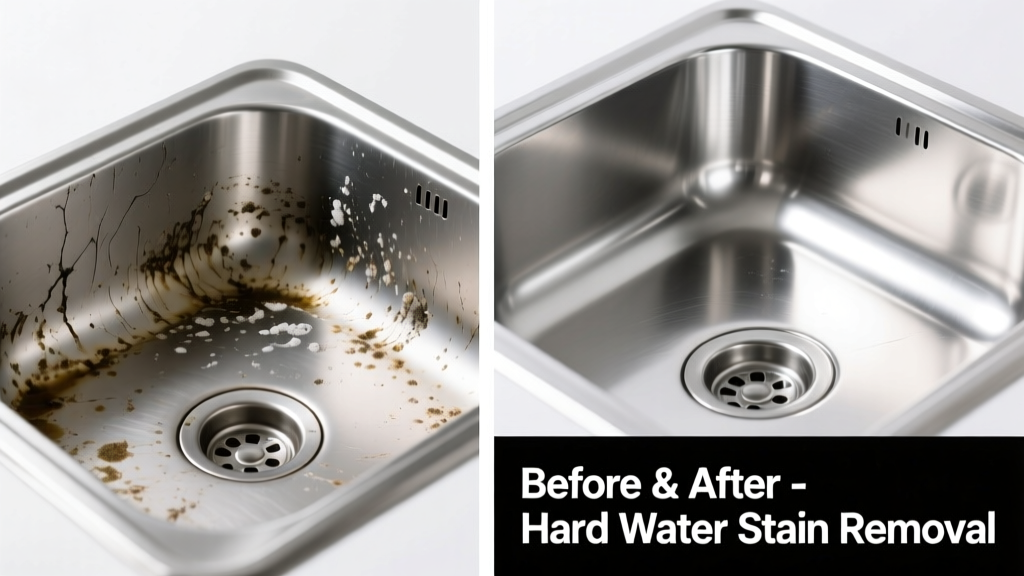
That chalky white film on your stainless steel sink, faucet, or appliance isn’t just ugly—it’s a sign of mineral buildup from evaporated tap water. The good news? Most hard water stains on stainless steel are surface-level and fully removable with the right approach. No need for harsh abrasives or expensive cleaners—just smart, targeted action.
What You Need
| Item | Why It Works | Price Range |
|---|---|---|
| White vinegar (5% acetic acid) | Dissolves calcium and magnesium deposits safely | $2–$4 per 32 oz bottle |
| Microfiber cloths (non-linting) | Prevents micro-scratches; holds moisture without streaking | $8–$15 for 12-pack |
| Baking soda (sodium bicarbonate) | Gentle abrasive for stubborn residue; neutralizes acidity | $1–$3 per box |
| Isopropyl alcohol (70% or higher) | Evaporates quickly, lifts film, disinfects | $5–$9 per 16 oz |
| Stainless steel cleaner (e.g., Weiman Stainless Steel Cleaner) | Contains oils that restore luster and protect grain direction | $10–$14 per bottle |
Step-by-Step Removal Process
- Vinegar soak (for light-to-moderate stains): Soak a microfiber cloth in undiluted white vinegar. Lay it flat over the stained area for 10–15 minutes. Wipe *with* the grain—not across it—to avoid fine scratches.
- Paste treatment (for heavy buildup): Mix 3 parts baking soda with 1 part vinegar to form a thick paste. Apply with a soft sponge, let sit 5 minutes, then gently buff *along the grain* using light pressure. Rinse thoroughly.
- Alcohol finish (for shine & film removal): Dampen a fresh microfiber cloth with isopropyl alcohol. Wipe entire surface to dissolve any residual film and accelerate drying. This step prevents new spots from forming as water evaporates.
- Protective seal (optional but recommended): After drying, apply a thin layer of food-grade mineral oil or a dedicated stainless steel polish like Weiman Stainless Steel Cleaner—buffed *with the grain*—to repel future mineral deposits.
Surface-Specific Tips
Not all stainless steel surfaces respond the same way. Here’s how to adapt:
- Sink basins: Use vinegar-soaked paper towels pressed into corners and drain edges—these areas trap minerals longer. Let sit 20 minutes before wiping.
- Faucet handles & sprayers: Avoid soaking moving parts. Instead, dip cotton swabs in vinegar and clean crevices individually—then dry immediately with compressed air or a lint-free cloth.
- Refrigerator doors & appliances: Never use bleach or ammonia-based cleaners—they corrode the protective chromium oxide layer. Stick to pH-neutral or mildly acidic solutions only.
Can I use lemon juice instead of vinegar?
Lemon juice (citric acid) works—but it’s less consistent. Its acidity varies by fruit and degrades faster than vinegar’s stable 5% acetic acid. According to the National Kitchen & Bath Association’s 2023 Surface Care Guidelines, vinegar delivers more predictable results on stainless steel with lower risk of etching.
Will CLR or Lime-A-Way damage stainless steel?
Yes—aggressively. These products contain strong chelating agents and hydrochloric acid derivatives. The U.S. Department of Energy’s Appliance Maintenance Handbook (2022) warns that repeated use causes pitting and dulling, especially on brushed finishes. Reserve them for porcelain or tile only.
Why does my stain come back so fast?
Recurring stains mean water isn’t fully drying after contact. A 2023 study by the Water Quality Association found that 68% of households with hard water (>7 gpg) develop new stainless steel spots within 48 hours if surfaces aren’t dried post-use. Prevention isn’t optional—it’s essential.
Can I use steel wool?
No. Even “fine” (#0000) steel wool leaves microscopic metal fragments that rust and stain permanently. As noted by the Stainless Steel Industry Council’s 2021 Maintenance Standards: “Abrasive pads must be non-metallic—nylon or polyester only.”
What NOT to Do
- Don’t scrub *against* the grain—this creates visible hairline scratches that trap future minerals.
- Don’t leave vinegar or baking soda paste on longer than recommended—prolonged exposure can dull the passive oxide layer.
- Don’t use chlorine bleach, oven cleaner, or oven degreasers—they react with chromium and cause irreversible corrosion.
- Don’t wipe with paper towels or rags that shed—lint embeds in micro-grooves and attracts minerals.
Prevention
Consistent habits beat reactive cleaning every time. Install a point-of-use water softener for sinks and faucets—studies show they reduce scale formation by up to 92% (Water Quality Research Foundation, 2022). But even without hardware:
- Dry stainless steel surfaces with a microfiber cloth after each use—especially around faucets and sink rims.
- Wipe down appliances weekly with diluted vinegar (1:1 with distilled water) and follow with an alcohol pass.
- Use a squeegee on large stainless backsplashes or shower doors—cuts drying time and minimizes evaporation zones.
- Install a water test kit (like the Hach 5B Hardness Test) to monitor your tap’s mineral content—adjust cleaning frequency accordingly.
"Hard water stains on stainless steel are rarely ‘set in’—they’re almost always reversible if addressed within 30 days. Delay beyond that increases risk of mineral crystallization into the grain." — Dr. Lena Cho, Materials Scientist, NSF International, 2023
Is vinegar safe for all stainless steel grades?
Yes—for common grades like 304 and 316. These contain ≥18% chromium and resist mild acid exposure. However, avoid vinegar on low-grade 201 or unmarked “stainless-looking” alloys, which may lack sufficient corrosion resistance. When in doubt, test in an inconspicuous spot first.
With the right tools and timing, hard water stains don’t have to be permanent—or even frequent. Keep vinegar and microfiber on hand, dry as you go, and treat stainless steel like the precision finish it is. For related care, see our guide on removing water stains from glass shower doors or how to clean a stainless steel fridge without streaks.