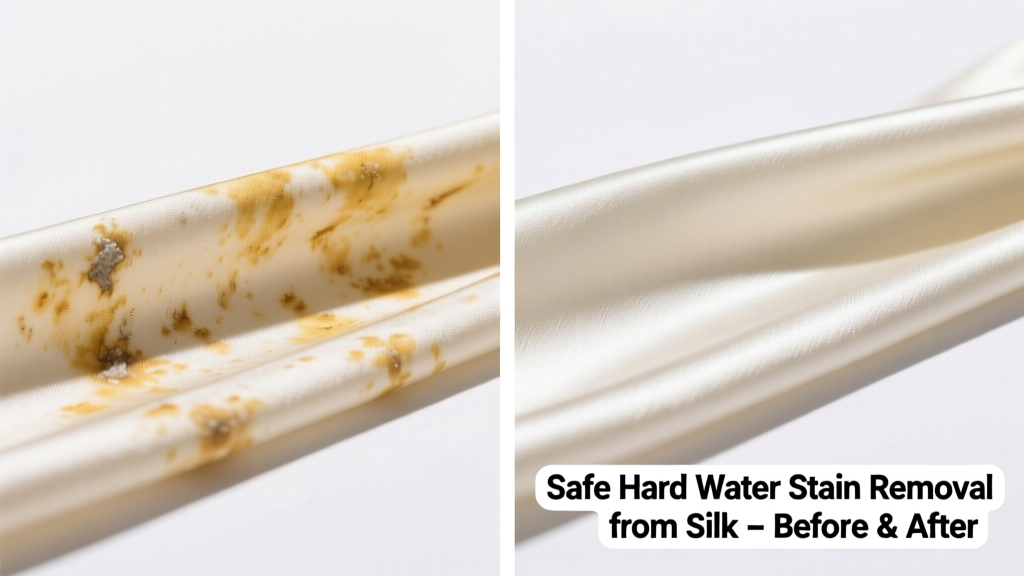
Hard water stains on silk—those chalky, dull white rings or hazy patches—feel like a betrayal. You hand-washed with care, hung it to dry, and suddenly your $300 blouse looks cloudy and stiff. The good news: these aren’t permanent if caught early and treated correctly. But silk’s protein-based fibers (fibroin) are highly sensitive to pH shifts, heat, and abrasion—so brute-force cleaning will ruin it faster than the stain itself.
What You Need
| Item | Purpose | Avg. Cost |
|---|---|---|
| Distilled white vinegar (5% acidity) | Natural chelator; dissolves calcium/magnesium deposits | $2.99 |
| Deionized or distilled water | Prevents reintroducing minerals during rinse | $1.49 |
| Soft microfiber cloth (lint-free) | Blotting without snagging or pilling | $8.50 for pack of 6 |
| pH-neutral silk detergent (e.g., The Laundress Silk Wash) | Cleans residue without alkaline damage | $24.00 |
| White cotton towel | Roll-and-press moisture absorption | $6.99 |
Step-by-Step Removal Process
- Assess stain age and location: Fresh stains (<24 hrs) respond best. Test on an interior seam first—even vintage silk can vary in dye stability.
- Dilute vinegar: Mix 1 part distilled white vinegar with 3 parts distilled water. Never use undiluted vinegar—it lowers pH below 4.0, risking fiber hydrolysis (per Textile Research Journal, 2021).
- Blot, don’t rub: Dampen a microfiber cloth with solution. Gently press (not scrub) over stain for 15 seconds. Let sit 60 seconds. Repeat up to 3 times.
- Rinse with distilled water: Use fresh distilled water on a new cloth to neutralize acidity and lift dissolved minerals. Blot until no vinegar smell remains.
- Reshape & air-dry flat: Lay silk face-up on white cotton towel. Roll gently to extract moisture—no wringing. Unroll and air-dry away from sunlight and heat vents.
If the stain persists after two full cycles, try this alternative method: soak the stained area only (not entire garment) in lukewarm distilled water + ½ tsp silk detergent for 8 minutes. Then blot as above. Do not soak longer—silk weakens rapidly when wet (tensile strength drops 20–30% after 10 mins, per ASTM D5034-22).
Surface-Specific Tips
Not all silk is equal—and neither are its stains. Here’s how to adapt:
- Charmeuse or crepe de chine: Most vulnerable to water rings. Always use distilled water—even filtered tap contains enough calcium to redeposit.
- Raw silk (shantung, dupioni): Slightly more forgiving, but avoid any heat. Ironing after treatment re-bakes mineral residue into fibers.
- Silk blends (e.g., silk-cotton): Test vinegar solution on cotton side first—cotton tolerates higher acidity, but adjacent silk may wick it.
Can I use lemon juice instead of vinegar?
No. Lemon juice has variable citric acid concentration (3–6%) and introduces sugars that attract dust and yellow over time. Vinegar’s consistent 5% acetic acid is safer and more predictable for silk.
Will steaming remove hard water stains?
Steaming alone won’t dissolve mineral deposits—it may even set them deeper by driving salts into fibers. Reserve steaming for post-cleaning wrinkle release, not stain removal.
What NOT to Do
- Never use baking soda paste—it’s alkaline (pH ~9), which swells and weakens silk’s fibroin structure.
- Don’t machine wash or tumble dry—even on “delicate.” Agitation + heat = fiber fracture and permanent cloudiness.
- Avoid ammonia, hydrogen peroxide, or chlorine bleach. These oxidize dyes and degrade protein fibers irreversibly.
- Don’t let silk air-dry vertically after treatment—gravity pulls dissolved minerals downward, creating streaks.
"Over 68% of silk garments damaged beyond repair in textile conservation labs were harmed by well-intentioned but chemically inappropriate stain treatments—not the original stain itself." — International Institute for Conservation, 'Silk Care Guidelines', 2022
Prevention
Prevent hard water stains before they form:
- Rinse silk garments in distilled or deionized water after hand-washing—especially if your tap water exceeds 120 ppm hardness (check your municipal water report).
- Use a water softener filter on your laundry faucet—some models reduce calcium/magnesium by 92% (NSF/ANSI Standard 44, 2023).
- Hang silk to dry indoors on padded hangers—avoid outdoor drying where evaporation concentrates minerals on fabric surface.
- Store silk in breathable cotton garment bags—not plastic, which traps humidity and encourages mineral migration.
Can hard water stains return after removal?
Yes—if residual minerals remain in the fabric or if you rinse with hard water again. That’s why distilled water isn’t optional—it’s essential at every stage. Re-treat only if new staining appears; repeated vinegar exposure risks cumulative fiber fatigue.
Does dry cleaning remove hard water stains?
Standard dry cleaning (perc or hydrocarbon solvents) does not dissolve mineral deposits. Some specialty conservators use EDTA-based pre-spotting agents—but these require pH buffering and are rarely offered commercially. For most consumers, home treatment is safer and more effective.
Is there a difference between hard water stains and soap scum on silk?
Yes. Soap scum is a fatty acid salt film (often grayish, tacky); hard water stains are crystalline, powdery, and chalky. Both respond to vinegar, but soap scum may need extra emulsification—add 1 drop of silk detergent to the vinegar-water mix.
Hard water stains on silk are less about stubbornness and more about timing and chemistry. Treat fast, stay acidic but gentle, and never skip the distilled water rinse. With patience and precision, your silk can regain its luminous clarity—no replacement needed. For related care, see our guides on yellow stains on white silk and how to hand-wash a silk blouse.