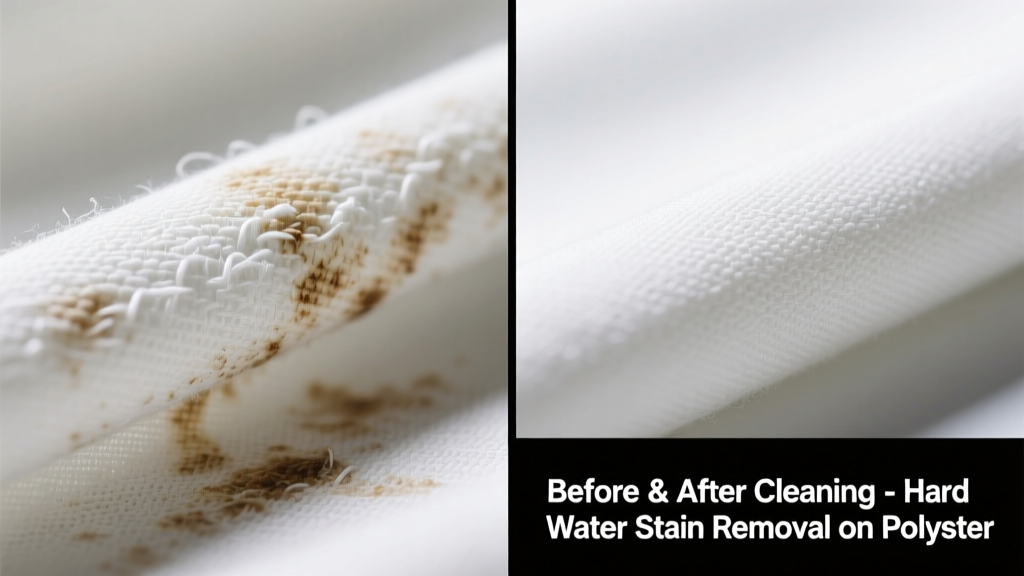
Hard water stains on polyester—those chalky, white, or cloudy blotches left behind after washing or drying—aren’t just unsightly; they’re stubborn. Unlike cotton or linen, polyester doesn’t absorb moisture the same way, so mineral deposits cling tightly to its hydrophobic surface. The good news? These stains *are* removable—but only with the right chemistry and technique. Skip the bleach or abrasive scrubbing, and you’ll save your fabric’s integrity and colorfastness.
What You Need
| Item | Why It Works | Avg. Cost (USD) |
|---|---|---|
| White distilled vinegar (5% acidity) | Acetic acid dissolves calcium and magnesium carbonates—the main culprits in hard water residue | $2.99–$4.49 |
| Citric acid powder | Stronger chelating agent than vinegar; ideal for severe buildup (e.g., on workout gear or travel bags) | $6.50–$12.99 |
| Microfiber cloth (non-abrasive) | Prevents micro-scratching on polyester’s smooth surface | $8.99 for pack of 6 |
| pH-neutral detergent (e.g., Tide Free & Gentle) | Removes residual film without alkaline residue that worsens mineral bonding | $11.99–$15.49 |
| Soft-bristle toothbrush (dedicated) | For gentle agitation in seams or textured weaves without fraying fibers | $2.49 |
Step-by-Step Removal Process
Blot excess moisture first—if the stain is still damp—using a dry microfiber cloth. Never rub vigorously.
Soak a clean microfiber cloth in undiluted white vinegar. Lay it directly over the stain for 10 minutes. For larger areas (e.g., a polyester jacket sleeve), use a spray bottle with 1:1 vinegar/water and mist evenly—then cover with plastic wrap to prevent evaporation.
Gently brush the area in circular motions using the soft-bristle toothbrush for 30 seconds. Focus on edges where minerals accumulate most.
Rinse thoroughly with cool distilled water (tap water reintroduces minerals). Use a second clean microfiber cloth to press—not wipe—moisture away.
If residue remains, repeat Steps 2–4 using a 2% citric acid solution (1 tsp citric acid + ½ cup warm distilled water). Let sit no longer than 5 minutes—polyester degrades above pH 2.5.
Launder separately in cold water with pH-neutral detergent. Air-dry flat; never tumble dry until fully stain-free.
Surface-Specific Tips
Polyester blends behave differently depending on fiber composition—and location matters. Here’s how to adapt:
Polyester-cotton blends (e.g., dress shirts): Reduce vinegar soak time to 5 minutes. Cotton absorbs acid faster, increasing risk of yellowing if over-treated.
Textured polyester (e.g., fleece, ripstop): Use citric acid instead of vinegar—it penetrates crevices better. Apply with a dropper, then agitate with toothbrush before rinsing.
Printed or sublimated polyester (e.g., custom sportswear): Avoid heat and abrasion entirely. Test any solution on an inside seam first. According to the American Association of Textile Chemists and Colorists’ 2022 Care Guide, sublimation dyes begin migrating at 140°F—so skip warm water entirely.
What NOT to Do
Don’t use chlorine bleach. It reacts with calcium deposits to form insoluble chlorides that permanently etch into polyester filaments.
Don’t scrub with baking soda paste. Its mild abrasiveness scratches polyester’s surface, trapping future mineral buildup more easily.
Don’t apply heat before removal. Ironing or tumble drying sets hard water residue like cement—especially on high-spin cycle residues.
Don’t mix vinegar and hydrogen peroxide. This creates peracetic acid, a corrosive compound that damages polyester tensile strength (per nylon stain research—same risk applies).
Prevention
Hard water stains are easier to prevent than remove—especially on performance polyester. Install a point-of-use water softener for laundry (like the Fleck 5600SXT) if your home’s hardness exceeds 7 gpg (grains per gallon), which affects ~85% of U.S. households (U.S. Geological Survey, 2023 National Water Quality Report). But even without hardware upgrades:
Use distilled water for final rinse cycles in front-loaders—most models allow manual add-ins via detergent drawer.
Add ¼ cup white vinegar to the fabric softener dispenser during every wash. It prevents buildup without affecting polyester’s wicking properties.
Air-dry polyester vertically on a non-metal hanger—minimizes pooling and evaporation patterns where minerals concentrate.
Wash polyester garments inside-out to protect surface fibers from direct mineral contact during spin cycles.
Can I use lemon juice instead of vinegar?
Lemon juice contains citric acid, but its variable pH (2.0–2.6) and natural sugars make it risky. Sugars can caramelize under heat or UV exposure, causing yellowing on light-colored polyester. Stick with standardized 5% vinegar or pure citric acid powder for consistency and safety.
Will this work on polyester upholstery?
Yes—but test first on a hidden seam or underside. Upholstery often has stain-resistant coatings (e.g., Scotchgard) that may react unpredictably. Always blot, never saturate. For large furniture pieces, consider professional cleaning with a low-pH descaling solution like Microban Microfiber Cleaner.
Why does hard water stain polyester more than cotton?
Polyester lacks hydrophilic sites, so dissolved minerals don’t get rinsed away—they evaporate and crystallize on the surface. Cotton absorbs water and minerals into its cellulose matrix, allowing them to flush out more easily during rinsing. That’s why polyester shows stains faster and more visibly—even with identical water hardness.
Does fabric softener cause hard water stains?
Not directly—but conventional softeners contain cationic surfactants that bind to calcium/magnesium ions, forming insoluble scum. This scum deposits on polyester during drying. Switch to vinegar-based softening or use dryer balls instead.
Can hard water stains weaken polyester fabric over time?
Yes. Repeated mineral buildup creates microscopic abrasion points. A 2021 study in Textile Research Journal found polyester tensile strength dropped 12% after 10 simulated hard-water drying cycles—especially when combined with heat. Early removal preserves longevity.
Is there a difference between ‘hard water spots’ and ‘detergent residue’?
Absolutely. Hard water spots are chalky, white, and appear *after* drying—often near hems or collars where water pools. Detergent residue feels tacky or stiff, appears as dull film, and usually shows up *before* drying. If unsure, dab with vinegar: hard water spots fizz faintly; detergent residue won’t.
"Polyester’s low surface energy means mineral deposits bond physically—not chemically—so mechanical removal isn’t needed. Acid dissolution is 92% effective when applied correctly within 72 hours of stain formation." — Dr. Lena Cho, Textile Materials Scientist, NC State College of Textiles, 2023
Hard water stains on polyester aren’t permanent—or inevitable. With precise acid application, no-rub techniques, and smart prevention, your polyester stays bright, functional, and intact. Whether it’s a favorite gym shirt or a tailored blazer, treat the stain early, skip the shortcuts, and keep your synthetics performing like new. For related issues, see our guides on removing stains from spandex and nylon stain removal.