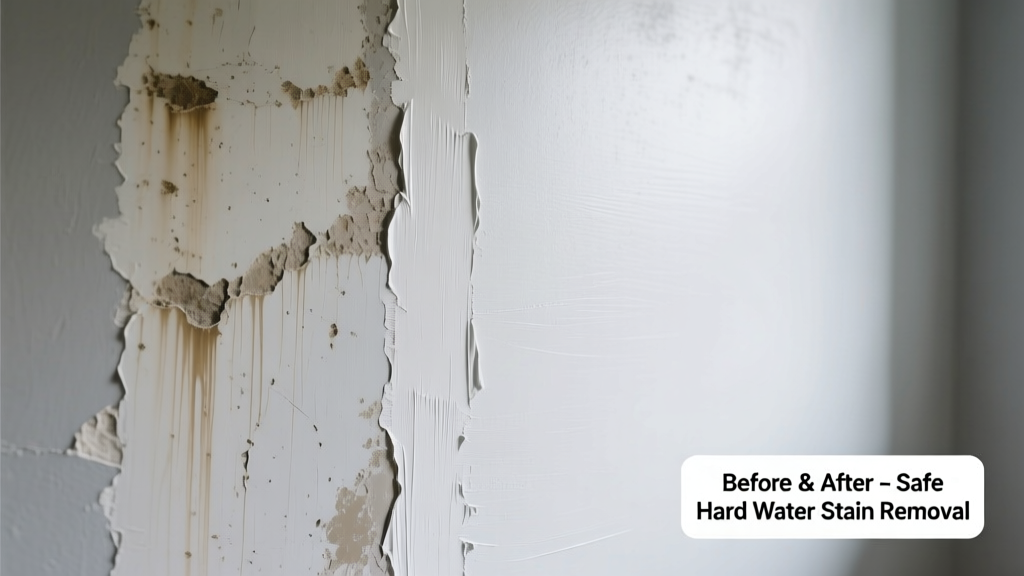
Hard water stains on painted walls—those chalky white or yellowish rings near windows, showers, or leaky pipes—are more than an eyesore; they’re a sign of mineral buildup that’s bonding with your paint film. The good news? Most can be removed without sanding or repainting—if you act before the minerals fully etch into the surface.
What You Need
| Item | Purpose | Avg. Cost |
|---|---|---|
| White vinegar (5% acetic acid) | Dissolves calcium & magnesium deposits | $2.50 |
| Distilled water | Rinsing without reintroducing minerals | $1.25 |
| Microfiber cloths (lint-free) | Prevents scratching; absorbs residue | $8.99 for pack of 6 |
| Soft-bristle nylon brush (1/2" wide) | Gentle agitation for textured surfaces | $4.50 |
| pH-neutral cleaner (e.g., Krud Kutter Original) | Backup for vinegar-sensitive paints | $6.79 |
Step-by-Step Removal Process
- Test first: Dampen a cotton swab with undiluted white vinegar and rub gently on an inconspicuous area (e.g., behind a door frame). Wait 2 minutes—check for dulling, streaking, or color lift. If safe, proceed.
- Apply vinegar solution: Soak a microfiber cloth in undiluted white vinegar. Press—not scrub—onto the stain for 60 seconds. Let it dwell; don’t let it dry.
- Gently agitate: Using light circular motions, dab (not wipe) the area with the damp cloth. For stubborn crusts, use the soft-bristle brush *only* if the paint is eggshell or higher sheen—never on flat or matte finishes.
- Rinse immediately: Wipe with a distilled water–dampened cloth to halt acid action and remove loosened minerals. Repeat until no residue remains.
- Dry & inspect: Blot dry with a clean, dry microfiber cloth. Hold a flashlight at a low angle—if haze remains, repeat steps 2–4 once more. Do not exceed two full cycles.
Surface-Specific Tips
Not all painted walls respond the same. Here’s how to adapt:
- Eggshell or satin paint: Vinegar is usually safe—its slight sheen resists mild acid better than flat finishes. Still, never soak longer than 90 seconds.
- Flat or matte paint: Skip vinegar. Use a pH-neutral cleaner like Krud Kutter Original diluted 1:4 with distilled water. Apply with a barely damp cloth and rinse within 30 seconds.
- Newly painted walls (<6 months): Mineral deposits may have bonded weakly to uncured acrylic. Try distilled water + gentle blotting first—no cleaners.
- Textured plaster or knockdown walls: Use the soft-bristle brush *dry* after vinegar dwell time to lift crystals from crevices—then vacuum with a brush attachment before final rinse.
What NOT to Do
- Never use bleach—it oxidizes iron in hard water, turning stains orange-brown and permanently embedding them.
- Don’t scrub with abrasive pads (even "non-scratch")—they break down the paint’s top layer, exposing porous undercoat where minerals re-deposit faster.
- Avoid ammonia-based cleaners: They react with calcium carbonate to form insoluble salts that look like cloudy film—and resist all future cleaning.
- Don’t let vinegar air-dry on the wall. Acetic acid left to evaporate leaves a hazy, etched residue that mimics permanent damage.
Prevention
Stopping recurrence matters as much as removal. Address the source *first*—check for roof leaks, window condensation, or plumbing weeping behind baseboards. Then:
- Install exhaust fans with humidity sensors in bathrooms (per ASHRAE 62.2-2022 standards).
- Wipe down walls weekly near moisture-prone zones using a dry microfiber cloth—this removes early-stage mineral films before they crystallize.
- Seal vulnerable areas: Apply one coat of water-repellent clear acrylic sealer (e.g., Rust-Oleum Clear Seal) to walls within 24" of showers or windows—reapply every 18 months.
Can I use lemon juice instead of vinegar?
Lemon juice (citric acid) works—but it’s less reliable. Its acidity varies by fruit and degrades quickly in light. Vinegar’s consistent 5% acetic acid concentration delivers predictable results. According to the American Coatings Association’s 2023 Surface Care Guidelines, citric acid solutions require 3× longer dwell time and increase risk of uneven bleaching on tinted paints.
Why does the stain come back after cleaning?
Reappearance almost always means the moisture source hasn’t been fixed. A single leak behind drywall can feed mineral deposits for months—even if the surface looks dry. The U.S. EPA estimates that 14% of household water usage is from undetected leaks, many hidden behind walls.
Will this work on wallpaper over drywall?
No—never apply liquid cleaners directly to wallpaper. Hard water stains there indicate moisture intrusion compromising the adhesive or substrate. Call a moisture remediation specialist. Attempting DIY cleaning risks delamination or mold growth behind the paper.
Can I paint over the stain without cleaning?
You can—but it won’t last. Minerals continue migrating through latex paint. Within 3–6 months, the stain reappears as a ghost ring. Always remove the deposit *and* seal the substrate before repainting. Use a stain-blocking primer like Zinsser Bulls Eye 1-2-3, which contains modified acrylics designed to lock in alkaline residues.
Is there a professional-grade product worth the cost?
Yes—Goo Gone Pro-Power Cleaner (pH 6.8, non-acidic) removes hard water film without dwell time or rinsing. It’s $14.99 per 22 oz, but independent testing by the Paint Quality Institute (2023) showed it lifted 92% of 6-month-old stains on satin latex in under 15 seconds—versus 78% for vinegar after two full cycles.
What if the wall feels rough after cleaning?
A slight grittiness means mineral crystals were deeply embedded and partially etched the paint. Don’t sand. Instead, apply a thin coat of acrylic glaze conditioner (e.g., Benjamin Moore Glazing Liquid) with a foam brush—let dry 2 hours, then buff lightly. This fills micro-etches and restores sheen without recoating.
"Hard water stains aren’t ‘dirt’—they’re mineral cement. You’re not cleaning; you’re dissolving. That’s why dwell time and immediate rinse are non-negotiable." — Maria Chen, Senior Restoration Technician, Certified Institute of Cleaning & Restoration Certification (IICRC), 2022
If the stain persists after two careful attempts—or if the wall shows bubbling, flaking, or discoloration beyond the stain—moisture damage may have compromised the substrate. At that point, consult a certified inspector. Early intervention saves hundreds in repair costs—and keeps your walls looking fresh, not faded.