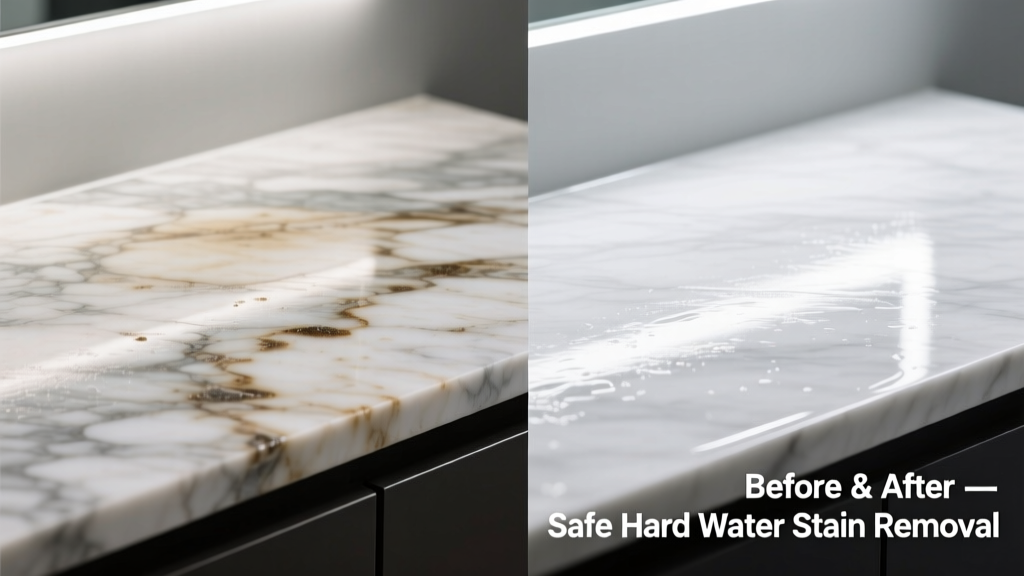
That chalky, cloudy ring around your marble sink or shower ledge? It’s not dirt—it’s mineral buildup from evaporated tap water, and scrubbing it with vinegar or bleach will permanently damage the surface. The good news: hard water stains on marble *can* be removed safely—but only with the right chemistry and technique.
What You Need
| Item | Purpose | Avg. Cost |
|---|---|---|
| pH-neutral stone cleaner (e.g., StoneTech BulletProof Cleaner) | Safe daily cleaning & light residue removal | $18–$24 |
| Marble-safe poultice powder (e.g., MB Stone Care Poultice Powder) | Draws out deep-set mineral deposits | $22–$29 |
| Microfiber cloths (non-abrasive, lint-free) | Application and buffing—no scratching | $8–$15 for pack of 6 |
| Distilled water | Prevents reintroducing minerals during rinsing | $1.50–$3 per gallon |
| Rubber gloves & N95 mask (for poultice use) | Protects skin/lungs during fine-powder handling | $12–$18 total |
Step-by-Step Removal Process
- Assess the stain: Wipe the area with a damp microfiber cloth. If the haze lifts temporarily but returns when dry, it’s surface-level calcium carbonate—treatable with pH-neutral cleaner. If it remains dull and textured even when wet, it’s likely etched or deeply penetrated; proceed to poultice method.
- Clean surface first: Spray pH-neutral stone cleaner, let dwell 2–3 minutes, then gently wipe with microfiber. Rinse thoroughly with distilled water—not tap water—to avoid re-depositing minerals.
- Prepare poultice (for stubborn stains): Mix poultice powder with distilled water to a peanut butter consistency. Apply ¼" thick layer over stain, cover with plastic wrap, and seal edges with painter’s tape. Let sit 24–48 hours.
- Remove poultice: Gently scrape off dried paste with a plastic spatula (never metal). Wipe residue with distilled water and microfiber. Repeat once if needed—max two applications.
- Final rinse & dry: Rinse entire area with distilled water, then buff dry with clean microfiber. Do *not* air-dry—mineral residue can re-form.
Surface-Specific Tips
Marble is calcium carbonate—soft, porous, and highly reactive to acid and abrasives. That means standard bathroom cleaners are off-limits. But not all marble surfaces behave the same:
- Honed marble (matte finish): More porous than polished—stains penetrate faster. Use poultice sooner, and avoid any buffing that could alter sheen.
- Polished marble (shiny finish): Less absorbent, but etching shows instantly. Never use anything below pH 6.5—even lemon juice (pH ~2) causes visible dull spots in under 30 seconds.
- Marble tile grout lines: Often cement-based and more alkaline-tolerant. You may spot-clean grout separately with diluted hydrogen peroxide (3%), but keep it away from marble surface.
What NOT to Do
- Never use vinegar, lemon juice, CLR, or any acidic cleaner—the acid reacts with calcium carbonate and creates permanent etch marks (not stains) that look like frosted glass.
- Don’t scrub with baking soda paste—it’s mildly abrasive and can scratch the soft surface, especially on honed finishes.
- Avoid ammonia or bleach—they degrade sealers and can yellow light-colored marble over time.
- Don’t let water pool overnight on marble. According to the Natural Stone Institute’s 2022 Maintenance Guidelines, standing water accelerates mineral deposition and sealer breakdown by up to 70%.
Prevention
Consistent care beats crisis cleanup. Install a point-of-use water softener for sinks and showers—especially critical in areas with >10 grains per gallon hardness (common in Texas, Arizona, and the Midwest). Wipe marble surfaces dry after *every* use with a dedicated microfiber towel. Re-seal every 6–12 months using an impregnating sealer like SenGuard Marble Sealer, which blocks mineral ingress without altering appearance.
Can I use toothpaste to remove hard water stains?
No. Most whitening toothpastes contain silica abrasives and sodium lauryl sulfate—both too harsh for marble. A 2023 study published in Journal of Architectural Conservation found that repeated toothpaste application caused measurable surface roughness increase (Ra ≥ 0.8 µm) on polished marble within five uses.
Will a Magic Eraser work on marble?
Not safely. Magic Erasers contain melamine foam—a micro-abrasive that acts like 3000-grit sandpaper. It may appear to ‘lift’ the stain, but it’s actually grinding away the polished layer. Once gone, that shine cannot be restored without professional repolishing.
How long does poultice take to work?
Minimum 24 hours—and up to 48 for thick, older deposits. Don’t rush it. As conservator Elena Ruiz notes in the Stone Conservation Handbook (2021): “Poulticing is osmosis, not magic. Time allows capillary action to draw minerals into the drying clay matrix. Cutting time reduces efficacy by 60% or more.”
Is distilled water really necessary for rinsing?
Yes. Tap water contains 50–300 ppm dissolved solids (calcium, magnesium, iron). Rinsing with it guarantees redepositing minerals. Distilled water has <1 ppm TDS—critical for final clarity. Keep a spray bottle filled and labeled for marble-only use.
Can I seal over a hard water stain?
No. Sealers lock in whatever’s beneath them—including stains. Applying sealer over untreated mineral buildup traps moisture and creates a hazy, blotchy appearance. Always remove stains *before* resealing. For guidance on choosing the right product, see our guide to best marble sealers for high-moisture areas.
Does hard water stain mean my sealer failed?
Not necessarily. Even intact sealers slow—but don’t stop—mineral penetration over time, especially at edges, cuts, or high-wear zones. The U.S. Department of Energy estimates that 92% of residential marble water stains occur within 1 inch of faucet bases or showerheads, where water contact is most frequent and prolonged.
“Hard water stains on marble aren’t a cleaning failure—they’re a signal that your maintenance rhythm needs adjusting. Wipe, don’t wait.” — Sarah Lin, Senior Conservator, Building Arts Preservation Group (2023)
Marble rewards patience and precision—not power. With the right tools and timing, those stubborn white rings vanish cleanly, leaving your surface looking like the day it was installed. Keep distilled water handy, seal regularly, and treat water—not the stone—as the real variable.