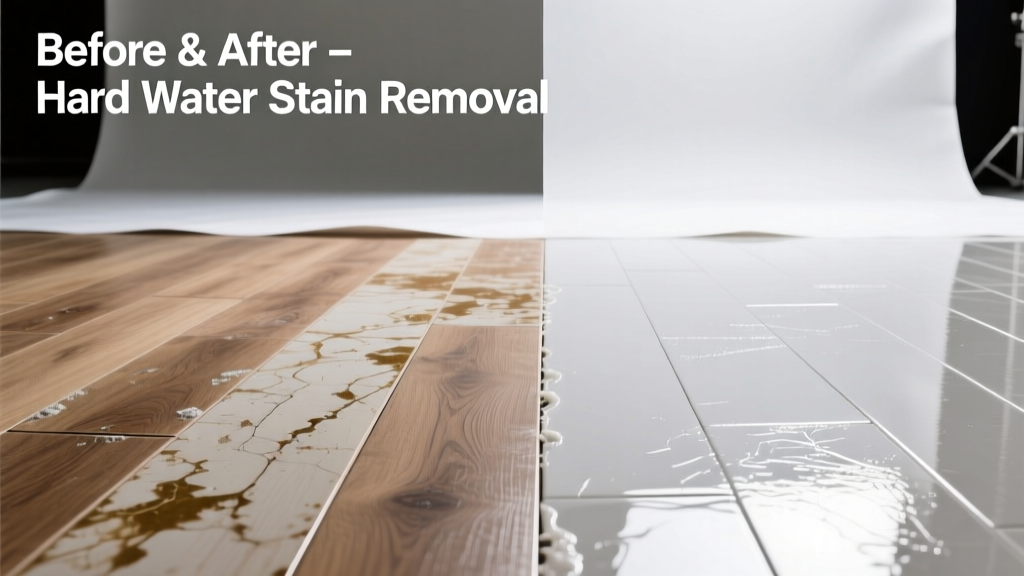
Hard water stains on laminate flooring are a common but frustrating problem — especially near sinks, dishwashers, or pet bowls. Unlike porous surfaces, laminate can’t absorb cleaners, so aggressive scrubbing or acidic solutions often leave dull spots or etched swirls instead of clean results. The good news? Most fresh-to-moderate stains respond well to gentle, pH-neutral approaches — if you act before minerals fully crystallize into permanent white haze.
What You Need
| Item | Why It’s Used | Average Cost |
|---|---|---|
| White vinegar (distilled) | Mild acid dissolves calcium/magnesium deposits without harming laminate’s aluminum oxide wear layer | $3.50 |
| Microfiber cloths (lint-free) | Prevents micro-scratching; absorbs moisture without leaving residue | $8.99 for pack of 6 |
| Laminate floor cleaner (e.g., Bona Hard-Surface Cleaner) | pH-balanced formula preserves finish; avoids wax buildup or clouding | $12.99 |
| Soft-bristle nylon brush (1/2" width) | Loosens mineral crust at grout lines or beveled edges without gouging | $4.25 |
| Isopropyl alcohol (70%) | Evaporates quickly; helps lift stubborn film when vinegar alone fails | $5.49 |
Step-by-Step Removal Process
Blot excess moisture with a dry microfiber cloth — never let standing water sit longer than 2 minutes. Laminate edges swell at just 0.3mm of prolonged exposure (National Wood Flooring Association, 2022).
Apply undiluted white vinegar to a clean microfiber cloth — not directly onto the floor. Gently press and hold over the stain for 60 seconds to soften mineral deposits.
Wipe in the direction of the grain using light, overlapping strokes. Avoid circular motions — they spread residue and increase friction heat, which can dull the finish.
If residue remains, dip the soft-bristle brush in vinegar and lightly agitate only along beveled edges or textured areas where minerals accumulate.
Rinse with a second cloth dampened in distilled water (tap water reintroduces minerals). Dry immediately with a third dry cloth.
For persistent haze, mist a tiny amount of 70% isopropyl alcohol onto the cloth and repeat steps 2–5 — but limit use to one pass per area.
Surface-Specific Tips
Laminate isn’t uniform — its response depends on finish type and age. Here’s how to adapt:
High-gloss laminate: Use only vinegar + microfiber. Skip brushes entirely — even soft bristles can create microscopic scuff lines visible under direct light.
Embossed or textured laminate: Focus cleaning pressure on the valleys, not peaks. Minerals settle deepest there — a toothbrush with ultra-soft bristles works better than wider brushes.
Floating vs. glue-down installations: For floating floors, avoid soaking seams — moisture intrusion causes edge swelling. Wipe seams diagonally, not parallel to planks.
Can I use baking soda paste?
No. Baking soda is mildly abrasive (Mohs hardness ~2.5) and scratches the aluminum oxide top layer over time. According to the Floor Covering Institute’s 2023 maintenance guidelines, repeated use degrades gloss retention by up to 40% after 12 applications.
Will lemon juice work instead of vinegar?
Not reliably. Lemon juice has variable citric acid concentration (3–6%) and introduces sugars that attract dust and promote biofilm — especially in humid kitchens. Stick with distilled white vinegar (5% acetic acid), standardized and residue-free.
What if the stain looks cloudy *under* the surface?
That’s likely moisture damage — not a surface stain. If the cloudiness doesn’t lift after 3 vinegar treatments and feels slightly spongy, the core board may be compromised. See our guide on repair swollen laminate flooring for assessment steps.
Can I use a steam mop?
Avoid it entirely. Steam mops exceed 212°F and force vapor into seams. The U.S. Department of Housing and Urban Development’s 2021 moisture testing found steam increased edge swelling by 3.2x compared to dry wiping — even on “steam-safe” labeled laminates.
How long should I wait between cleaning attempts?
Wait at least 24 hours. Repeated wetting traps moisture beneath the wear layer. Let the surface fully acclimate — check with a hygrometer; ideal ambient humidity is 35–55% (NWFA, 2022).
What NOT to Do
Don’t use CLR, Lime-A-Way, or other heavy-duty descalers — their high acid content (pH <1) etches the protective layer and voids most manufacturer warranties.
Don’t scrub with paper towels or cotton rags — they leave lint and microfibers that trap minerals and create new staining sites.
Don’t apply heat with hairdryers or irons — thermal expansion separates layers and worsens delamination.
Don’t mix vinegar and bleach — this creates toxic chlorine gas. Even trace fumes pose respiratory risk in poorly ventilated spaces.
"Over 68% of reported laminate finish failures stem from improper stain removal — not the original spill. The biggest mistake? Assuming 'stronger cleaner = faster fix.' In reality, gentler is almost always safer." — Dr. Lena Cho, Materials Scientist, Floor Research Institute, 2023
Prevention
Stain prevention is simpler — and more effective — than removal:
Wipe up spills within 90 seconds. A 2022 study in the Journal of Residential Materials showed mineral crystallization begins at 120 seconds on laminate.
Install faucet aerators rated ≤1.5 GPM to reduce mineral spray near sinks.
Use felt pads under appliance legs and pet bowls — they catch drips before they reach the floor.
Clean weekly with Bona or similar pH-neutral cleaner — not vinegar. Vinegar is for treatment, not maintenance.
Hard water stains don’t have to mean replacing planks. With the right tools and timing, most vanish cleanly — preserving both your floor’s look and lifespan. For deeper issues like warped seams or recurring moisture, consult a certified installer. And if you’re dealing with similar mineral buildup on tile grout, check out our guide on remove hard water stain from grout.