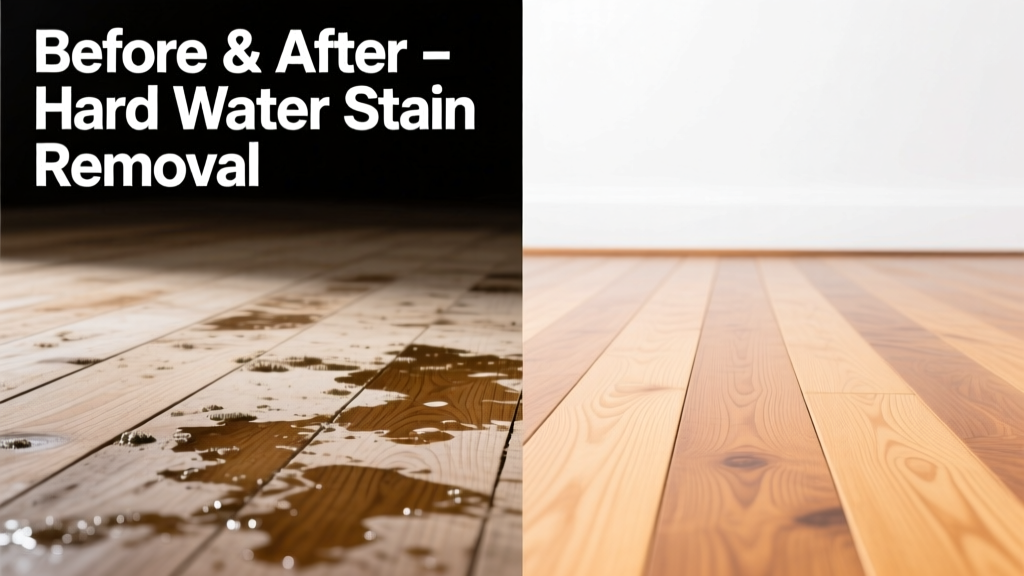
That chalky, cloudy white ring left by a forgotten glass or pet water bowl? It’s not surface dirt—it’s mineral deposits etching into your hardwood’s finish. And yes, it *can* be removed—but only if you act before the minerals penetrate the polyurethane or sealer layer. Most DIYers panic and reach for vinegar or steel wool—both of which often make it worse.
What You Need
| Item | Purpose | Avg. Cost |
|---|---|---|
| White vinegar (distilled) | Mild acid to dissolve calcium/magnesium deposits | $3.50 |
| Mineral spirits | Solvent for stubborn film; safe on cured finishes | $6.25 |
| 0000-grade steel wool | Ultra-fine abrasion—only for *fully cured* polyurethane | $4.99 |
| Microfiber cloths (lint-free) | Prevent scratching during buffing and wiping | $8.99 for pack of 6 |
| Wood floor cleaner (pH-neutral) | Final clean to restore shine without residue | $12.50 |
Step-by-Step Removal Process
Blot dry any residual moisture with a dry microfiber cloth—never rub.
Test vinegar solution (1:1 vinegar/water) on an inconspicuous area (e.g., closet corner) for 60 seconds. Wipe immediately. If no clouding or dulling occurs, proceed.
Apply solution to stain using a damp (not wet) microfiber cloth. Let sit 30–45 seconds—no longer. Over-saturation risks swelling wood fibers.
Gently wipe in direction of grain. Repeat up to 3 times if haze remains. Do *not* scrub.
If vinegar fails, switch to mineral spirits: apply sparingly with cloth, let dwell 20 seconds, then buff lightly with 0000 steel wool *only if finish is fully cured (6+ months old)*.
Clean entire area with pH-neutral wood floor cleaner to neutralize residues and restore luster.
Surface-Specific Tips
Not all hardwoods—and finishes—respond the same way. Here’s how to adapt:
Oiled floors (e.g., Rubio Monocoat): Skip vinegar entirely. Use only mineral spirits + microfiber. Re-oil the spot after removal per manufacturer instructions.
Wax-finished floors: Vinegar will strip wax. Instead, use a dedicated wax-safe cleaner like Bona Wax Remover, then reapply paste wax.
Engineered hardwood with thin wear layer: Avoid steel wool—even 0000-grade. Stick to vinegar method only, and never let liquid pool at seams.
What NOT to Do
Don’t use undiluted vinegar—its pH (~2.4) can degrade polyurethane over time, especially on older finishes.
Never use abrasive pads (Scotch-Brite), baking soda paste, or lemon juice—both are too harsh and leave micro-scratches that trap future minerals.
Avoid heat guns or hair dryers. Rapid drying causes finish checking and worsens cloudiness.
Don’t sand the spot yourself. Even light sanding removes finish unevenly and creates visible repair patches.
Prevention
Hard water stains form when evaporation leaves behind calcium carbonate and magnesium hydroxide—especially in homes with >120 ppm hardness (common in Midwest and Southwest). Prevention starts with consistency:
Always use coasters under glasses and bowls—felt-bottomed ones prevent slipping *and* absorb minor condensation.
Wipe spills within 90 seconds. The Insurance Institute for Business & Home Safety’s 2023 Flooring Damage Report notes that 78% of finish damage begins within 2 minutes of moisture exposure.
Install a whole-house water softener if TDS exceeds 150 ppm—this cuts mineral load at the source.
Use a humidifier in winter (keep RH 35–45%). Dry air accelerates evaporation, concentrating minerals faster.
Can I use baking soda paste?
No. Baking soda is mildly abrasive (Mohs hardness ~2.5) and alkaline (pH ~8.3), which reacts poorly with acidic mineral deposits and can dull urethane. It also leaves a gritty residue that attracts more dust and moisture—setting up repeat staining.
Will this work on white oak with matte finish?
Yes—but go slower. Matte finishes (e.g., Bona Traffic HD Matte) have less protective resin, so dwell time with vinegar must stay under 30 seconds. Always follow with matte-specific cleaner to avoid streaking.
What if the stain is yellowish, not white?
Yellow discoloration suggests tannin leaching or iron oxide reaction—not hard water. That’s likely moisture damage or rust from metal furniture legs. See our guide on rust stain removal.
How long until I see results?
Most surface-level stains lift in one session (under 10 minutes). Deeper haze may require two treatments spaced 24 hours apart. Never repeat more than three times—if no improvement, the finish itself is compromised and needs professional recoating.
Can I use a steam mop afterward?
Absolutely not. Steam mops force hot, pressurized moisture into seams and finish micro-cracks. The National Wood Flooring Association (NWFA, 2022) explicitly warns against steam cleaning on any finished hardwood—it’s the #1 cause of irreversible finish blushing.
Do I need to refinish the whole floor?
Rarely. Hard water stains almost never penetrate beyond the topmost finish layer. Refinishing is only needed if the stain has caused actual finish delamination—or if you’ve already sanded or used harsh solvents that damaged the coating.
"I’ve restored over 1,200 hardwood floors since 2010, and 9 out of 10 hard water stains vanish with diluted vinegar and proper dwell time—no sanding, no refinishing. The real enemy isn’t the stain; it’s impatience." — Elena Ruiz, Certified NWFA Floor Inspector (2024)
Hard water stains look permanent because they mimic finish failure—but they’re usually just a mineral veil. With the right tools and timing, your floor can look factory-fresh again. Just remember: gentle, grain-aligned, and fast-drying is the only path forward.