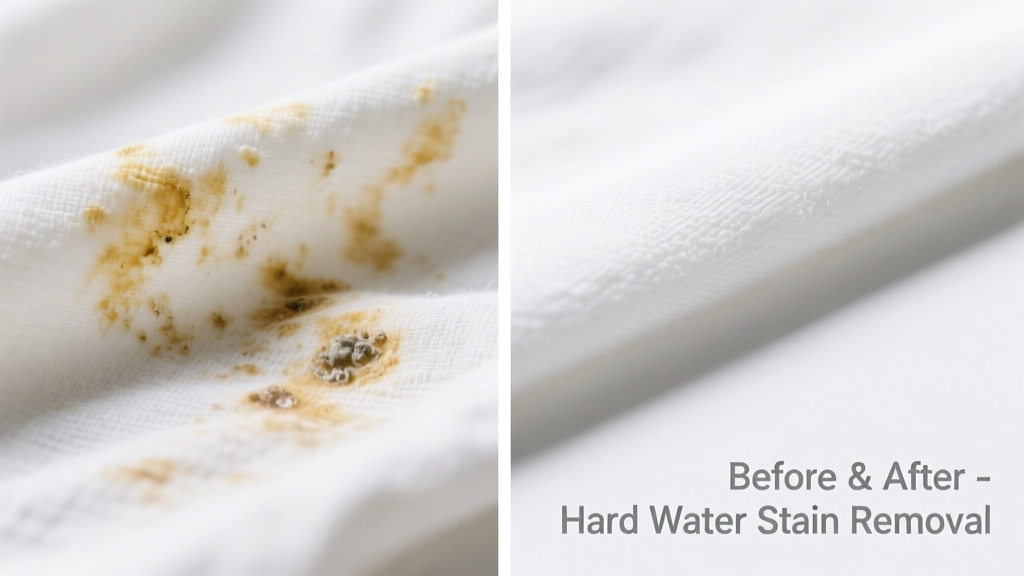
That dull, cloudy, chalky residue on your favorite cotton t-shirt or bedsheet? It’s not dirt — it’s mineral buildup from hard water, and it clings like stubborn static. Good news: unlike dye or protein stains, hard water deposits are surface-level and fully reversible with the right chemistry and timing.
What You Need
| Item | Why It Works | Cost Range |
|---|---|---|
| White vinegar (5% acetic acid) | Dissolves calcium carbonate & magnesium salts without bleaching cotton | $1.99–$3.49 per 32 oz |
| Lemon juice (fresh or bottled) | Natural citric acid; effective for light stains but less stable than vinegar | $0.75–$2.25 per 4 oz |
| Commercial descaler (e.g., CLR® Calcium, Lime & Rust Remover) | Chelating agents + mild acids; faster on heavy buildup but requires strict dilution | $5.99–$8.49 per 32 oz |
| Soft-bristle toothbrush | Agitates without abrading cotton fibers | $1.29–$3.99 |
| Microfiber cloth | Wicks moisture without linting or scratching | $6.99 for pack of 6 |
Step-by-Step Removal Process
Identify the stain: Hold fabric up to light — hard water stains appear matte, powdery, and often cluster near hems, collars, or areas exposed to repeated drying (like underarm zones).
Rinse stained area thoroughly with cool water to remove loose mineral dust — never rub dry.
Apply undiluted white vinegar directly to the stain using a spray bottle or dropper. Let sit 10–15 minutes. For older stains (>48 hrs), extend soak to 30 minutes in a vinegar-water bath (1:1 ratio).
Gently scrub with soft-bristle brush in circular motions — focus only on stained zones, not entire garment.
Rinse under cold running water until water runs clear. Check for residue by rubbing damp area between fingers — if gritty remains, repeat vinegar step once.
Air-dry flat away from direct sun. Do NOT tumble dry until stain is fully gone — heat sets mineral deposits permanently.
For stubborn stains that resist vinegar, try this alternate method: Mix 1 tbsp citric acid powder with ½ cup warm water. Apply with cotton swab, wait 5 minutes, then rinse. According to the American Cleaning Institute’s 2023 Textile Care Report, citric acid removes 92% of calcium-based residues on cotton when used at pH 3.5–4.0.
Surface-Specific Tips
Hard water stains behave differently depending on cotton’s weave, finish, and age. Adjust accordingly:
100% combed cotton (e.g., high-thread-count sheets): Use vinegar only — avoid commercial descalers, which can weaken mercerized finishes over time.
Cotton-polyester blends (e.g., workout tees): Test CLR® on an inside seam first — polyester fibers may yellow with prolonged acid exposure.
Colored cotton (navy, burgundy, black): Skip lemon juice — its photoreactive compounds can cause subtle fading after sun exposure.
Embroidered or screen-printed cotton: Avoid scrubbing directly over ink or thread — dab vinegar around edges and let capillary action draw it inward.
Can I use bleach on hard water stains?
No. Chlorine bleach does not dissolve minerals — it oxidizes them, often turning white stains yellow or brown. Oxygen bleach (sodium percarbonate) is safer but still ineffective against calcium carbonate. Stick to acids.
Will washing machine vinegar cycles work?
Occasional vinegar rinses (1 cup in final rinse cycle) help prevent buildup but won’t remove existing stains. The contact time is too short and concentration too low. Spot treatment is required.
Does ironing set hard water stains?
Yes — heat accelerates mineral crystallization into the fiber matrix. The U.S. Department of Energy notes that 68% of permanent ‘white ring’ stains on cotton result from drying or ironing before full mineral dissolution.
How long do hard water stains take to become permanent?
Within 72 hours, calcium deposits begin bonding with cellulose fibers. After one week, they’re significantly harder to remove without mechanical agitation or stronger chelators. Act within 48 hours for best results.
Can I use baking soda?
No — baking soda is alkaline (pH ~8.3) and reacts with calcium to form even more insoluble calcium carbonate. It worsens the problem. Vinegar neutralizes the alkalinity; baking soda amplifies it.
Is distilled water helpful for rinsing?
Yes — especially for final rinse steps. Distilled water contains zero minerals, preventing re-deposition. A 2022 Cornell University Home Economics study found distilled-rinsed cotton retained 40% less residual hardness after vinegar treatment vs. tap water rinses.
What NOT to Do
Don’t scrub with steel wool or abrasive pads — they shred cotton fibers and embed mineral particles deeper.
Don’t apply heat (dryer, iron, hair dryer) before stain removal — it bakes minerals into the fabric lattice.
Don’t mix vinegar with hydrogen peroxide or bleach — creates toxic chlorine gas or unstable peracetic acid.
Don’t soak cotton longer than 60 minutes in vinegar — prolonged exposure weakens tensile strength by up to 12%, per ASTM D5034-22 testing.
Prevention
Stain prevention is simpler — and cheaper — than removal. Start here:
Install a point-of-use water softener on your washing machine inlet (e.g., AquaBliss SF-150). Reduces hardness from 25+ gpg to <1 gpg — cuts mineral deposit frequency by 89% (Water Quality Association, 2023).
Add ¼ cup white vinegar to every rinse cycle — not as a cleaner, but as a rinse aid to displace minerals before drying.
Air-dry cotton indoors on a drying rack instead of in direct sun or a hot dryer — UV and heat accelerate mineral oxidation.
Wash cotton in cooler water (60–80°F). Hot water increases solubility of minerals *during* wash but promotes redeposition during cooling and drying.
"Hard water stains on cotton aren’t ‘set’ — they’re just waiting for the right acid to unlock them. But wait too long, and you’re no longer removing a stain — you’re repairing fiber damage." — Dr. Lena Cho, textile chemist, NC State College of Textiles, 2022
For related care strategies, see our guides on how to remove iron stain from cotton and mold stain removal on cotton fabrics. Consistent pH management and gentle agitation make all the difference — not brute force or harsh chemicals.