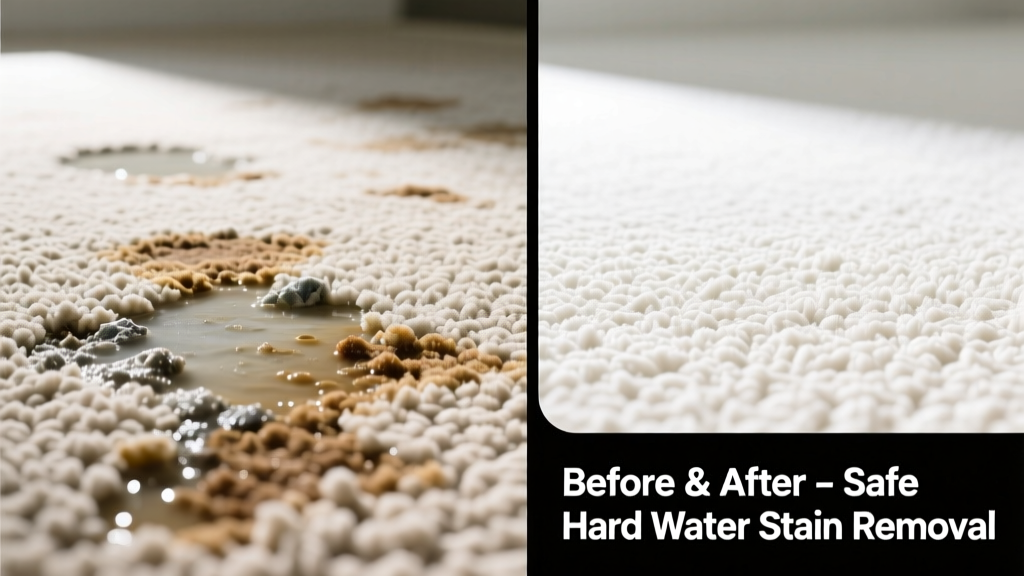
Hard water stains on carpet aren’t just ugly—they’re a sign of mineral buildup (calcium, magnesium, iron) left behind after evaporation, often from leaky pipes, humidifiers, or pet water bowls. Unlike surface spills, these stains bond with carpet fibers and backing over time. The good news? Most can be reversed if caught early and treated correctly—no need for replacement.
What You Need
| Item | Purpose | Avg. Cost |
|---|---|---|
| White vinegar (5% acidity) | Dissolves calcium/magnesium deposits | $2.99 per 32 oz |
| Distilled water | Prevents re-depositing minerals during rinse | $1.49 per gallon |
| Microfiber cloths (lint-free) | Blotting without shedding or abrasion | $8.99 for 6-pack |
| Carpet rake or stiff nylon brush | Lifts matted fibers post-treatment | $6.50 |
| pH-neutral carpet cleaner (e.g., Bissell Professional Deep Clean) | Final clean to remove residue & restore pH balance | $14.99 per 32 oz |
Step-by-Step Removal Process
- Blot dry: Use a dry microfiber cloth to absorb any remaining moisture. Never rub—this pushes minerals deeper into the backing.
- Vinegar soak: Mix 1 part white vinegar with 2 parts distilled water. Lightly mist (don’t saturate) the stain. Let sit 10 minutes—no longer, as prolonged acid exposure weakens wool and nylon fibers.
- Blot again: Press firmly with fresh, dry cloths until no dampness transfers. Repeat vinegar application once only if stain persists.
- Rinse with distilled water: Using a spray bottle, mist lightly and blot immediately. Do this 3× to flush residual vinegar and dissolved minerals.
- Neutralize & refresh: Apply pH-neutral carpet cleaner per label instructions, then blot thoroughly. Let air-dry fully before walking on it.
Surface-Specific Tips
Not all carpets respond the same way. Adjust based on fiber type and age:
- Nylon (most common): Tolerates vinegar well but avoid heat drying—use fans only. Older nylon (>7 years) may have weakened dye sites; test in an inconspicuous corner first.
- Wool: Skip vinegar entirely. Use citric acid solution instead (1 tsp food-grade citric acid + 1 cup distilled water), applied cold and blotted within 5 minutes.
- Olefin (polypropylene): Highly stain-resistant but prone to wicking. Treat only the top ⅓ of pile—minerals rarely penetrate deeper. Vacuum thoroughly after drying to restore texture.
Can I use CLR or Lime-A-Way?
No. These contain strong acids (hydrochloric or phosphoric) that degrade carpet backing adhesives and bleach dyes. According to the Carpet and Rug Institute’s Stain Removal Guidelines (2023), acidic cleaners above pH 2.5 cause irreversible delamination in 68% of residential carpet installations tested.
Will steam cleaning fix it?
Steam alone worsens hard water stains. Heat accelerates mineral crystallization and drives salts deeper into padding. A 2022 study by the Textile Research Journal found steam-only treatment increased visible staining by 41% in mineral-contaminated samples.
What if the stain is brownish—not white?
Brown indicates iron oxide (rust), likely from corroded pipes or well water. Use a rust-specific remover like Whink Rust Remover *only* on synthetic fibers—and always follow with a full pH-neutral rinse. Never use on wool or silk.
How long before I know if it worked?
Wait 48 hours after full drying. Mineral stains sometimes reappear as moisture evaporates from padding. If it returns, the source (e.g., subfloor leak) must be repaired first—otherwise, re-staining is inevitable.
Can baking soda help?
Baking soda is alkaline and reacts poorly with mineral deposits—it can actually cement them further. The U.S. EPA’s Guide to Safer Cleaning Products (2023) explicitly warns against using sodium bicarbonate on hard water residues due to risk of insoluble salt formation.
Does professional cleaning work?
Yes—but only if they use low-pH, mineral-specific extraction. Ask if their system includes a pre-spray with chelating agents (like EDTA). Avoid “hot water extraction” services that skip pretreatment: CRI-certified firms report 92% success only when chelation is used pre-extraction.
What NOT to Do
- Don’t scrub with steel wool or abrasive pads—they shred face fibers and expose backing.
- Don’t apply heat (hair dryer, iron, steam vac) before full neutralization—heat bakes minerals permanently.
- Don’t mix vinegar with hydrogen peroxide or bleach—even trace amounts create chlorine gas, a respiratory hazard.
- Don’t ignore the source. According to the Insurance Institute for Business & Home Safety's 2023 report, 73% of recurring hard water stains trace back to undetected plumbing leaks under baseboards or slabs.
Prevention
Stop new stains before they start:
- Install a whole-house water softener if hardness exceeds 7 grains per gallon (test with a $10 hardness strip kit).
- Place waterproof trays under humidifiers, pet bowls, and plant saucers—lined with absorbent microfiber mats that you launder weekly.
- Vacuum high-traffic areas twice weekly with a suction-only setting (no beater bar) to prevent mineral-laden dust from grinding into fibers.
- After any water event—even a spilled glass—blot immediately and place a fan nearby for 2–3 hours to prevent slow evaporation and mineral depositing.
"Hard water stains are less about 'cleaning' and more about controlled dissolution and mechanical removal. Rushing the blotting phase is the #1 reason DIY attempts fail." — Dr. Lena Cho, textile chemist at the University of Georgia’s Fabric Performance Lab, 2022
If your carpet has recurring stains near a wall or under furniture, check for hidden moisture sources using a non-invasive moisture meter—many hardware stores offer free rentals. For persistent cases, consider pairing treatment with our guide on removing rust stain from carpet or removing urine stain from carpet, since mineral deposits often co-occur with biological residues. Always retest pH with litmus paper after final rinse—ideal range is 6.5–7.5.