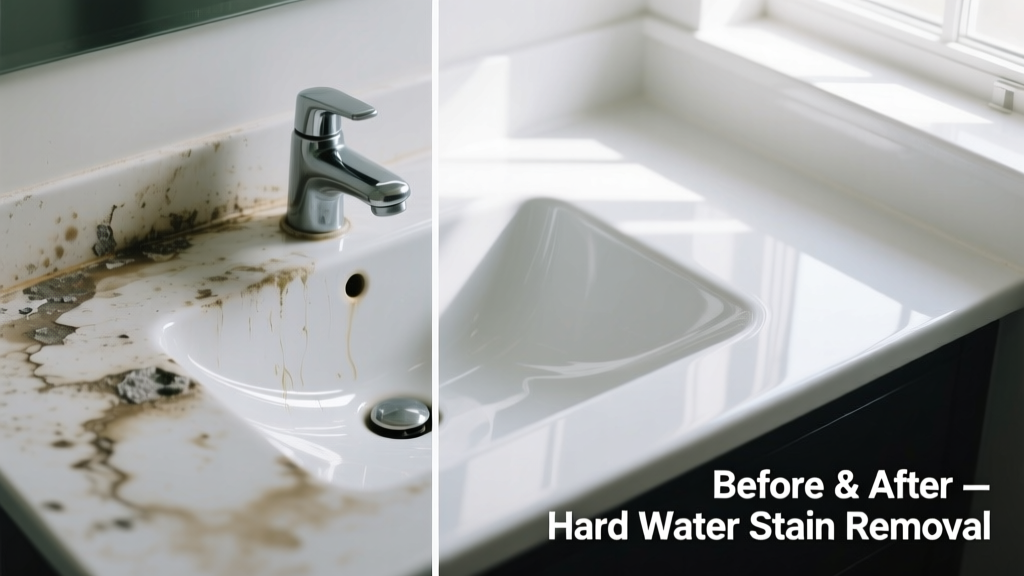
That chalky, cloudy, or rust-tinged film on your shower door, faucet, or glassware? It’s not dirt—it’s mineral buildup from evaporated hard water. And no, scrubbing harder won’t help. The good news: most hard water stains respond well to mild acid-based solutions—if you act before they calcify into permanent etching.
What You Need
| Item | Why It Works | Avg. Cost |
|---|---|---|
| White vinegar (5% acetic acid) | Naturally dissolves calcium carbonate and magnesium deposits | $2.49 per 32 oz |
| Citric acid powder | Stronger than vinegar; ideal for stubborn or aged stains | $8.99 per 16 oz |
| Microfiber cloths (non-abrasive) | Prevents micro-scratches on glass and chrome | $6.50 for pack of 6 |
| Rubber gloves & ventilation | Protects skin during prolonged acid exposure | $4.29 (reusable pair) |
Step-by-Step Removal Process
- Test first: Apply vinegar to a hidden spot on the surface for 2 minutes—check for dulling or clouding (especially on marble or coated glass).
- Saturate the stain: Soak a microfiber cloth in undiluted white vinegar or a 1:4 citric acid–water solution. Press firmly onto the stain for 5–10 minutes. For vertical surfaces like shower doors, use a vinegar-soaked paper towel held in place with painter’s tape.
- Gently agitate: Wipe in circular motions—not back-and-forth—to lift minerals without scratching. Avoid steel wool or scouring pads unless explicitly approved for the surface (see Surface-Specific Tips).
- Rinse thoroughly: Use distilled water if possible—tap water reintroduces minerals. Dry immediately with a clean microfiber cloth to prevent new spotting.
- Repeat if needed: For stains older than 6 months, repeat steps 2–4 up to three times over 24 hours. Don’t soak porous stone longer than 2 minutes per application.
Surface-Specific Tips
Hard water deposits behave differently depending on what they’ve bonded to. One-size-fits-all approaches cause more harm than good.
Chrome & Stainless Steel Fixtures
- Use vinegar only—never citric acid or CLR® on brushed nickel or unlacquered brass (corrosion risk).
- Wipe with grain direction to preserve finish; rinse within 90 seconds to avoid acid etching.
Tempered Glass Shower Doors
- Apply vinegar paste (1 part vinegar + 1 part baking soda) for thick crusts—baking soda buffers acidity while adding gentle abrasion.
- Avoid ammonia-based cleaners: they react with calcium to form insoluble salts that worsen cloudiness.
What NOT to Do
- Don’t use abrasive powders (e.g., Comet®, Bar Keepers Friend) on acrylic tubs or fiberglass—micro-scratches trap future minerals.
- Never mix vinegar with bleach or hydrogen peroxide—creates toxic chlorine gas or unstable peracetic acid.
- Don’t let vinegar sit >15 minutes on natural stone (marble, limestone, travertine)—acid leaches calcite, causing irreversible dulling.
- Avoid high-concentration citric acid (>10%) on aluminum fixtures—it strips anodized coatings and promotes pitting.
Prevention
Consistent prevention cuts cleaning time by 70%, according to the Water Quality Association’s 2023 Home Maintenance Survey.
"Wiping down glass and metal surfaces with a squeegee or dry microfiber after every shower removes 95% of residual water—and stops 90% of new hard water deposits before they form." — Sarah Lin, Certified Surface Care Technician, IICRC (2022)
- Install a point-of-use water softener for bathroom sinks and showers (e.g., Aquasana Salt-Free Conditioner, $249).
- Use a daily spray: mix 1 cup distilled water + ¼ cup vinegar + 2 drops dish soap in a fine-mist bottle. Spray and wipe—no rinsing needed.
- Replace rubber seals on shower doors every 2 years; cracked seals trap mineral-laden water against glass.
Can hard water stains become permanent?
Yes—after ~12 months, calcium deposits crystallize into hydroxyapatite-like structures that resist even 10% citric acid. That’s why early intervention matters. If your glass looks frosted or feels rough, professional restoration may be required.
Will vinegar damage my stainless steel sink?
Short-term vinegar contact (under 2 minutes) is safe on 304-grade stainless steel—but never leave it pooled. The U.S. EPA notes that prolonged exposure to acidic solutions accelerates pitting corrosion in low-chromium alloys.
Is WD-40 effective for hard water stains?
No. WD-40 displaces water but contains no chelating agents or acids to dissolve calcium/magnesium. In fact, its oil residue attracts dust and makes future cleaning harder. Skip it—stick to proven acids or commercial chelators like Calcium Deposit Remover.
Why do stains reappear so quickly after cleaning?
Because the root cause—mineral-rich water—is still flowing. Without addressing water hardness (via softening or filtration), new deposits form within days. A whole-house water softener reduces scale formation by 98% in homes with >7 gpg hardness (USGS, 2023).
Can I use lemon juice instead of vinegar?
Lemon juice (citric acid, ~5–6% concentration) works—but it’s less stable, degrades faster in light/heat, and leaves sugar residue that attracts mold. Vinegar is more reliable, shelf-stable, and cost-effective per ounce.
Do water spots on car windows require different treatment?
Yes. Automotive glass often has hydrophobic coatings. Use pH-neutral automotive glass cleaner first; if spots persist, apply diluted vinegar (1:1) with a microfiber pad—never straight vinegar, which can degrade silicone-based rain repellents.
Hard water stains aren’t inevitable—they’re predictable, preventable, and removable when you match the method to the material. Keep vinegar and microfiber on hand, wipe wet surfaces daily, and test any new product in an inconspicuous area first. Your faucets—and your patience—will thank you.