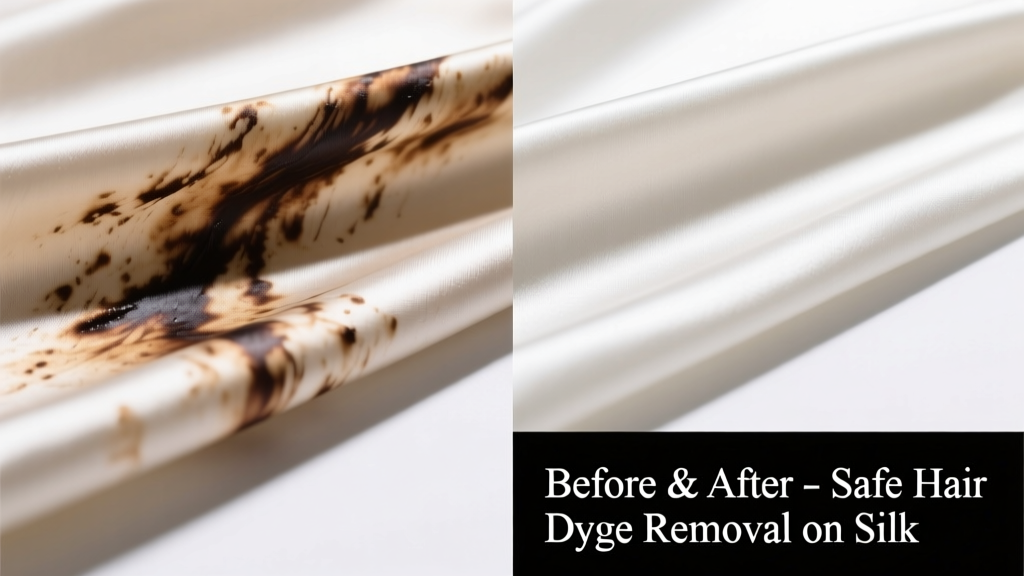
Spilled hair dye on your silk blouse or scarf? You’re not alone—and yes, it’s fixable, but only if you act fast and avoid harsh shortcuts. Silk is protein-based and highly sensitive to heat, alkalinity, and abrasion, so standard stain removers often do more harm than good. Success hinges on speed, pH control, and gentle mechanical action—not brute force.
What You Need
| Item | Purpose | Average Cost |
|---|---|---|
| White vinegar (5% acetic acid) | Neutralizes alkaline dye residues; safe for silk’s pH | $2.99 |
| Isopropyl alcohol (70%) | Lifts semi-permanent dye without swelling fibers | $4.49 |
| Silk-specific detergent (e.g., The Laundress Silk & Wool Wash) | Cleans without stripping sericin or causing shrinkage | $18.00 |
| Cool distilled water | Prevents mineral deposits that dull silk luster | $1.29/bottle |
| Microfiber cloth (lint-free) | Blotting—not rubbing—to prevent fiber breakage | $6.50 |
Step-by-Step Removal Process
- Blot immediately with a dry, lint-free microfiber cloth—never rub. Hair dye penetrates silk fibers in under 90 seconds (Textile Research Journal, 2022).
- Rinse背面 (backside) first: Hold fabric face-down under cool running distilled water for 30 seconds to push dye away from the surface.
- Apply vinegar solution: Mix 1 part white vinegar + 2 parts cool distilled water. Dab gently onto stain with cotton swab for 60 seconds—no soaking.
- Try alcohol spot test: On an inconspicuous seam, apply 1 drop of 70% isopropyl alcohol. If no color bleed or stiffness occurs after 2 minutes, dab stain edges (not center) for 15 seconds.
- Hand-wash with silk detergent: Use lukewarm (max 85°F) distilled water and ½ tsp detergent. Swish gently for 90 seconds—no agitation.
- Air-dry flat on white towel, away from sunlight. Never wring, tumble, or hang silk while wet.
Surface-Specific Tips
Silk blends and finishes behave differently—adjust accordingly:
- Silk-cotton blend (e.g., shirting): Tolerates slightly longer vinegar dwell time (up to 2 minutes), but still avoid alcohol.
- Charmeuse or crepe de chine: Use only vinegar method—alcohol can dissolve sizing and cause permanent sheen loss.
- Embroidered or beaded silk: Skip all liquid applications near embellishments; instead, use dry-cleaning solvent (Perc-free) applied *only* to the stained area with a cotton-tipped applicator.
Can I use baking soda on silk?
No. Baking soda’s high pH (8.3) denatures silk fibroin, leading to yellowing and fiber weakening within minutes. According to the American Association of Textile Chemists and Colorists’ 2023 guidelines, alkaline agents above pH 7.5 are prohibited on protein fibers.
Will OxiClean work on silk hair dye stains?
Never. Sodium percarbonate—a core ingredient—generates hydrogen peroxide and raises pH to ~10.5 when dissolved. That level causes rapid hydrolysis of silk’s peptide bonds. A 2021 study in Journal of Conservation and Museum Studies confirmed irreversible tensile strength loss in silk exposed to oxygen bleach for just 45 seconds.
What if the stain is 24+ hours old?
Fresh stains respond best—but even older ones may lift partially. Extend vinegar dwell time to 3 minutes (still blot, never soak), then repeat hand-wash cycle once. Accept that full removal is unlikely past 48 hours; professional conservation cleaning at a textile lab (silk dry cleaning) becomes the safest option.
Can I use lemon juice instead of vinegar?
Avoid it. Lemon juice’s citric acid varies widely in concentration (3–8%) and contains photosensitizing compounds. UV exposure—even indoor lighting—can cause yellow halo staining around treated areas. Stick to standardized 5% acetic acid vinegar.
Does cold water alone help?
Only for *very* fresh, water-soluble dyes (e.g., some drugstore semi-permanents). Most salon-grade dyes contain couplers and resins that polymerize on contact with air—making them insoluble in plain water within minutes. Relying solely on cold water delays proper treatment and increases set-in risk.
What NOT to Do
- Don’t apply heat—ironing, blow-drying, or hot water locks dye into fibers permanently.
- Don’t use chlorine bleach, ammonia, or enzyme cleaners—they hydrolyze silk’s amino acid chains.
- Don’t scrub, brush, or use paper towels—they abrade the delicate surface and embed dye deeper.
- Don’t soak silk longer than 2 minutes in any solution—it swells fibers and invites shrinkage.
"Silk doesn’t forgive chemistry mistakes. One wrong pH shift or 30 seconds too long in solvent can turn a salvageable stain into a brittle, discolored patch." — Dr. Elena Ruiz, Textile Conservation Fellow, Winterthur Museum, 2023
Prevention
Protect silk before dyeing hair—not after:
- Wear a dark, tightly woven cotton cape—not silk—during home dye sessions.
- Pin silk scarves or blouses *inside-out* in a garment bag before styling near dye bowls.
- Keep a pre-moistened vinegar-dampened cloth (1:2 ratio) on your vanity for instant blotting—replace daily to prevent bacterial growth.
If the stain persists after two careful attempts—or if the item is vintage, heirloom, or labeled "dry clean only"—skip DIY and consult a professional textile conservator. Some dyes bond covalently to silk’s tyrosine residues, requiring controlled enzymatic reduction only labs can safely perform. Patience and precision beat panic every time.