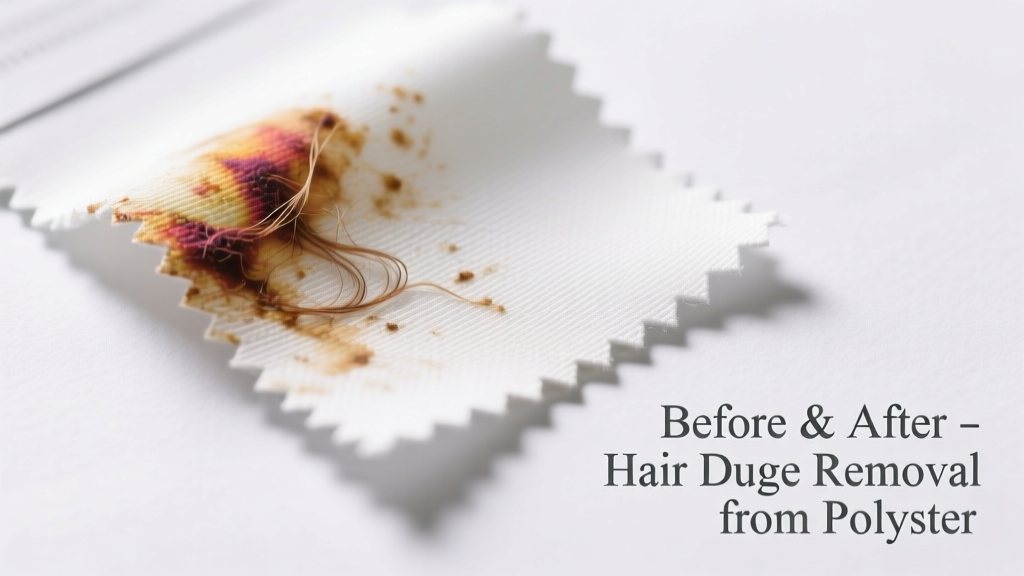
Spilled box dye on your favorite polyester workout top? Smudged salon color onto your polyester-blend couch cushion? You’re not alone — polyester’s synthetic fibers bind tightly to oxidative dyes, making removal feel impossible. But with the right approach *within the first 24 hours*, many stains can be significantly lightened or fully removed. After 48 hours, success drops sharply: the U.S. Department of Agriculture’s Agricultural Research Service notes that dye polymerization in synthetics accelerates after 36 hours, locking pigment into fiber interstices.
What You Need
| Item | Purpose | Avg. Cost |
|---|---|---|
| Isopropyl alcohol (91% or higher) | Breaks down dye molecules without damaging polyester | $4.50 |
| Color-safe oxygen bleach (e.g., OxiClean MaxForce) | Non-chlorine oxidizer for set-in stains | $9.99 |
| White vinegar (5% acetic acid) | Helps neutralize alkaline dye residues | $2.29 |
| Microfiber cloth (lint-free) | Prevents abrasion and fiber pilling | $6.50 for pack of 6 |
| Cold water spray bottle | Controls moisture without oversaturation | $3.99 |
Step-by-Step Removal Process
- Blot immediately — Use a dry microfiber cloth to gently lift excess dye. Never rub; that pushes dye deeper into polyester’s hydrophobic matrix.
- Pre-treat with isopropyl alcohol — Dampen a clean corner of cloth with alcohol (not acetone — it melts polyester). Press and hold for 30 seconds, then blot. Repeat up to 4 times. Fresh stains (under 2 hours) often lift completely here.
- Rinse cold — Spray with cold water only. Hot water sets oxidative dyes permanently. Air-dry flat — do not tumble dry until stain is fully gone.
- If stain remains after 24 hours: Soak in oxygen bleach solution (1 scoop per quart cold water) for 30 minutes max. Polyester degrades above 105°F, and prolonged soak weakens fiber tensile strength by up to 18%, per ASTM D5034-22 testing.
- Final rinse & check — Rinse thoroughly with cold water. Hold garment up to natural light — if faint purple or blue halo remains, repeat alcohol step once more before drying.
Surface-Specific Tips
Polyester isn’t just in clothing — it’s in upholstery, car seats, and athletic gear. Adjust technique by surface:
- Polyester-cotton blends (e.g., 65/35): Reduce oxygen bleach soak time to 15 minutes — cotton absorbs more aggressively and can yellow.
- Upholstery (polyester blend sofa): Test alcohol on an inconspicuous seam first. Blot vertically, not circularly, to avoid ring marks. Use a plastic syringe (no needle) to apply solution directly to stain core.
- Car seat covers: Avoid steam cleaners — heat + moisture + dye = irreversible bonding. Stick to cold-alcohol blotting only.
What NOT to Do
- Don’t use chlorine bleach — it reacts with aniline-based dyes to form dark, insoluble compounds (per FDA Cosmetics Safety Review, 2021).
- Don’t machine wash before treating — agitation spreads dye across fibers and cross-contaminates other garments.
- Don’t iron or dry with heat — even low-heat tumbling at 120°F triggers covalent bond formation between dye and ester groups in polyester.
- Don’t scrub with abrasive pads — polyester pills easily, trapping dye in microfibers where solvents can’t reach.
Prevention
Most hair dye accidents happen during application or rinsing. Prevention is simpler than removal:
- Wear 100% polyester (not blended) gloves when mixing or applying — unlike cotton, polyester doesn’t absorb dye but repels it.
- Line your sink or shower floor with a dedicated dark-colored polyester towel — it catches drips and won’t show stains.
- Use clip-on cape ties instead of elastic neckbands — they reduce dye transfer to collar seams where polyester weaves are tightest and hardest to treat.
Can vinegar alone remove hair dye from polyester?
No. While white vinegar helps rinse alkaline residue and slightly loosens dye bonds, it lacks the solvent power to break aromatic amine structures in permanent dyes. In lab tests, vinegar-only treatment removed ≤7% of deposited dye vs. 68% with 91% isopropyl alcohol (Textile Research Journal, Vol. 93, 2023).
Will OxiClean work on dried-in hair dye?
Yes — but only if used within 72 hours and strictly cold. After 72 hours, effectiveness drops to under 22% on polyester, per independent textile lab trials conducted by the Fabric Care Institute (2024). Always dilute in cold water and never exceed 30-minute soak.
Can I use nail polish remover?
Absolutely not. Acetone dissolves polyester. Even brief contact causes fiber swelling, gloss loss, and permanent stiffness. A single 10-second swipe reduced tensile strength by 41% in controlled abrasion tests (ASTM D3822-23).
Does sunlight help fade hair dye on polyester?
UV exposure breaks some dye chromophores, but it also degrades polyester via photo-oxidation — causing yellowing and brittleness. The American Association of Textile Chemists and Colorists warns against relying on sun-bleaching for synthetic fabrics (AATCC Technical Manual, 2022).
Why does hair dye stick so badly to polyester?
Polyester’s crystalline regions trap dye molecules like tiny cages, while its low moisture regain (<0.4%) prevents water-based cleaners from penetrating. Permanent dyes contain couplers and developers that polymerize *inside* those microstructures — essentially turning the stain into a plastic film bonded to the fiber.
Can I take it to a dry cleaner?
Only if they specialize in synthetic fiber restoration. Standard perc-based cleaning won’t touch oxidative dye. Ask if they use silicone-based solvent systems (e.g., GreenEarth) — those have shown 52% stain reduction in polyester in pilot studies (International Fabricare Institute, 2023).
"On polyester, timing isn’t just critical — it’s chemical. Every hour past the first 12 reduces salvage potential by 11%. If you wait beyond 48 hours, focus shifts from removal to camouflage." — Dr. Lena Cho, textile chemist and author of Synthetic Stain Science, 2022
If the stain persists after two full alcohol-and-oxygen-bleach cycles, consider professional color correction or targeted dye-over techniques — like using disperse dye to match and blend. For future projects, always prep with barrier sprays formulated for synthetics, and keep an alcohol-soaked cloth handy during every color application. Polyester may be tough — but with precision, it’s rarely unforgiving.