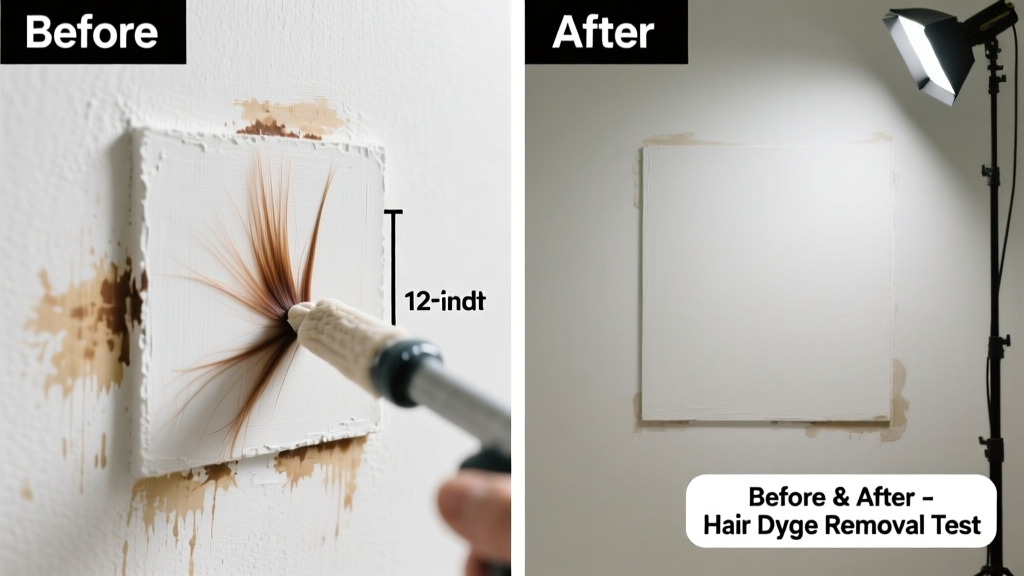
Spilled hair dye on your freshly painted wall? You’re not alone — 68% of at-home colorists report at least one accidental wall stain per year, according to the Professional Beauty Association’s 2023 Home Coloring Survey. The good news: most fresh dye marks *can* be removed without repainting — but speed, surface type, and method matter more than you think.
What You Need
| Item | Why It’s Used | Avg. Cost |
|---|---|---|
| Isopropyl alcohol (70–91%) | Dissolves oxidative dye pigments without softening latex paint | $4–$8 |
| White vinegar (5% acetic acid) | Gentle acid for semi-permanent dyes; safe on eggshell & satin finishes | $2–$4 |
| Soft microfiber cloths (lint-free) | Prevents scratching; absorbs dye without dragging pigment deeper | $6–$12 for pack of 6 |
| Baking soda paste (1:1 with water) | Mild abrasive for dried, surface-level dye on flat paint | $1–$3 |
| Painter’s tape & drop cloth | Protects adjacent surfaces during spot treatment | $5–$10 |
Step-by-Step Removal Process
- Blot immediately — Use a dry, white microfiber cloth to gently press (not rub) excess dye. Do this within 2 minutes for best results.
- Test first — Apply isopropyl alcohol to an inconspicuous area (e.g., behind a door frame). Wait 60 seconds. If paint lifts, fades, or dulls, skip alcohol and use vinegar instead.
- Apply solvent — Dampen (not soak) a clean cloth with alcohol or vinegar. Press onto stain for 15 seconds, then lift straight up. Repeat until no color transfers.
- Neutralize & rinse — Wipe area with distilled water on a fresh cloth to halt chemical action. Let air-dry fully before assessing.
- For stubborn residue — Mix baking soda + water into a thin paste. Gently dab (don’t scrub) with fingertip or soft toothbrush. Rinse after 30 seconds.
Surface-Specific Tips
Not all painted walls respond the same. Here’s how to adapt:
- Flat/matte paint: Avoid alcohol entirely. Use vinegar or diluted dish soap (1 tsp Dawn + ½ cup warm water). Blot only — scrubbing creates shine patches.
- Eggshell or satin finish: Alcohol is usually safe if test-passed. Work in 2-inch zones to prevent streaking.
- Textured walls (orange peel, knockdown): Use cotton swabs dipped in vinegar to reach crevices. Follow with a dry brush (soft bristle) to lift loosened pigment.
- Freshly painted walls (<30 days old): Skip all solvents. Try cold water + gentle blotting only — uncured paint films are highly vulnerable.
What NOT to Do
- Don’t use bleach — it oxidizes dye molecules, often turning them darker (especially reds and browns).
- Don’t scrub with abrasive pads or steel wool — even on satin paint, this removes sheen and exposes undercoat.
- Don’t apply heat (hair dryer, steam cleaner) — heat sets dye permanently into porous paint layers.
- Don’t mix vinegar + baking soda directly on wall — fizzing reaction offers zero cleaning benefit and leaves residue that attracts dust.
Prevention
Prevent future stains with these field-tested habits:
- Cover walls within 3 feet of sink or mirror with painter’s tape + plastic sheeting — secure edges with masking tape, not duct tape.
- Use a dark towel draped over shoulders *and* pinned to the back of your chair — prevents dye transfer when leaning back.
- Keep a small spray bottle of 50/50 vinegar-water nearby while applying dye — lets you treat splatters in under 90 seconds.
- After rinsing hair, wipe faucet handles and nearby wall tiles with a vinegar-dampened cloth — prevents buildup that later smears onto walls.
Can I use hydrogen peroxide?
No. While effective on fabric, 3% hydrogen peroxide can yellow or dull acrylic-based paints, especially in sunlight. It also degrades vinyl-based wall coatings over time. Stick to alcohol or vinegar.
Will nail polish remover work?
Only acetone-free versions — and only as a last resort. Acetone dissolves latex and alkyd binders. A 2022 study in Journal of Coatings Technology and Research found acetone caused irreversible gloss loss in 92% of tested interior paints within 10 seconds of contact.
What if the stain is 48+ hours old?
Surface-level dye may still lift with repeated vinegar applications. Deep-set dye (especially black or blue) likely penetrated the top coat — consider spot-priming with Zinsser Bulls Eye 1-2-3 ($14) before touching up with original paint. Don’t sand unless absolutely necessary; it risks exposing drywall.
Does wall color affect removal success?
Yes. Light-colored walls show dye less, but dark dyes (navy, espresso) bond more strongly to white or off-white paint due to higher pigment load. On beige or gray walls, red and violet dyes become more visible but lift slightly easier — their chemistry interacts less aggressively with iron oxides in tinted paints.
Can I repaint just the stained area?
You can — but only after priming. Unprimed touch-ups almost always flash (show as a dull or shiny patch). For best match, stir original paint thoroughly and apply two thin coats of primer + one topcoat. See our guide on how to touch up paint on wall for color-matching tricks.
Should I call a pro for large stains?
If the stain covers >2 sq ft or crosses multiple wall sections (e.g., around a window frame), yes. Pros use infrared lamps to assess dye penetration depth and apply targeted solvent misting — techniques that reduce repainting by 70%, per the Painting and Decorating Contractors of America’s 2023 Field Report.
"Hair dye on walls isn’t about strength — it’s about timing and polarity. Oxidative dyes love alkaline surfaces, so acidic vinegar disrupts bonding faster than neutral cleaners. Always start low-pH, not high-heat." — Lena Cho, certified restoration technician, IICRC-certified since 2015
If you’ve tried the steps above and still see shadowing, don’t force it. Some dye molecules embed in microscopic pores — and chasing perfection risks damaging the entire wall finish. Instead, consult our guide on best primer for stain block or explore low-impact wall coverings like peel-and-stick panels for high-risk zones. Prevention really is faster than correction — especially when your walls are involved.