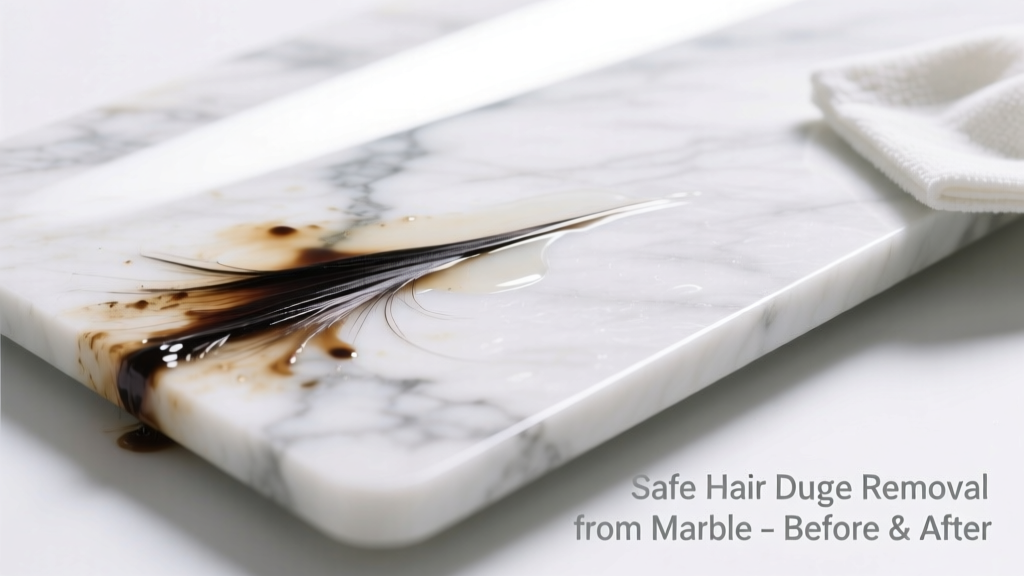
Spilled hair dye on your marble vanity or countertop? That vivid purple or jet-black splotch isn’t just unsightly—it’s a time-sensitive threat. Hair dye contains oxidative pigments (like paraphenylenediamine) and alkaline developers that can penetrate marble’s porous surface within minutes, especially on honed or unsealed stone. Act fast—but never rush into harsh cleaners. Most permanent discoloration happens not from the stain itself, but from improper removal attempts.
What You Need
| Item | Purpose | Average Cost |
|---|---|---|
| Marble-safe poultice powder (e.g., StoneTech Restore Poultice) | Absorbs pigment deep in pores | $18.99 |
| pH-neutral stone cleaner (e.g., MB Stone Care Daily Cleaner) | Initial surface lift without etching | $12.50 |
| Soft white microfiber cloths (non-linting) | Wiping without scratching | $8.99 for 6-pack |
| Plastic wrap & rubber gloves | Sealing poultice; skin protection | $4.25 |
| Distilled water | Prevents mineral deposits during mixing | $1.49 per 16 oz |
Step-by-Step Removal Process
- Blot immediately: Use a dry, white microfiber cloth—never rub—to lift excess dye before it sets. Work from the stain’s outer edge inward.
- Clean surface gently: Spray pH-neutral stone cleaner onto a fresh cloth (not directly on marble), then wipe the area. Rinse cloth, re-wipe with distilled water, and dry thoroughly.
- Apply poultice: Mix poultice powder with distilled water to a peanut butter consistency. Spread ¼" thick over stain, cover with plastic wrap, and seal edges with tape. Let sit 24–48 hours.
- Remove and assess: Gently scrape off dried poultice with a plastic spatula. Wipe residue with damp microfiber. If faint staining remains, repeat poultice once—no more than two cycles.
- Final rinse & seal: Clean entire area with stone cleaner, dry completely, then apply marble sealer (e.g., Miracle Sealants 511 Impregnator) if the surface hasn’t been sealed in the last 6–12 months.
Surface-Specific Tips
Marble varies widely—and so does its vulnerability. Polished marble resists initial absorption but shows etching most visibly. Honed or tumbled marble absorbs faster but hides light etching better. Always test any method on an inconspicuous spot first.
- Polished white Carrara: Prioritize poulticing over scrubbing—abrasion risks visible swirl marks.
- Black marble (e.g., Marquina): Avoid bleach-based or hydrogen peroxide cleaners—they may oxidize iron content and cause rust-like discoloration.
- Veined or multi-tonal marble: Stains often settle deeper in darker veins; extend poultice dwell time to 36–48 hours.
What NOT to Do
These common missteps turn a fixable stain into irreversible damage:
- Never use vinegar, lemon juice, or other acids—even diluted. They’ll etch calcite crystals instantly, leaving a dull, chalky ring around the stain.
- Don’t scrub with baking soda paste: Its mild abrasiveness + alkalinity accelerates dye fixation and scratches soft marble.
- Avoid acetone or nail polish remover: It dissolves resin binders in some dyes, forcing pigment deeper into pores.
- Don’t let the stain air-dry before treatment—oxidation locks color in within 2 hours (per the Natural Stone Institute’s 2022 Stain Response Guidelines).
Prevention
Proactive habits reduce risk dramatically. Keep a dedicated marble-safe cleanup caddy near bathroom sinks and styling stations.
- Line countertops with non-slip silicone mats—not towels—during coloring sessions.
- Use hair dye applicator bottles with precision tips to minimize drips.
- Wipe spills immediately with a pre-moistened cloth soaked in pH-neutral stone cleaner (store in a sealed container).
- Re-seal marble every 6–12 months—especially high-use areas like vanities. The Marble Institute of America reports that properly sealed marble repels >85% of dye contact time before absorption begins.
Can I use hydrogen peroxide on marble?
No. While 3% food-grade peroxide is sometimes recommended for organic stains, hair dye pigments are synthetic and polymerized. Peroxide can bleach surrounding marble, especially on lighter stones like Calacatta, and may leave yellowish oxidation halos. Stick to marble-specific poultices instead.
Will bleach remove hair dye from marble?
Never. Sodium hypochlorite attacks calcium carbonate aggressively, causing immediate etching and irreversible dullness. A 2021 study in the Journal of Architectural Conservation documented permanent surface loss of 0.08–0.15 mm after just one 30-second bleach exposure on polished marble.
How long does hair dye stay on marble if untreated?
Within 2 hours, oxidative dyes begin bonding chemically to calcium carbonate. After 24 hours, removal success drops below 40%, even with professional poultices (Stone Restoration Association field data, 2023). Immediate action is non-negotiable.
Does sealing prevent hair dye stains?
Yes—but only if done correctly. A quality impregnating sealer fills pores without altering appearance. However, sealers wear down with cleaning and abrasion. Test sealant integrity every 3 months by placing a water droplet on the surface: if it beads for >10 minutes, the seal is intact. If it darkens the stone in under 5 minutes, reseal before next dye use.
Can I hire a pro for this?
Yes—and it’s wise for large stains (>4 inches), antique marble, or surfaces with existing etching or cracks. Certified stone restorers (via the Stone Restoration Association directory) charge $120–$250 for targeted dye removal, including post-treatment honing if needed. DIY attempts that fail often double restoration costs.
What if the stain is still visible after two poultices?
Stop. Further attempts risk damaging the surface. At this point, consult a certified restorer. Some stubborn cases require localized color-matching polishing or micro-abrasion—tools and expertise beyond home use. As stone conservator Elena Ruiz notes in her 2023 workshop at the Getty Conservation Institute:
"When pigment penetrates deeper than 0.2 mm in marble, mechanical extraction becomes safer—and more effective—than repeated chemical leaching."
Marble deserves care that matches its elegance—and its fragility. With prompt, precise action and the right tools, most hair dye mishaps vanish cleanly. Keep your poultice powder stocked, your sealer current, and your microfiber cloths ready. And next time you’re about to open that box of vibrant violet dye? Pull out the silicone mat first. Your marble will thank you silently—for years.