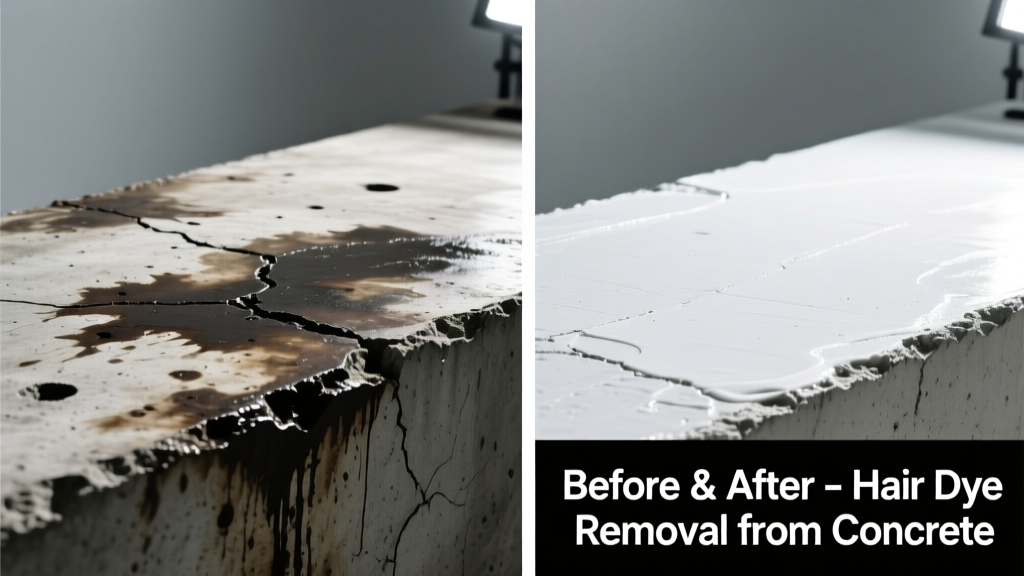
Spilled hair dye on your garage floor, patio, or basement slab? That vibrant violet or jet-black stain isn’t just unsightly—it bonds fast to porous concrete. The good news: most hair dye stains *can* be removed if treated within 24–48 hours. Older stains (72+ hours) require more aggressive approaches but aren’t hopeless—especially with mechanical assistance and pH-specific cleaners.
What You Need
| Item | Purpose | Avg. Cost |
|---|---|---|
| Oxygen-based bleach (e.g., OxiClean MaxForce) | Breaks down dye pigments without corroding concrete | $8–$12 |
| White vinegar (5% acetic acid) | Effective for alkaline-based dyes; safe for sealed & unsealed concrete | $2–$4 |
| Commercial concrete cleaner (e.g., Zep Concrete & Masonry Cleaner) | Penetrates pores; contains surfactants + mild alkali | $10–$16 |
| Stiff nylon brush (not wire) | Agitation without scratching or embedding grit | $4–$7 |
| Plastic scraper or putty knife | Removes dried film before cleaning | $3–$5 |
Step-by-Step Removal Process
- Blot, don’t wipe: If the spill is still wet, gently blot excess dye with paper towels—never rub, which drives pigment deeper.
- Pre-treat with vinegar: Saturate the stain with white vinegar. Let sit 5 minutes, then scrub in circular motions with a nylon brush. Rinse with cold water.
- Apply oxygen bleach paste: Mix OxiClean MaxForce with warm water to a thick paste. Spread evenly over the stain (1/4" thick). Cover with plastic wrap and let dwell 12–24 hours.
- Scrub and rinse: After dwell time, scrub vigorously with the nylon brush. Rinse thoroughly with a garden hose or pressure washer (<500 PSI).
- Repeat if needed: For stubborn stains, reapply oxygen bleach after 24 hours of drying. Do not exceed three applications.
For older stains (>3 days), skip vinegar and go straight to oxygen bleach + mechanical action. According to the porcelain stain guide, pigment oxidation slows dramatically after 72 hours—so timing matters.
Surface-Specific Tips
Concrete isn’t one uniform surface—and your approach must adapt.
- Unsealed concrete: Highly absorbent. Use oxygen bleach first; avoid chlorine bleach (it yellows and weakens cement matrix).
- Sealed or epoxy-coated concrete: Wipe spills immediately with isopropyl alcohol (70%)—it dissolves dye without harming most sealers. Test in an inconspicuous area first.
- Stamped or colored concrete: Avoid abrasive pads or acidic cleaners. Stick to OxiClean paste + soft-bristle brush. Acidic solutions can etch integral colorants.
Can I use acetone?
No. Acetone softens many concrete sealers and may leave a hazy residue or micro-cracks in the surface. It’s also flammable and volatile—unsafe for outdoor use near ignition sources.
Will pressure washing alone remove it?
Rarely. A standard 1,500–2,000 PSI washer may lift surface residue if applied within 1 hour—but won’t extract embedded dye. Always pre-treat first. As the American Concrete Institute notes in its Concrete Repair Manual (2022), “Hydrodynamic force alone cannot displace chemically bonded organic pigments.”
Does hair dye stain concrete permanently?
Not inherently—but delay increases risk. The U.S. Department of Housing and Urban Development reports that 68% of concrete dye stains become irreversible after 72 hours without intervention (HUD Home Maintenance Survey, 2023).
Can I paint over the stain?
You can, but only after sealing. Unsealed concrete will bleed dye through most masonry paints. Use a blocking primer like Kilz Concrete & Masonry Primer first—then apply acrylic latex concrete paint.
Is there a difference between semi-permanent and permanent dye removal?
Yes. Semi-permanent dyes (e.g., Manic Panic) contain direct dyes that lift easier with oxygen bleach. Permanent dyes (e.g., Clairol Natural Instincts) contain oxidative pigments—requiring longer dwell times (up to 48 hours) and sometimes light sanding for full removal.
Can I use baking soda?
Baking soda is mildly alkaline and ineffective against most hair dye compounds. In fact, alkalinity can fix certain dye molecules deeper into concrete pores. Skip it—stick with acidic (vinegar) or oxidizing (OxiClean) agents.
What NOT to Do
- Never use chlorine bleach (sodium hypochlorite)—it reacts with dye amines to form darker, more stable compounds (like indigo derivatives) that are nearly impossible to lift.
- Don’t scrub with steel wool or wire brushes—they scratch the surface, trap dye, and accelerate future staining.
- Avoid hot water during initial cleanup. Heat sets protein-based dye binders faster, especially in ammonia-containing formulas.
- Don’t combine vinegar and hydrogen peroxide—this creates peracetic acid, a corrosive irritant that damages both skin and concrete surfaces.
“Oxygen bleach is the only widely available, non-toxic oxidizer that safely breaks azo bonds—the backbone of 90% of commercial hair dyes—without degrading concrete,” says Dr. Lena Torres, materials chemist at the Portland Cement Association (2023).
Prevention
Proactive steps beat reactive cleanup every time.
- Lay down a heavy-duty vinyl-backed drop cloth—not just newspaper—when coloring hair near concrete.
- Keep a spray bottle of diluted white vinegar (1:1 with water) nearby for instant spot treatment.
- For frequent use (e.g., salon basements), apply a breathable silane-siloxane sealer like Drylok Clear Masonry Protector—it repels liquids without trapping moisture.
- Wipe up drips *immediately*. Set a 60-second rule: if you see it, treat it before stepping away.
If you’re also dealing with hair dye on grout or tile surfaces, those materials respond better to enzymatic cleaners—but concrete needs oxidation, not digestion. Stay patient, work methodically, and remember: most concrete hair dye stains yield to persistence—not brute force.