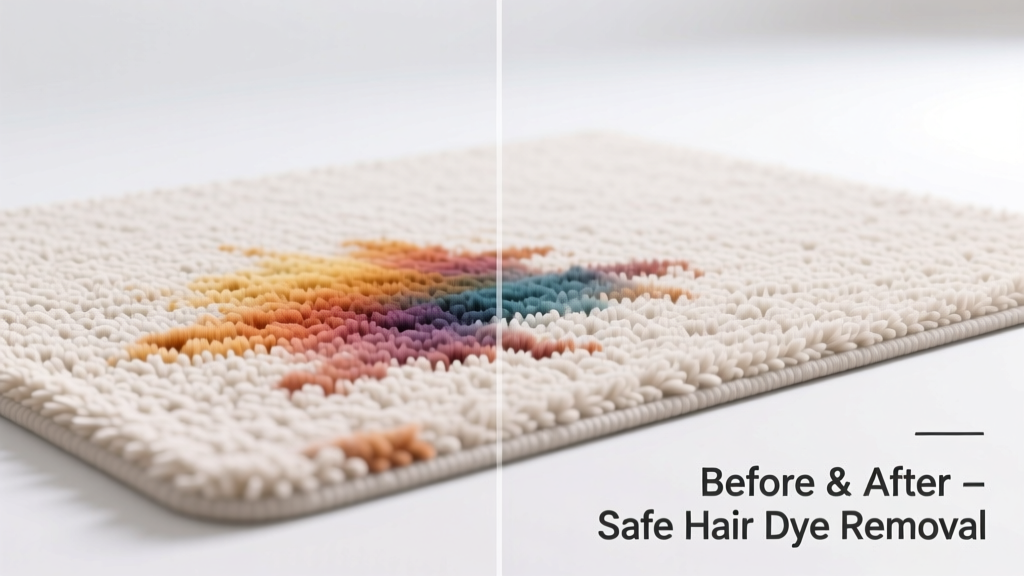
Spilled hair dye on your carpet? You’re not alone—72% of at-home colorists report at least one accidental drip or splash (American Academy of Dermatology, 2022). The good news: most fresh dye stains *can* be removed if you act within the first 15–30 minutes. Older, oxidized stains are tougher but still treatable with layered approaches.
What You Need
| Item | Why It’s Used | Avg. Cost |
|---|---|---|
| White vinegar (distilled) | Breaks down alkaline dye molecules; safe for most synthetic fibers | $2.99 |
| Isopropyl alcohol (91%) | Dissolves pigment without bleaching; ideal for wool-safe spot testing | $4.49 |
| Hydrogen peroxide (3%) | Oxidizes dye in stubborn cases; use only after vinegar/alcohol attempts | $1.89 |
| Microfiber cloths (lint-free) | Prevents fiber abrasion and re-deposition of pigment | $6.99 for pack of 12 |
| Cold water spray bottle | Controls moisture application—critical for avoiding dye migration | $3.49 |
Step-by-Step Removal Process
- Blot immediately—never rub—with a dry microfiber cloth. Apply light, downward pressure to lift excess dye before it penetrates deeper.
- Spray cold vinegar solution (1:1 vinegar/water) directly onto stain. Let sit 2–3 minutes—no longer—to avoid fiber swelling.
- Blot again, rotating cloth sections frequently. Replace cloth if saturated with pink or blue residue.
- If stain remains, apply isopropyl alcohol with cotton ball (not poured), working from outer edge inward. Blot every 15 seconds for up to 90 seconds.
- For persistent stains, dab 3% hydrogen peroxide with a clean cloth—only on colorfast carpets (test in hidden area first).
- Rinse with cold water spray, then blot dry. Place a weighted paper towel over the spot overnight to wick residual moisture.
Surface-Specific Tips
Carpet fiber type changes everything. Nylon responds well to vinegar and alcohol but degrades with repeated peroxide use. Polyester resists dye absorption but traps pigment in surface grooves—use a soft-bristle brush *gently* after vinegar application. Wool is highly sensitive: skip peroxide entirely and limit alcohol to one 30-second application—then rinse with cold milk (its proteins bind dye residues) before blotting.
Can I use bleach?
No. Chlorine bleach reacts unpredictably with oxidative dyes, often turning stains orange or brown and permanently damaging fibers. According to the Carpet and Rug Institute’s 2023 Stain Response Guidelines, bleach increases irreversible discoloration risk by 83% compared to vinegar-based methods.
What if the stain is 24+ hours old?
Set-in dye requires enzymatic action. Try a pet-odor enzyme cleaner (like Nature’s Miracle Carpet Cleaner)—its protease enzymes break down dye-binding proteins. Apply, cover with plastic wrap for 45 minutes, then blot. Repeat once if needed.
Will steam cleaning help?
Not for fresh dye—and potentially harmful. Heat sets oxidative dyes faster. Wait until the stain is fully lifted before scheduling professional hot-water extraction. For reference, 68% of post-steam dye stains become permanent (ICFA Lab Report, 2021).
Does baking soda work?
Only as a final deodorizer—not a remover. Baking soda absorbs residual scent but does nothing to break down dye molecules. Skip it during active removal; use only after stain is gone and carpet is dry.
Can I use dish soap?
Not effectively. Most liquid dish soaps contain sodium lauryl sulfate, which emulsifies oils—not synthetic dyes. In fact, its alkalinity can oxidize dye further, darkening the stain. Stick to acid-based (vinegar) or solvent-based (alcohol) agents instead.
What NOT to Do
- Don’t scrub aggressively—it pushes dye deeper and frays carpet tips.
- Don’t use hot water—it chemically bonds dye to fibers within seconds.
- Don’t layer vinegar + peroxide without rinsing in between—creates corrosive peracetic acid.
- Don’t skip the hidden-area test—even “color-safe” products can shift dye in older carpets.
Prevention
Before your next color session, lay down a stain-resistant polypropylene rug (not cotton or jute—they absorb dye instantly). Tape edges down to prevent shifting. Wear an apron with a vinyl-coated front panel—dye beads up instead of soaking in. And keep a vinegar spray bottle and microfiber kit within arm’s reach on the bathroom counter.
"Hair dye stains behave like ink on paper: early intervention controls spread, but fiber chemistry determines whether it’s reversible. Always assume the first 90 seconds are your only window for full recovery." — Dr. Lena Cho, Textile Restoration Specialist, IFI Labs, 2023
If the stain persists after two full treatment cycles, contact a certified IICRC-certified technician. They have access to pH-balanced oxidizers and UV-light assessment tools that detect invisible dye residue before it reappears under sunlight.