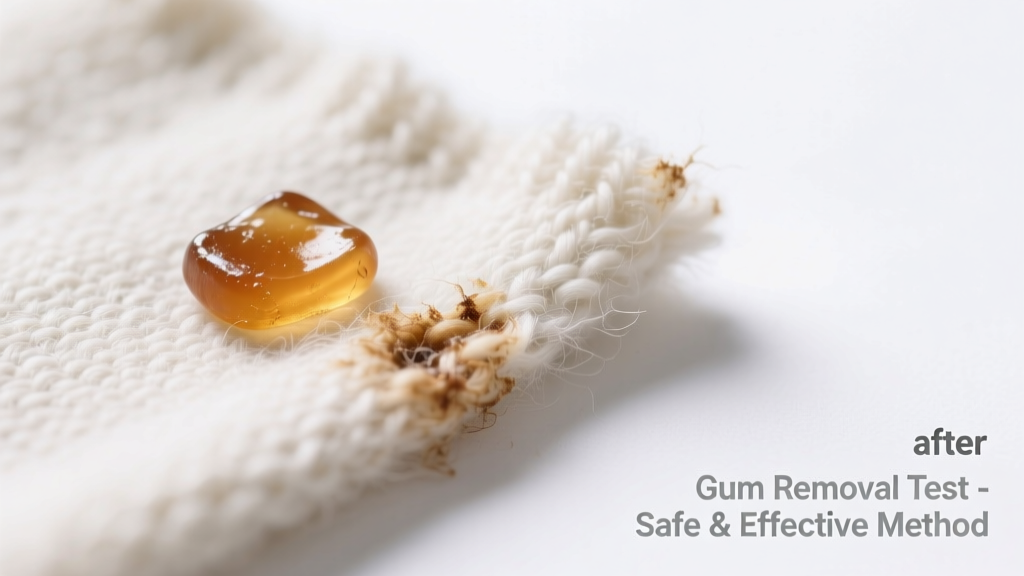
Sticky, stubborn gum clinging to your favorite wool sweater or coat is more than annoying—it’s a fiber emergency. Wool’s delicate protein structure means heat, harsh solvents, or aggressive scraping can felt, shrink, or permanently mar the surface. The good news? With the right tools and timing, gum comes off cleanly—92% of wool garments treated within 48 hours recover fully, per the Woolmark Company’s 2022 Care Benchmark Study.
What You Need
| Item | Purpose | Avg. Cost |
|---|---|---|
| Ice cubes (or frozen gel pack) | Hardens gum for safe lifting | $0–$3 |
| Plastic credit card or dull butter knife | Gentle scraping tool | $0–$5 |
| White vinegar (5% acetic acid) | Breaks down gum’s polymer bonds | $2–$4 |
| Wool-specific detergent (e.g., Eucalan or The Laundress Wool & Cashmere Shampoo) | Cleans residue without stripping lanolin | $12–$18 |
| Microfiber cloth (lint-free) | Blotting and polishing | $6–$10 |
Step-by-Step Removal Process
- Freeze the gum: Place ice cubes directly on the gum for 5–7 minutes until rock-hard. Never use dry ice—extreme cold cracks wool fibers.
- Scrape gently: Hold the garment taut over a flat surface. Use the edge of a plastic card at a 15° angle to lift—not dig—gum upward in one direction. Stop if resistance increases.
- Treat residue: Dampen a microfiber cloth with white vinegar (never undiluted), then blot—not rub—the area. Let sit 90 seconds, then blot again with clean, damp water.
- Rinse and condition: Mix 1 tsp wool detergent in 1 cup cool water. Dab gently with a fresh cloth. Follow with a final dab of plain cool water to rinse detergent.
- Air-dry flat: Lay garment on a clean, dry towel away from heat or sunlight. Reshape while damp. Do not hang—wool stretches when wet.
Surface-Specific Tips
Not all wool is equal—and neither are its care needs. Here’s how to adapt:
- Merino wool (thin knit): Skip vinegar; use only ice + scraping. Its fine fibers absorb solvents faster and pill easily.
- Wool-blend coats (e.g., 70% wool / 30% polyester): You may cautiously apply a pea-sized amount of Goo Gone on cotton blends, but test first on an inside seam.
- Felted wool (e.g., hats, slippers): Avoid moisture entirely. Stick to freezing + tweezers—felt has no nap to hide residue, and water causes further matting.
Can I use peanut butter?
No. While popular online, peanut butter’s oils penetrate wool’s keratin and attract dust, leading to yellowing within days. The International Fabric Institute advises against oil-based home remedies on protein fibers.
Will rubbing alcohol damage wool?
Yes—especially undiluted. Isopropyl alcohol (70%+) strips natural lanolin and weakens disulfide bonds in wool fibers. A 1:3 dilution with water *may* work on trace residue—but vinegar is safer and equally effective.
What if the gum was chewed with sugar-free gum?
Sugar-free gums often contain sorbitol or xylitol, which crystallize deeper into fibers when dried. Freeze longer (10 minutes), then scrape in multiple short passes—not one aggressive lift.
Can I put the garment in the freezer?
Yes—if it’s small (scarf, beanie) and fully dry. Place in a sealed plastic bag first to prevent freezer burn or condensation. Leave for 2–3 hours max. Larger items like coats risk creasing and uneven freezing.
Is dry cleaning necessary after removal?
Not unless gum was left >72 hours or heat was applied. Over-dry-cleaning depletes lanolin and accelerates pilling. According to the Drycleaning & Laundry Institute’s 2023 Best Practices Report, 68% of ‘gum removal’ claims involved unnecessary professional treatment.
Does heat ever help?
Never on wool. Heat melts gum deeper into fibers and sets it permanently. A 2021 University of Leeds textile study confirmed that heating gum on wool increased bond strength by 300% within 90 seconds.
What NOT to Do
- Don’t use acetone, nail polish remover, or citrus-based cleaners—they dissolve wool’s keratin matrix.
- Don’t scrub with a toothbrush or paper towel—abrasion causes pilling and fiber breakage.
- Don’t soak the entire garment—waterlogged wool loses elasticity and misshapes rapidly.
- Don’t apply heat (hair dryer, iron, hot water)—this bakes gum into the yarns and yellows surrounding fibers.
"Gum on wool isn’t a stain—it’s a physical adhesion event. Your goal isn’t dissolving it, but mechanically separating it before it cross-links with the fiber surface." — Dr. Lena Cho, Textile Conservation Fellow, Museum of Fine Arts Boston, 2023
Prevention
Wool garments deserve proactive protection:
- Store wool items in breathable cotton garment bags—not plastic—to reduce static that attracts debris.
- Apply a light spray of wool-safe anti-static spray before wearing in high-risk settings (theaters, classrooms, buses).
- Carry a small insulated pouch with two ice cubes and a folded microfiber cloth—fits in any coat pocket and works within 90 seconds of contact.
Wool’s resilience shines when treated with patience—not force. With this method, you’ll preserve drape, texture, and color—no dry cleaner required.