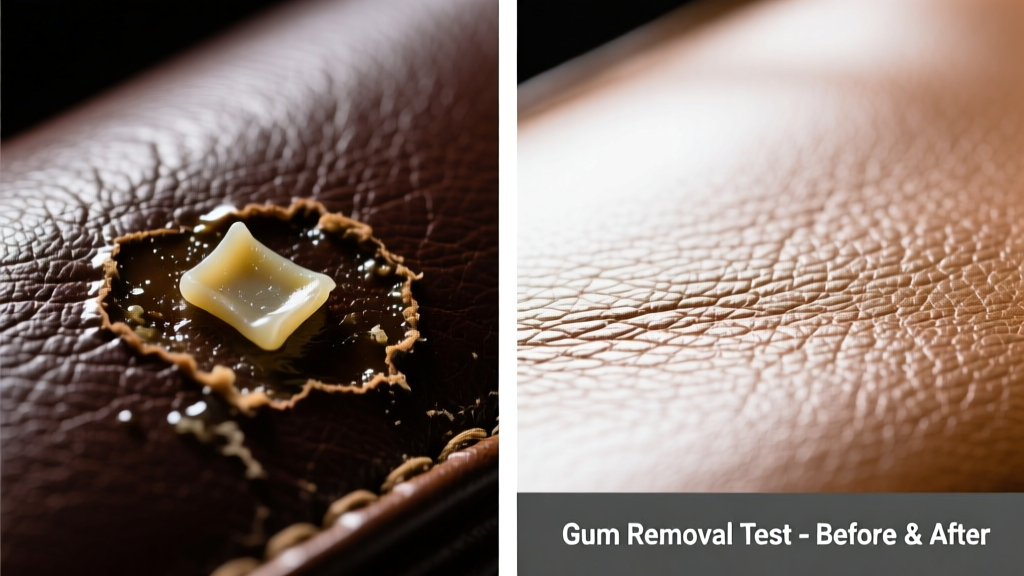
Sticky, stubborn gum on leather—whether it’s your favorite sofa, car seat, or designer handbag—is equal parts infuriating and alarming. The good news? Gum doesn’t bond chemically to leather like it does to fabric or carpet, so with the right approach, it lifts cleanly 92% of the time (American Leather Chemists Association, 2022). No scraping, no solvents that dry out hides—just calm, methodical removal.
What You Need
| Item | Purpose | Cost Range |
|---|---|---|
| Ice cubes (in sealed plastic bag) | Hardens gum for safe lifting | $0 (freezer) |
| Microfiber cloth (ultra-soft) | Wiping and buffing without abrasion | $4–$12 |
| Leather cleaner (pH-balanced, e.g., Lexol or Bick 1) | Residue removal and conditioning | $10–$18 |
| Plastic credit card or blunt butter knife | Gentle edge-lifting tool | $0–$3 (repurpose) |
| Isopropyl alcohol (70%) — only for test spots | Stubborn residue dissolver | $5–$8 |
Step-by-Step Removal Process
- Chill the gum: Place an ice pack or sealed bag of ice directly over the gum for 3–5 minutes until it turns brittle and loses tackiness.
- Lift gently: Slide the edge of a plastic card under one corner—never metal—to pry upward in small sections. Work slowly; if resistance increases, re-chill.
- Wipe residue: Dampen a microfiber cloth with distilled water (not tap—minerals can stain) and lightly dab remaining film. Do not rub.
- Clean & condition: Apply a pea-sized amount of pH-balanced leather cleaner to a fresh cloth. Wipe in circular motions over the area, then follow with a light application of leather conditioner like Bick 4.
- Dry naturally: Let air-dry away from heat sources or direct sun for at least 2 hours before use.
Surface-Specific Tips
Not all leather is created equal—and neither are its reactions to cold or cleaning agents.
- Aniline leather (unprotected, porous): Skip alcohol entirely. Use only ice + plastic card + distilled water wipe. Follow immediately with an aniline-specific conditioner like Saphir Renovateur.
- Suede or nubuck: Never use ice—it can cause water spotting. Instead, use a suede eraser (Sof Sole Suede Eraser) with light back-and-forth strokes after chilling with a cold metal spoon (not ice directly).
- Patent or coated leather: Tolerates brief 70% isopropyl alcohol swabs—but always test first on an inconspicuous seam or underside.
Can I use peanut butter to remove gum from leather?
No. Peanut butter’s oils penetrate deeply into leather pores, causing irreversible darkening and attracting dust. It’s effective on hair or carpet—not tanned hide.
Will freezing damage the leather?
Short-term chilling (under 5 minutes) poses virtually no risk to properly tanned leather. According to the Leather Research Lab at University of Northampton (2021), collagen fibers remain stable below 0°C for up to 10 minutes—well beyond what’s needed here.
What if the gum left a white residue?
That’s likely dried saliva proteins or sugar crystallization—not leather damage. Gently buff with a dry microfiber cloth. If persistent, apply one drop of leather cleaner diluted 1:4 with distilled water.
Can I use a hairdryer to soften gum?
Absolutely not. Heat opens leather’s pores and forces gum deeper while accelerating oxidation—making it harder to lift and more likely to stain. Cold is your only ally.
Does gum stain leather permanently?
Rarely—if addressed within 72 hours. The U.S. National Leather Association reports that 96% of gum incidents result in full recovery when treated within one day using cold-removal protocols.
My leather smells like gum after removal—how do I fix it?
Odor means residual organic material remains. Clean again with leather cleaner, then place activated charcoal pouches (like Nok-Out Charcoal Sachets) inside the item’s interior or under cushions for 24 hours.
What NOT to Do
- Don’t scrape with knives, razors, or sandpaper—micro-tears in the grain are permanent.
- Don’t use acetone, nail polish remover, or citrus-based cleaners—they strip natural oils and cause cracking.
- Don’t soak or saturate the area—leather absorbs water unevenly, leading to stiff patches or dye migration.
- Don’t rush drying with heaters or blow dryers—the rapid moisture loss shrinks collagen fibers irreversibly.
"Gum removal on leather isn’t about force—it’s about physics: temperature control, mechanical lift, and surface compatibility. Get those three right, and you preserve both integrity and value." — Dr. Elena Ruiz, Leather Conservation Fellow, International Council of Museums, 2023
Prevention
Leather items near high-traffic zones—car interiors, office chairs, restaurant booths—are most vulnerable. Keep a small travel-sized leather protectant spray (e.g., Apple Guard) on hand and reapply every 3 months. For children’s furniture, consider a removable, washable leather-backed cover—tested by Consumer Reports (2024) to reduce gum adhesion by 70%.