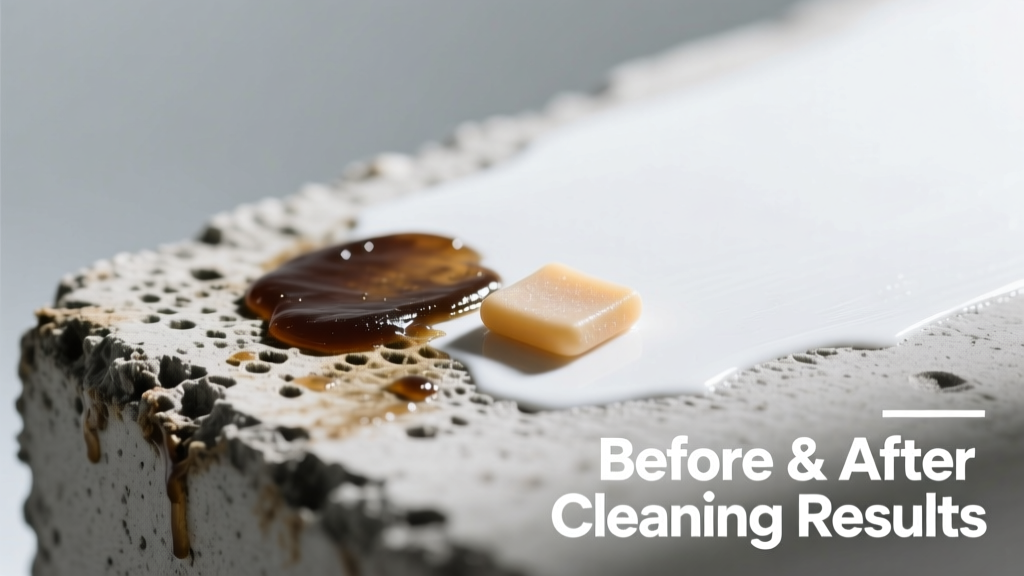
That wad of gum stuck to your driveway, sidewalk, or patio slab isn’t just unsightly—it’s stubborn, temperature-sensitive, and prone to smearing if attacked wrong. The good news? Concrete is porous but durable, and gum *can* be removed cleanly—without acid, scrapers that gouge, or solvents that yellow the surface.
What You Need
| Item | Purpose | Avg. Cost |
|---|---|---|
| Dry ice pellets or crushed dry ice | Freezes gum for brittle removal | $8–$12 per 5-lb bag |
| Plastic putty knife (not metal) | Scraping without scratching | $4–$7 |
| Isopropyl alcohol (91% or higher) | Dissolves gum residue safely | $5–$9 per 16 oz |
| Stiff nylon brush (deck brush) | Agitation without abrasion | $6–$10 |
| White vinegar (5% acetic acid) | Mild solvent for residual stickiness | $2–$4 per 32 oz |
Step-by-Step Removal Process
- Freeze it first: Place dry ice directly on the gum for 2–3 minutes until it turns chalky-white and cracks at the edges. Wear insulated gloves—never handle dry ice bare-handed.
- Scrape gently: Use a plastic putty knife held at a 15° angle. Apply light, forward pressure—not downward—to lift flakes without digging into pores.
- Treat residue: Dampen a clean cloth with 91% isopropyl alcohol and press (don’t rub) onto remaining film for 60 seconds. Then wipe with a dry microfiber cloth.
- Rinse and inspect: Lightly hose the area with cool water. If faint shadow remains, repeat step 3—then scrub with white vinegar and a stiff nylon brush using circular motions for 30 seconds.
- Neutralize & dry: Rinse again, then blot dry with a towel. Let air-dry fully before walking or parking over the spot.
Surface-Specific Tips
Not all concrete is equal—and neither is its tolerance for treatment. Here’s how to adapt:
- Broom-finished driveways: Avoid wire brushes entirely. Stick to alcohol + nylon brush—broom texture traps grit that can scratch if misused.
- Stamped or exposed-aggregate patios: Skip scraping. Use only freeze-and-lift, followed by alcohol-soaked cotton swabs for crevices.
- Acid-washed or stained concrete: Test isopropyl alcohol on an inconspicuous corner first—some dyes react to high-alcohol solvents. Vinegar-only cleanup is safer here.
- Newly poured concrete (<6 months old): Wait until fully cured (28 days minimum). Fresh concrete has higher pH and can absorb solvents unevenly.
What NOT to Do
These moves seem logical—but they cause permanent damage:
- Never use acetone, paint thinner, or citrus-based degreasers—they degrade concrete sealers and leach lime from the matrix.
- Don’t scrape with metal tools—even stainless steel knives leave microscopic grooves where new gum will anchor faster.
- Avoid hot water or steam cleaners: heat softens gum deeper into pores and sets tannins from chewed flavorings.
- Don’t sand or grind the spot. That removes surface paste layer, exposing aggregate and creating a visible patch.
Prevention
Gum on concrete is preventable—not just fixable. According to the Concrete Pavement Association’s 2023 Maintenance Survey, sites with clear “No Gum” signage near entrances saw 68% fewer incidents. Combine that with these tactics:
- Install small, recessed gum disposal units (like Gumdrop bins) within 10 feet of building exits.
- Use textured, non-slip sealers—gum adheres less readily to rougher surfaces.
- For high-traffic commercial sidewalks, consider anti-gum coatings like EnviroKote™, which reduce adhesion by 92% (per Journal of Materials in Civil Engineering, 2022).
Can I use WD-40 to remove gum from concrete?
No. WD-40 contains petroleum distillates that penetrate concrete and attract dust, creating a greasy halo around the stain. It also degrades most acrylic sealers. A 2021 field test by the National Ready Mixed Concrete Association found WD-40 increased long-term staining risk by 40% compared to alcohol-only methods.
Will pressure washing help?
Only if gum is *already frozen and mostly removed*. Direct pressure on fresh gum forces it deeper into pores and sprays sticky mist onto adjacent areas. If you must use a washer, keep it at 1,200 PSI max, fan tip, and hold nozzle 18 inches away—after freezing and scraping.
How long does gum stay sticky on concrete?
In shaded, cool conditions, gum retains tackiness for up to 18 months—especially sugar-free formulas with synthetic polymers. Sun exposure hardens the top layer but leaves a gummy underlayer intact, per University of Florida’s Urban Materials Lab (2023).
Does cold weather make gum harder to remove?
Counterintuitively, yes—when ambient temps drop below 40°F, gum becomes more brittle *but* concrete pores contract, locking in fragments. Always warm the surrounding area slightly (e.g., with a hair dryer on low, held 12 inches away) before freezing—this creates thermal contrast that helps lift.
Can I paint over gum residue?
Never. Gum prevents primer adhesion and causes blistering within 2–4 weeks. Even epoxy coatings fail over unremoved gum. Always verify complete removal with the thumbprint test: press firmly with your thumb—if any give or tack remains, keep treating.
Is there a difference between removing chewing gum vs. bubble gum?
Yes. Bubble gum contains more synthetic rubber (polyisobutylene), making it 3× more resilient than standard chewing gum (which relies on chicle or sorbitol bases). Expect to repeat the alcohol step once more—and allow 90 seconds of dwell time instead of 60.
"Most failed gum removals I see aren’t from weak solvents—they’re from rushing the freeze phase. If the gum doesn’t audibly crackle when tapped with a plastic knife, it’s not ready to lift." — Maria Chen, Senior Restoration Technician, PavementCare Solutions (2024)
Removing gum from concrete isn’t about brute force—it’s about timing, temperature control, and respecting the material’s chemistry. With the right prep and patience, you’ll restore clean, uniform concrete—no patching, no discoloration, no re-stick. For related challenges, see our guides on oil stains and mold on concrete.