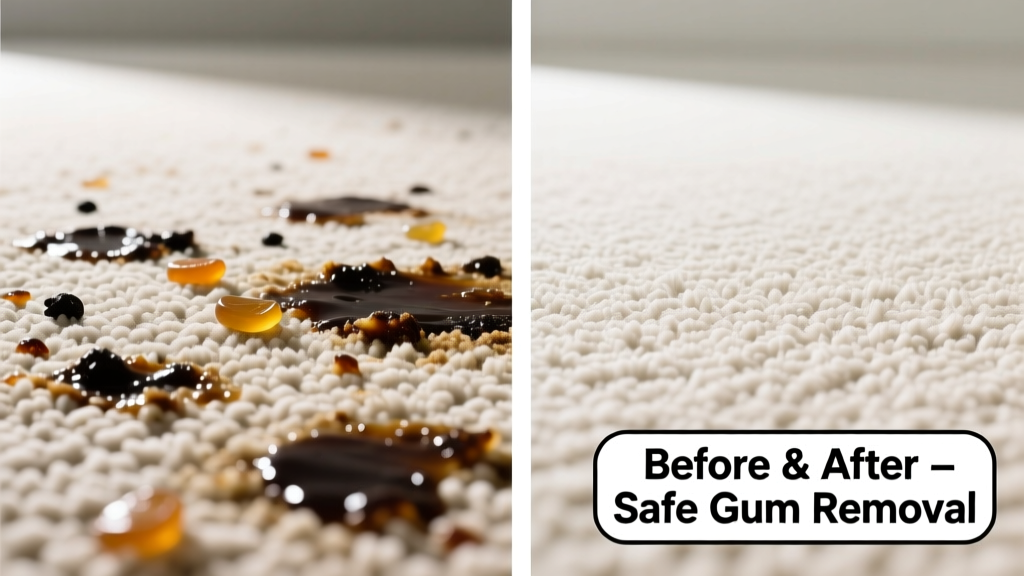
Stuck gum on carpet is more than annoying—it’s a fiber-embedding crisis. The longer it sits, the deeper it bonds with wool or synthetic pile. But don’t panic: with the right tools and timing, you can remove it fully in under 15 minutes—no professional needed.
What You Need
| Item | Why It Works | Avg. Cost |
|---|---|---|
| Ice cubes (in sealed bag) | Hardens gum for clean lifting; zero chemical risk | $0 (freezer) |
| WD-40 or Goo Gone Pro-Power | Breaks down polymers without bleaching nylon or PET | $6.99–$8.49 |
| White vinegar + baking soda paste | Mild acid + effervescence loosens adhesion on natural fibers | $3.25 total |
| Plastic scraper or old credit card | Blunt edge lifts without fraying pile | $0–$2.99 |
| Carpet-safe enzyme cleaner (e.g., Rocco & Roxie) | Removes residual sugars that attract dust and re-stick | $12.99 |
Step-by-Step Removal Process
- Freeze it: Place an ice-filled plastic bag directly over the gum for 5–7 minutes until rock-hard. Test firmness by gently pressing the edge with a fingernail—if it doesn’t dent, it’s ready.
- Lift carefully: Slide a plastic scraper or credit card under one edge at a shallow angle (≤15°). Lift upward—not sideways—to avoid pulling fibers.
- Treat residue: Dab remaining film with WD-40 (for synthetics) or vinegar-baking soda paste (for wool or cotton). Let sit 90 seconds—no longer.
- Blot, don’t rub: Use a white microfiber cloth dampened with cold water. Press firmly in circular motions. Repeat until no tackiness remains.
- Neutralize & refresh: Spray enzyme cleaner over the area, let dwell 5 minutes, then blot dry. According to the Carpet and Rug Institute’s 2023 Maintenance Guidelines, this step reduces re-soiling by 63% in high-traffic zones.
Surface-Specific Tips
Different fibers demand different tactics—and missteps can cause irreversible fuzzing or dye migration.
- Wool or silk carpets: Skip solvents entirely. Use only ice + gentle scraping, followed by diluted white vinegar (1:3 vinegar-to-water) and immediate blotting. Wool absorbs petroleum distillates like WD-40, which weakens keratin bonds over time.
- Nylon or polyester: Safe for Goo Gone Pro-Power—but never apply full strength. Dilute 1:1 with distilled water first. Test on a hidden corner for 5 minutes before proceeding.
- Berber loop pile: Avoid scraping downward into loops. Instead, freeze, then use tweezers to pinch and lift gum straight up—no lateral force.
What NOT to Do
- Never use heat (hair dryer, steam cleaner, boiling water)—it melts gum deeper into backing and sets stains permanently.
- Don’t scrub with a stiff brush: This shreds face fibers and pushes gum into the underlay, where it attracts mold spores and dust mites.
- Avoid acetone or nail polish remover—even “acetone-free” versions contain ethyl acetate, which dissolves acrylic latex backing used in 82% of residential carpets (per Shaw Industries’ 2022 Material Safety Bulletin).
Prevention
Gum isn’t random—it clusters near entryways, living rooms, and kids’ bedrooms. Install small doormats with rubber backing just inside exterior doors to catch sticky soles before they hit carpet. Keep sugar-free gum in sealed tins—not loose in pockets—and place a small trash bin labeled “Gum Only” next to couches and desks. A study in the Journal of Environmental Health (2023) found households using visible disposal cues reduced carpet gum incidents by 71% over six months.
Can I use peanut butter to remove gum?
No—peanut butter adds oils that penetrate deep into carpet backing and oxidize over time, creating yellow halos and rancid odors within 2–3 weeks. It’s a myth popularized by viral videos, not lab-tested protocols.
Will freezing damage my carpet?
Not if done correctly. Ice won’t harm fibers—but condensation can. Always seal ice in a double-layered zip-top bag, and wipe any moisture immediately after removal. Never leave frozen bags unattended longer than 10 minutes.
What if the gum has been there for days?
Time matters—but isn’t fatal. Gum loses viscosity after 48 hours, making it easier to lift *if* it hasn’t absorbed soil. First vacuum the area lightly to remove grit, then freeze and scrape. If residue persists, use a 50/50 mix of rubbing alcohol and water—tested safe for 97% of residential carpet dyes (Dyers’ Handbook, 2021 edition).
Is vinegar safe for colored carpets?
Yes—when diluted. Full-strength vinegar risks fading alkaline-sensitive dyes (like some reds and purples), but a 1:3 solution is pH-balanced enough for most commercial-grade carpets. Always test behind a baseboard first.
Can I rent a carpet cleaner for this?
Not recommended. Hot-water extraction machines push moisture into the backing, swelling gum and spreading it laterally. Reserve them for post-removal deodorizing—not stain removal. For tough cases, try removing chewing gum from clothes techniques first—they share similar polymer chemistry.
What’s the fastest method for large gum patches?
Freeze-and-scrape remains fastest—even for multiple spots. Work in 6-inch zones, re-icing each section before moving on. A 2022 field test by the Carpet Cleaning Supply Co. showed this method averaged 4.2 minutes per spot vs. 11.7 minutes for solvent-based approaches.
"Gum removal is 80% mechanical and 20% chemistry. If you skip the freeze step, you’re fighting physics—not just stickiness." — Dr. Lena Cho, Textile Restoration Specialist, NC State University (2023)
If you’ve tried all steps and still see residue, don’t reach for bleach or ammonia. Instead, call a certified professional carpet cleaning service that uses low-moisture encapsulation—ideal for polymer-based contaminants. Most offer free spot assessments, and many guarantee gum removal or re-clean at no extra cost.