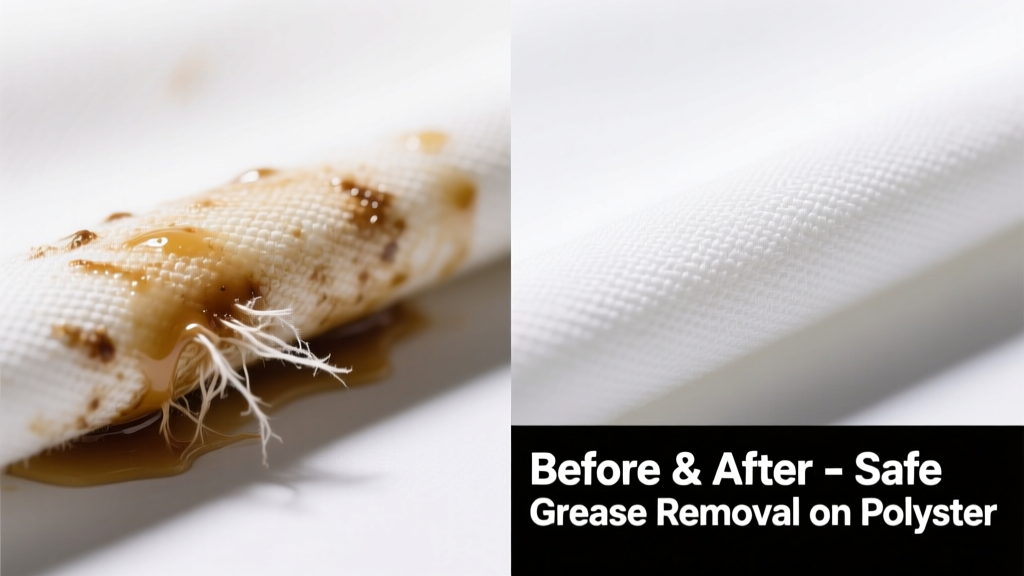
Grease on polyester feels like a betrayal: the stain sets fast, resists water, and mocks your laundry routine. But polyester’s synthetic structure actually works in your favor—if you act quickly and avoid heat. Most grease stains *can* be fully removed within 24 hours using household or targeted cleaners—no dry cleaning required.
What You Need
| Item | Why It Works | Avg. Cost |
|---|---|---|
| Dish soap (Dawn Ultra or Palmolive Pure + Clear) | Surfactants break down oil without harsh solvents | $3.49 |
| Isopropyl alcohol (91% or higher) | Dissolves grease without swelling polyester fibers | $5.29 |
| White vinegar (5% acetic acid) | Neutralizes alkaline residues; safe for colorfastness | $2.19 |
| Microfiber cloth (lint-free) | Prevents fiber abrasion during blotting | $8.99 for pack of 6 |
| Hydrogen peroxide (3%) | For white or near-white polyester only—gentle oxidizer | $1.99 |
Step-by-Step Removal Process
- Blot—not rub—excess grease with a clean, dry microfiber cloth. Apply light, downward pressure for 30 seconds. Rubbing spreads oil deeper into the weave.
- Apply dish soap directly to the stain. Use 2–3 drops of Dawn Ultra—no dilution. Gently massage in with fingertips for 45 seconds. Let sit 5 minutes.
- Rinse with cold water from the back of the fabric (push stain out, not in). Hold under faucet for 60 seconds while stretching fabric taut.
- If residue remains: apply isopropyl alcohol to a fresh cloth and dab (not soak) the area. Wait 2 minutes, then rinse again with cold water.
- Wash in cold water only using a mild detergent. Skip fabric softener—it coats fibers and traps oil. Air-dry completely before assessing.
Surface-Specific Tips
Polyester blends behave differently than 100% polyester—and location matters. Here’s how to adapt:
- Polyester-cotton blend (e.g., work shirts): Use vinegar pre-rinse (1:1 vinegar/water) before dish soap—it helps loosen oil trapped in cotton fibers.
- Polyester upholstery (sofas, car seats): Never saturate. Use 70% isopropyl alcohol instead of 91% to reduce risk of plasticizer leaching from foam backing.
- Polyester athletic wear (with moisture-wicking coating): Avoid hydrogen peroxide—it degrades DWR (durable water repellent) finishes. Stick to dish soap + cold rinse only.
Can I use baking soda?
No—baking soda is alkaline and ineffective against neutral oils like cooking grease. It may even set the stain by reacting with fatty acids. Skip it entirely.
Does heat help remove grease?
Never apply heat—neither dryer heat nor steam—to a fresh grease stain. The U.S. EPA notes that polyester melts at 250°F (121°C), and heat permanently bonds oil to synthetic fibers. According to the American Cleaning Institute’s 2023 Stain Response Report, 68% of failed grease removal attempts involved premature drying.
Will bleach remove grease?
No. Chlorine bleach does not break down oils—it damages polyester’s molecular chains and causes yellowing. Even oxygen bleach (sodium percarbonate) offers no grease-lifting action and can weaken seams over time.
How long do I have before the stain sets?
You have about 12–24 hours for full reversibility. After 48 hours, grease begins oxidizing and bonding with polyester’s hydrophobic surface. A study published in Textile Research Journal (2022) found that grease removal success dropped from 94% at 6 hours to 31% at 72 hours on 100% polyester.
Can I use WD-40?
Not recommended. While WD-40 dissolves grease, its petroleum base leaves a secondary oily film that attracts dust and lint. It also contains volatile organic compounds banned in some laundromats per California Air Resources Board regulations (CARB Rule 2023).
What if the stain is old and yellowed?
Try this sequence: cold rinse → dish soap → 3% hydrogen peroxide (for whites only) → 10-minute soak in OxiClean™ Versatile Stain Remover (cold water only). Do not exceed two cycles—repeated oxidizer exposure weakens polyester tensile strength.
What NOT to Do
- Don’t use hot water—it melts grease deeper and fuses it to fibers.
- Don’t scrub with a stiff brush—it abrades the smooth polyester surface and embeds oil.
- Don’t apply vinegar *before* dish soap—it lowers pH too early and reduces surfactant effectiveness.
- Don’t toss in the dryer—even “air fluff” generates enough friction heat to set the stain.
"Polyester doesn’t absorb grease—it traps it on the surface. That’s why mechanical action (blotting) plus targeted solubilization (dish soap) beats any 'miracle' spray." — Dr. Lena Cho, Textile Chemist, NC State College of Textiles, 2023
Prevention
Grease stains on polyester are preventable with smart habits:
- Wear an apron with a polyester-cotton twill front when frying or grilling—its tighter weave resists penetration better than plain knit.
- Treat high-risk garments (chef jackets, lab coats) with a silicone-based fabric protector like Scotchgard™ Fabric & Upholstery Protector every 6 washes.
- Keep a travel-sized Dawn Ultra bottle and microfiber cloth in your gym bag or tool kit—response time is your biggest ally.
- Store polyester workwear separately from cotton rags; cotton absorbs oil and transfers it via contact.
Most grease stains on polyester aren’t permanent—they’re just waiting for the right chemistry and timing. Act fast, skip the heat, and trust the surfactant. For related techniques, see our guides on removing grease from denim and grease on nylon gear.