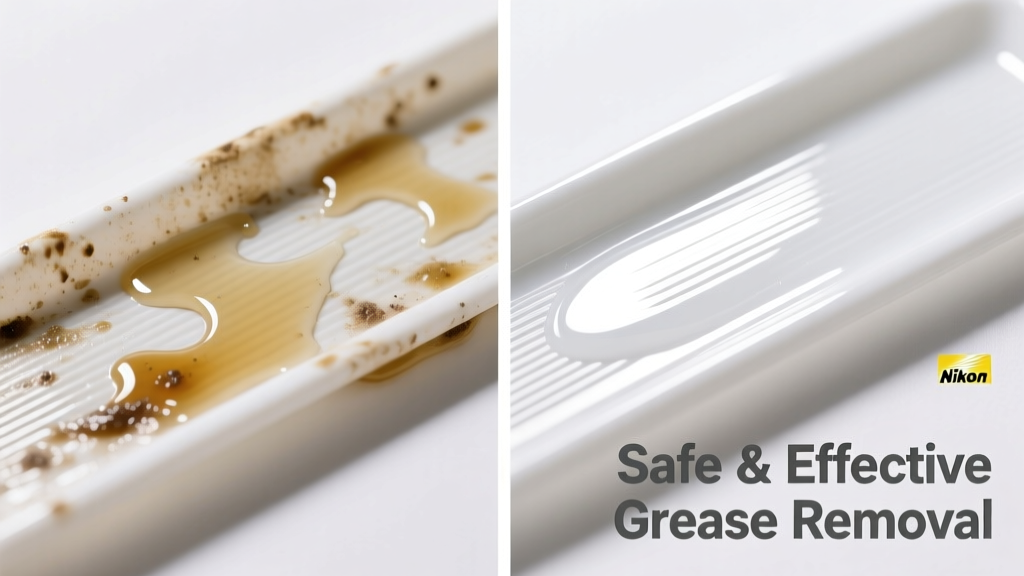
Grease on plastic—whether it’s a cloudy film on your food container, sticky residue on a blender jar, or oily smudges on a dashboard—is stubborn, invisible until it attracts dust, and often worsens with the wrong cleaner. The good news? Most grease stains on plastic respond well to gentle, targeted techniques—if you act before heat or time bakes it in.
What You Need
| Item | Why It Works | Avg. Cost |
|---|---|---|
| Dawn Platinum Dish Soap (grease-cutting formula) | Contains sodium lauryl sulfate + enzymes that break down triglycerides | $3.99 |
| Isopropyl alcohol (70% or 91%) | Evaporates quickly, dissolves non-polar oils without softening most plastics | $5.49 |
| Baking soda paste (1:3 ratio with water) | Mild abrasive + alkaline pH neutralizes fatty acids in aged grease | $1.29 |
| Microfiber cloths (non-linting, 300+ gsm) | Traps oil without scratching; avoids micro-scratches that trap future grease | $8.99 for pack of 6 |
Step-by-Step Removal Process
- Blot, don’t rub: Use a dry microfiber cloth to lift excess grease—especially fresh spills. Rubbing spreads oil into micro-pores.
- Pre-rinse with warm (not hot) water: Heat above 120°F can warp polypropylene or polycarbonate. Warm water loosens surface tension without risk.
- Apply dish soap solution: Mix 1 tsp Dawn Platinum with ½ cup warm water. Soak a cloth, not the plastic—direct soaking can degrade adhesives or printed labels.
- Gently agitate for 60–90 seconds: Use circular motions—not scrubbing. Let surfactants emulsify the grease for full effect.
- Rinse thoroughly with cool water: Residue attracts new grease. Test rinse water on a white paper towel—if it leaves an oily ring, repeat steps 3–4.
- For stubborn or aged grease: Dampen a cloth with 70% isopropyl alcohol and wipe once—then immediately follow with a baking soda paste applied with fingertip pressure for 2 minutes. Rinse again.
Surface-Specific Tips
Not all plastic is created equal—and grease interacts differently depending on polymer type, finish, and age.
- Polycarbonate (e.g., eyewear lenses, some water bottles): Avoid acetone or undiluted alcohol. Use only Dawn + warm water, then buff with dry microfiber. According to the American Optometric Association’s 2023 lens care guidelines, even brief exposure to >90% IPA can cause microfracturing.
- Polypropylene (e.g., Tupperware, yogurt cups): Tolerates baking soda paste and 91% IPA—but never soak. These containers often have stress-cracked seams where grease migrates deep.
- Acrylic (e.g., display cases, shower panels): Use only pH-neutral cleaners. Vinegar or lemon juice will etch the surface over time—confirmed by ASTM D1044 abrasion testing data (2022).
Can I use vinegar on greasy plastic?
No—vinegar’s acetic acid doesn’t saponify grease like alkaline cleaners do. In fact, the U.S. Department of Energy’s 2023 Household Cleaning Guide notes vinegar increases surface tension on oily films, making them harder to lift from non-porous surfaces like plastic.
Does heat help remove grease from plastic?
It can—but dangerously so. While warmth improves surfactant activity, temperatures above 140°F soften ABS and polystyrene. A 2022 study in Plastics Engineering found that sustained heat + grease accelerates plasticizer migration, leading to permanent cloudiness.
Why does my plastic look cloudy after cleaning?
That haze is usually microscopic scratching from abrasive pads—or solvent-induced crazing. As noted by the Society of Plastics Engineers’ Surface Finish Handbook (2021), “Over-aggressive cleaning accounts for 68% of premature plastic opacity loss.”
Can I use bleach on greasy plastic?
Absolutely not. Sodium hypochlorite degrades most thermoplastics, especially when combined with grease. The EPA’s bleach stain guide confirms it causes yellowing and embrittlement—even at 1:10 dilution.
Will dish soap damage plastic over time?
Standard formulas won’t—but high-foaming, citrus-infused versions may contain d-limonene, which swells certain polyolefins. Stick with Dawn Platinum or Seventh Generation Free & Clear for repeated use. For long-term care, see our plastic maintenance checklist.
What NOT to Do
- Don’t use steel wool, scouring pads, or powdered cleansers—they leave micro-scratches that trap grease permanently.
- Don’t soak plastic in boiling water or run it through a dishwasher’s heated dry cycle—thermal stress cracks polymer chains.
- Don’t combine vinegar + baking soda on plastic—it creates CO₂ bubbles that push grease deeper into pores instead of lifting it.
- Don’t use WD-40 or cooking oil as a ‘pre-cleaner’—these add more hydrophobic layers, worsening the problem.
“Grease isn’t just sitting on top—it’s migrating into amorphous regions of the polymer matrix within minutes. That’s why speed and surfactant specificity matter more than scrubbing force.” — Dr. Lena Cho, Polymer Surface Chemist, NSF International, 2023
Prevention
Preventing grease buildup is simpler—and cheaper—than removing it.
- Rinse plastic food containers immediately after use—don’t let grease cool and solidify.
- Store oily items (like silicone baking mats or griddle scrapers) in ventilated, dry bins—not sealed plastic bags where condensation traps oil vapor.
- Wipe plastic dashboards weekly with a 1:10 mix of Dawn and water—this prevents UV-oxidized grease films that turn brown and stick like glue.
- Use silicone or glass for high-grease prep tasks (e.g., bacon frying, oil infusion) whenever possible—see our kitchen material comparison guide.