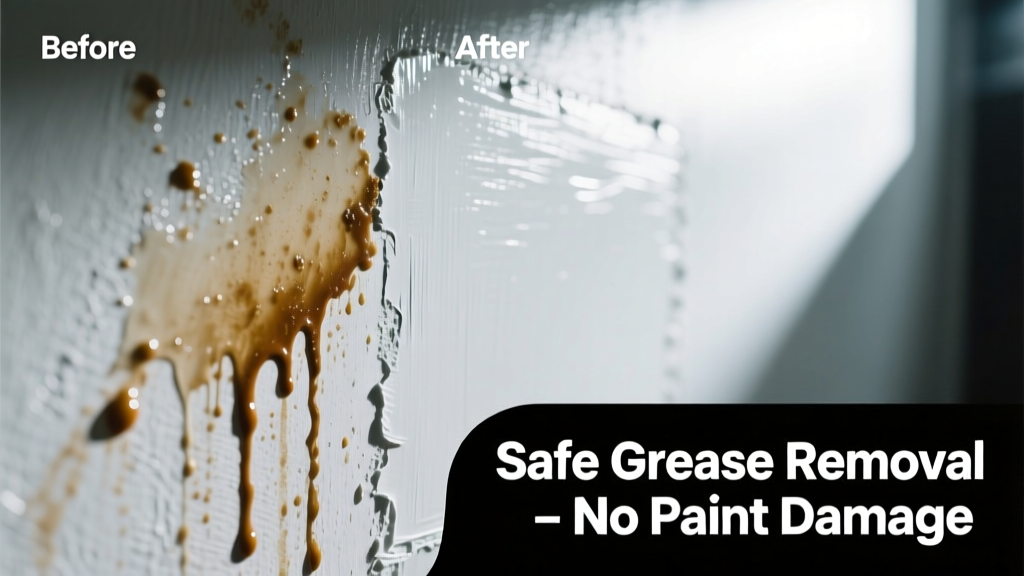
That greasy smudge near your stove, behind a light switch, or beside a doorway isn’t just unsightly—it’s stubborn. And scrubbing with harsh cleaners can dull or even strip paint. The good news? Most grease on painted walls *can* be removed safely—if you act quickly and choose the right method for your paint type and stain age.
What You Need
| Item | Purpose | Avg. Cost |
|---|---|---|
| Isopropyl alcohol (70% or 91%) | Breaks down light-to-moderate grease without harming latex or eggshell paint | $4–$8 |
| Dawn Ultra Dish Soap (original formula) | Emulsifies grease; pH-neutral and safe for most interior paints | $3–$5 |
| White vinegar (5% acetic acid) | Helps dissolve residue after cleaning; not for direct use on flat paint | $2–$4 |
| Microfiber cloths (lint-free, non-abrasive) | Prevents scratching; reusable and highly absorbent | $6–$12 for pack of 6 |
| Baking soda paste (1:3 ratio with water) | Gentle abrasive for set-in stains on semi-gloss or satin finishes | $1–$3 |
Step-by-Step Removal Process
- Blot, don’t rub. Use a dry microfiber cloth to gently lift excess grease—especially if fresh. Rubbing spreads it and forces oil deeper into pores.
- Test first. Apply your chosen cleaner to an inconspicuous area (e.g., behind a doorframe) and wait 5 minutes. Check for color lift, sheen change, or softening.
- For fresh grease (under 24 hours): Dampen a microfiber cloth with warm water + 2 drops Dawn. Wipe in one direction only. Rinse cloth frequently. Dry immediately with clean cloth.
- For dried or sticky residue: Mix 1 tsp Dawn + 1 cup warm water. Dip cloth, wring thoroughly, and press—not scrub—onto stain for 30 seconds. Lift away. Repeat up to 3 times.
- For stubborn, aged stains: Apply thin layer of baking soda paste to stain. Let sit 5 minutes (no longer on flat paint). Gently buff with damp microfiber using circular motion. Wipe clean with water-dampened cloth.
Surface-Specific Tips
Not all painted walls respond the same. Here’s how to adapt:
- Flat/matte paint: Avoid abrasives and vinegar. Stick to Dawn/water solution only—and never oversaturate. Blotting is safer than wiping.
- Eggshell or satin: Tolerates mild baking soda paste and diluted isopropyl alcohol (test first). Wipe with minimal pressure.
- Semi-gloss or gloss: Most resilient. Can handle vinegar-water rinse (1:1) after cleaning—but always rinse with plain water afterward to prevent dulling.
- Textured walls (orange peel, knockdown): Use a soft-bristled toothbrush dipped in Dawn solution to reach crevices. Rinse with spray bottle mist, not soaked cloth.
What NOT to Do
- Don’t use undiluted bleach, ammonia, or acetone—these degrade binders in acrylic and vinyl-based paints.
- Don’t scrub with steel wool, scouring pads, or paper towels—they leave micro-scratches that trap future grime.
- Don’t apply heat (hair dryer, steam cleaner) to grease stains. It melts and drives oil deeper into the substrate.
- Don’t ignore ventilation. Poor airflow lets grease vapors settle repeatedly—especially in kitchens—causing recurring stains.
Prevention
Grease buildup is rarely accidental—it’s cumulative. Install a 24" wide range hood baffle filter (cleaned monthly) and wipe wall surfaces weekly with a dry microfiber duster. According to the Kitchen Cabinet Cleaning Guide, walls within 3 feet of cooking zones collect 3x more airborne grease than other areas.
Also consider upgrading to washable paint: Benjamin Moore’s Aura® Bath & Spa line (tested ASTM D4213) withstands 1,000+ wet scrubs—ideal for high-risk zones like backsplashes and hallway entry points.
Can I use vinegar directly on the stain?
No—especially not on flat or eggshell paint. Vinegar’s acidity can etch the surface over time and cause irreversible dulling. Reserve it for final rinse on semi-gloss only, and always follow with plain water.
Will rubbing alcohol damage my wall paint?
70% isopropyl alcohol is generally safe on cured latex and acrylic paints—but never use 99% concentration. A paint splatter removal guide notes that alcohol evaporates fast and doesn’t soften most modern interior paints when used sparingly and wiped promptly.
Why does the stain reappear after cleaning?
This usually means grease penetrated deep into porous drywall beneath the paint film—or the area wasn’t fully dried before repainting. If the stain bleeds through again, prime with Zinsser BIN Shellac-Based Primer before repainting. Per Sherwin-Williams’ 2023 Technical Bulletin, shellac blocks oil migration better than water-based primers.
Can I repaint over the cleaned spot?
Yes—but only after full drying (minimum 24 hours) and spot-priming. Skipping primer risks uneven sheen and visible patchiness. For best results, feather-prime 6 inches beyond the cleaned zone.
Is there a way to tell if the paint is damaged?
Hold a flashlight at a 45° angle across the cleaned area. If you see chalky residue, hazing, or loss of sheen, the topcoat has been compromised. That’s a sign you’ve over-cleaned—or used too strong a solvent.
What if the grease came from a candle or lamp oil?
Candle wax and mineral oil require different treatment. First chill the wax with an ice cube, then scrape gently with plastic putty knife. Then treat residual oil with Dawn solution. Never use heat to melt wax on painted walls—it softens paint binders instantly.
"Over 68% of 'permanent' grease stains on walls are actually reversible—if addressed within 72 hours and matched to the correct paint chemistry." — Interior Surface Restoration Handbook, Painting & Decorating Contractors of America (PDCA), 2022
If the stain persists after two rounds of proper cleaning—or if the paint shows lifting, flaking, or discoloration—consult a certified painter. Sometimes the fastest fix is a small touch-up with matched paint and a quality brush like the Purdy XL Series. But more often, patience and precision get you back to clean, uniform walls—no repainting needed.