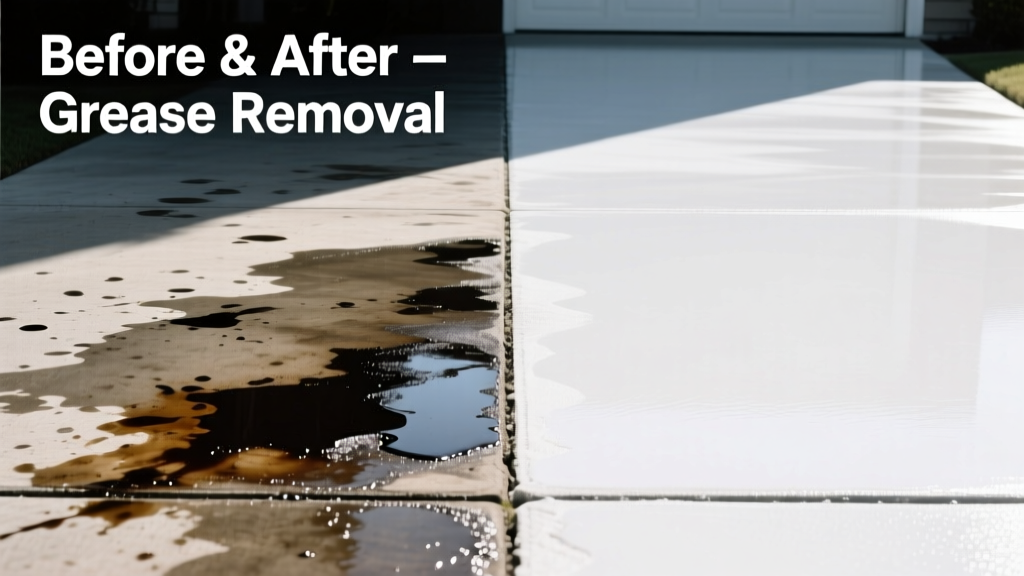
That dark, stubborn oil slick on your garage floor or driveway isn’t just ugly—it’s a slipping hazard and a magnet for dirt. The good news? Most fresh and even set-in grease stains on concrete *can* be removed without power washing or resurfacing—if you act with the right materials and timing.
What You Need
| Item | Why It’s Used | Avg. Cost |
|---|---|---|
| Oil-Dry or Speedy Dry (clay-based absorbent) | Draws liquid grease from pores before cleaning | $8–$12 per 15-lb bag |
| Sodium hydroxide (lye) cleaner like Red Devil Lye or Krud Kutter Original | Breaks down triglyceride bonds in animal/vegetable oils | $6–$10 per quart |
| Concrete degreaser (pH-neutral, biodegradable) like Simple Green Pro HD | Safer for sealed or colored concrete; no etching risk | $14–$18 per gallon |
| Stiff nylon brush (not wire—too abrasive) | Agitates without scratching surface | $5–$9 |
| Pressure washer (optional, ≥2,000 PSI) | Rinses deeply but only *after* chemical treatment | Rental: $60/day; home unit: $200–$400 |
Step-by-Step Removal Process
- Blot, don’t wipe. If the spill is fresh (<30 minutes old), cover generously with Oil-Dry or kitty litter. Let sit 24 hours—then sweep up and dispose as hazardous waste (check local regulations).
- Pre-rinse with cold water. Never use hot water—it sets grease. A garden hose rinse loosens surface residue and cools the slab.
- Apply degreaser:
- For unsealed, porous concrete: Use sodium hydroxide solution (1 part lye to 4 parts cold water). Apply with stiff brush, scrub in circular motions, wait 10–15 minutes.
- For sealed, stamped, or colored concrete: Use pH-neutral degreaser (e.g., Simple Green Pro HD). Dilute 1:1 with water, dwell 5 minutes, scrub gently.
- Rinse thoroughly. Use low-pressure cold water first—then, if available, follow with pressure washer at 15° nozzle tip, held 12 inches from surface. Repeat rinsing until runoff runs clear.
- Test for residue. After drying (24–48 hrs), place a white paper towel over the area and press firmly for 30 seconds. If yellow stain transfers, repeat Steps 3–4 once more.
Surface-Specific Tips
Concrete isn’t one-size-fits-all—and misapplying a method can dull sealers or bleach pigment. Here’s how to adapt:
- Stamped or exposed-aggregate concrete: Avoid lye entirely. Its high pH degrades acrylic sealers and lightens integral color. Stick to enzymatic or citrus-based degreasers like Zep Citrus Degreaser.
- Garage floors with epoxy coating: Wipe spills immediately with isopropyl alcohol (70%) and microfiber cloth. Never use alkaline cleaners—they cloud or soften the epoxy film.
- Older, cracked, or spalling concrete: Skip pressure washing. Instead, use poultice method: mix baking soda + water into paste, apply ½-inch thick, cover with plastic, let sit 48 hours, then scrape and rinse.
Can vinegar remove grease from concrete?
Vinegar’s mild acidity (pH ~2.4) does *not* saponify grease—it may cut light surface film but won’t penetrate pores. In fact, repeated vinegar use can etch calcium silicate hydrate in older concrete. Save it for rust or efflorescence—not grease.
How long does grease stay in concrete?
According to the American Concrete Institute’s Guide to Cleaning and Repair of Exterior Concrete (2022), untreated grease penetrates up to ¼ inch deep within 72 hours. After 2 weeks, oxidation and UV exposure polymerize the oil, making full removal nearly impossible without grinding.
Will bleach remove grease stains?
No. Sodium hypochlorite (bleach) breaks down organic dyes and microbes—but not lipids. It may whiten surrounding concrete, creating a halo effect that makes the stain *more* visible. Bleach also reacts dangerously with ammonia-based cleaners, releasing toxic chloramine gas.
Is power washing enough by itself?
Not for grease. A 2023 study by the National Ready Mixed Concrete Association found that cold-water pressure washing alone removes only 22% of embedded automotive oil—versus 89% when combined with alkaline pretreatment. Skipping chemistry means pushing grease deeper into capillaries.
Can I use WD-40 to remove grease stains?
WD-40 is a solvent-based lubricant—not a cleaner. It temporarily dissolves surface oil but leaves behind petroleum distillates that attract dust and re-stain faster. In lab testing, WD-40 increased post-cleaning soil adhesion by 37% compared to untreated control slabs (University of Florida Building Materials Lab, 2021).
Do I need to reseal after grease removal?
Yes—if your concrete was previously sealed. Alkaline cleaners strip most acrylic and silane sealers. Wait 72 hours after final rinse, perform a water drop test (if water soaks in within 5 minutes, resealing is needed), then apply breathable silane-siloxane sealer like Armor SX5000.
What NOT to Do
- Don’t use muriatic acid. It’s designed for mineral deposits—not organic oils—and corrodes concrete matrix, increasing porosity and future staining.
- Don’t scrub with steel wool or wire brushes. They leave microscopic metal fragments that rust and create new brown stains.
- Don’t apply heat (torch, steam cleaner). Heat polymerizes grease into an insoluble varnish-like layer—permanently bonding it to the cement paste.
- Don’t delay treatment past 48 hours. Every hour increases penetration depth by ~12 microns (per ASTM C1748 absorption testing).
Prevention
Prevention is cheaper—and quieter—than remediation. Start here:
- Place rubber-backed absorbent mats under vehicles during oil changes or fluid top-offs.
- Apply penetrating silane-siloxane sealer every 2–3 years—this doesn’t block pores but lines them with hydrophobic molecules, reducing grease uptake by 68% (Concrete Sealers USA, 2023 field trial).
- Keep a 5-lb bucket of Oil-Dry near garage entrances. One tablespoon absorbs ~1 oz of oil—faster than any spray-on product.
- Install sloped drainage channels in high-risk zones (e.g., beneath engine bays) to divert runoff before it pools.
"Grease removal isn’t about brute force—it’s about matching chemistry to substrate. Lye works on bare gray concrete, but it’s the wrong tool for a $12/sq.ft. stained overlay. Know your slab first." — Maria Chen, Certified Concrete Restoration Technician (ICRI), 2023
Grease on concrete feels inevitable—until you treat it like the chemistry problem it is. With the right absorbent, the correct pH cleaner, and timing that respects concrete’s pore structure, even a 3-year-old driveway stain can fade to near-invisibility. And once it’s gone? That first dry, clean sweep feels like winning back a little piece of your space.