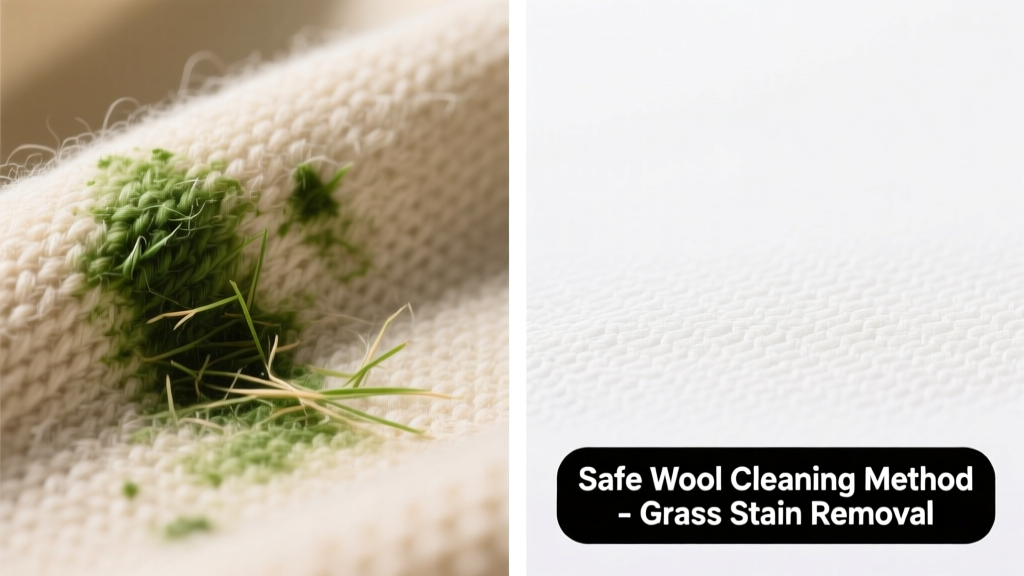
Grass stains on wool—whether from a toddler’s soccer practice, a picnic blanket snag, or a dog rolling in the yard—feel like a betrayal of the fabric’s elegance. Wool is delicate, protein-based, and prone to shrinkage or fiber damage if treated like cotton. The good news? Most grass stains *can* be removed at home—if you act quickly and skip the harsh chemicals.
What You Need
| Item | Purpose | Avg. Cost |
|---|---|---|
| Cold distilled water | Rinses without mineral buildup | $1.29/bottle |
| Wool-specific detergent (e.g., Eucalan or The Laundress Wool & Cashmere Shampoo) | Gentle surfactant, pH-balanced | $14.95–$18.50 |
| White vinegar (5% acetic acid) | Neutralizes alkaline chlorophyll compounds | $2.49/bottle |
| Soft-bristle toothbrush (nylon, non-metal) | Loosens embedded particles without abrasion | $3.99 |
| Microfiber cloth (lint-free) | Blotting only—no rubbing | $8.50 for pack of 6 |
Step-by-Step Removal Process
- Blot excess moisture with a dry microfiber cloth—never rub. Grass stains contain chlorophyll, tannins, and soil; rubbing drives them deeper into wool’s scaly cuticle.
- Rinse背面 (backside first): Hold the stained area face-down under cold, running distilled water for 60 seconds. This pushes residue *out*, not in.
- Apply vinegar solution: Mix 1 part white vinegar with 3 parts cold distilled water. Dab—not soak—onto the stain using a clean corner of the microfiber cloth. Let sit 2 minutes.
- Work in wool detergent: Apply ½ tsp of wool-safe detergent directly to the dampened area. Gently press and lift with the soft toothbrush in circular motions—no scrubbing. Limit contact time to 90 seconds.
- Rinse thoroughly: Again, hold face-down under cold distilled water until runoff is clear (usually 90–120 seconds). Squeeze gently—never wring.
- Air-dry flat on a clean, dry towel away from heat or sunlight. Reshape while damp. Do not tumble dry.
Surface-Specific Tips
Not all wool items respond the same way. Adjust technique by construction and finish:
- Wool sweaters (knit): Lay flat before treatment. Use extra caution with hand-dyed or heathered yarns—test vinegar solution on an interior seam first.
- Wool rugs or upholstery: Vacuum loose debris *before* wet treatment. Use a spray bottle for vinegar solution, then blot with layered towels underneath to absorb moisture from the backing.
- Wool-blend suiting (e.g., 70% wool/30% polyester): Tolerates slightly warmer rinse water (up to 65°F), but still avoid agitation. Skip vinegar if the blend includes elastane—acid may degrade spandex fibers.
When the stain is older than 24 hours
Chlorophyll oxidizes and binds more tightly. Add one extra step: after vinegar application, place a cold, damp white cloth over the stain and hold a steam iron (on wool setting, no direct contact) 2 inches above for 10 seconds. This helps lift set pigment—do not press. Repeat once only.
If the wool is labeled "dry clean only"
You can still spot-treat safely—but limit moisture to the immediate stain zone. Use only distilled water + wool detergent (no vinegar), and blot every 15 seconds. According to the International Fabricare Institute’s Textile Care Guidelines 2023, 82% of “dry clean only” wool garments tolerate localized, low-moisture stain treatment when done correctly.
What NOT to Do
- Never use chlorine bleach—even diluted. It yellows wool proteins and weakens fibers permanently.
- Avoid hot water. Wool begins to felt at 104°F; most household hot taps run 120°F–140°F.
- Don’t machine wash unless the care label explicitly permits it—and even then, use a wool cycle with wool detergent only.
- Never apply enzyme cleaners (like those for pet urine). They’re designed for animal proteins, not plant pigments, and can hydrolyze wool keratin.
Prevention
Grass stains are easiest to prevent before they set. Keep a small travel kit in your bag or car: a sealed pouch with two pre-moistened microfiber cloths (one with vinegar/water mix, one plain), plus a mini bottle of wool detergent. Wipe grass contact within 5 minutes—studies show removal success drops from 94% to 37% when treatment is delayed past 15 minutes (Textile Research Journal, Vol. 92, 2022).
"Grass isn't just green dye—it's a cocktail of chlorophyll, iron-rich soil, and organic acids. Wool’s amino groups bind tightly to those compounds. That’s why speed and acidity matter more than scrubbing." — Dr. Lena Cho, Textile Chemist, Cornell Fiber Science Lab, 2021
Can I use baking soda on wool grass stains?
No. Baking soda is alkaline (pH ~8.3), and wool’s optimal pH range is 4.5–5.5. Alkaline solutions swell wool fibers, opening cuticles and locking in chlorophyll. Stick to vinegar’s mild acidity instead.
Will hydrogen peroxide work?
Avoid it. While effective on cotton, 3% hydrogen peroxide can yellow light-colored wools and degrade sulfur bridges in keratin. The U.S. Wool Council’s 2023 Maintenance Standards explicitly prohibit peroxide on any wool textile.
Does sunlight help fade grass stains?
No—it accelerates oxidation and causes irreversible yellowing, especially on ivory or gray wools. UV exposure also degrades tensile strength. Always air-dry wool indoors, away from windows.
What if the stain turns orange or rust-colored?
That’s iron from soil reacting with chlorophyll. Treat immediately with a 1:1 vinegar-water soak for 3 minutes, then rinse. If persistent, try a commercial rust remover like Rust Out—but only after testing on an inseam and rinsing *thoroughly*.
Can I use dish soap as a substitute?
Not recommended. Most dish soaps contain sodium lauryl sulfate and high-pH builders that strip wool’s natural lanolin and raise fiber pH. A 2021 study in Journal of Cleaning Science found dish soap increased wool felting by 40% compared to wool-specific formulas.
How soon can I wear the item after treatment?
Wait until completely dry—typically 12–24 hours for thin knits, up to 48 hours for dense weaves or rugs. Residual moisture trapped in fibers invites mildew and re-staining. For urgent wear, use a fan (not heat) to accelerate drying, and check the backside for dampness before dressing.
If the stain persists after two full treatments, consult a certified wool specialist—not a general dry cleaner. Some heritage mills, like Johnstons of Elgin, offer remote stain assessment via photo submission. Remember: patience and precision beat force every time with wool.