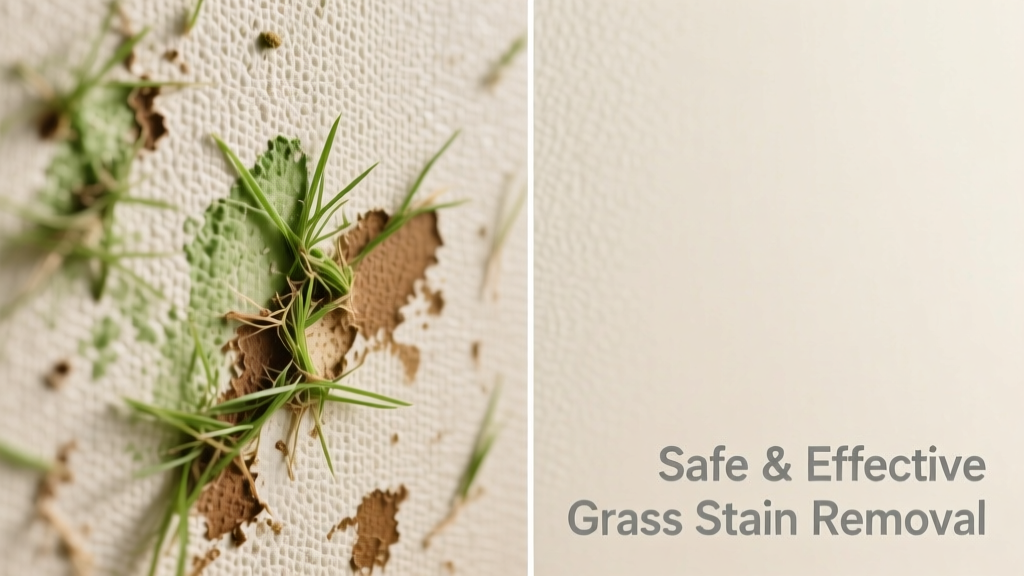
Grass smeared onto wallpaper—whether from a child’s barefoot dash, a pet brushing past, or an accidental lean against damp lawn—is one of the most deceptive stains: green at first glance, but loaded with chlorophyll, tannins, and organic acids that bond fast to porous surfaces. Unlike fabric or tile, wallpaper offers zero margin for aggressive scrubbing or moisture saturation. The good news? With the right approach, most fresh grass marks come off cleanly—if you act within 24 hours and match your method to the wallpaper type.
What You Need
| Item | Purpose | Approx. Cost |
|---|---|---|
| Microfiber cloths (lint-free) | Blotting and gentle wiping | $8–$12 for pack of 6 |
| White vinegar (5% acetic acid) | Breaks down chlorophyll and mild tannins | $2.50 per 32 oz bottle |
| Isopropyl alcohol (70%) | De-greases and lifts organic residue without swelling paper | $4–$6 per 16 oz |
| Soft-bristle artist’s brush (size 2–4) | Loosens dried particles without scratching | $5–$9 |
| Wallpaper-safe adhesive remover (e.g., DIF Gel) | For vinyl-coated or washable papers only | $11–$14 per 22 oz |
Step-by-Step Removal Process
- Assess freshness and coverage: If grass is still damp or applied within 4 hours, skip to Step 3. If dried >6 hours, begin with dry brushing (Step 2).
- Dry-brush gently: Use the soft-bristle artist’s brush in one direction only—never circular—to lift crusted grass particles. Hold the brush at a 15° angle and apply feather-light pressure. Discard loosened debris with a dry microfiber cloth.
- Spot-test first: Dampen a cotton swab with diluted white vinegar (1:1 with distilled water) and apply to an inconspicuous seam or corner. Wait 5 minutes. If color bleeds or paper bubbles, stop—your wallpaper is non-washable.
- Blot, don’t rub: For washable wallpapers, dampen a folded microfiber cloth with vinegar solution (not soaking wet), then press—don’t wipe—for 10 seconds. Lift straight up. Repeat until green fades. For stubborn residue, switch to 70% isopropyl alcohol on a fresh swab, applying same blot-and-lift motion.
- Air-dry flat: Leave the area uncovered and unobstructed. Never use a hair dryer or fan directly on the spot—rapid drying can cause edge curling or adhesive failure.
Surface-Specific Tips
Not all wallpaper reacts the same way. Your removal strategy hinges entirely on composition:
- Vinyl-coated or scrubbable wallpaper: Safe for vinegar/alcohol blends and light dabbing with DIF Gel (follow label dilution ratios). Test near baseboard first—some vinyl layers delaminate if over-saturated.
- Non-woven (paper-backed): Tolerates vinegar blots but never alcohol or enzyme cleaners. Its cellulose fibers swell easily; limit moisture to <3 seconds contact time per application.
- Traditional paper-based (uncoated): Treat as archival. Dry brushing only. If stain persists beyond 12 hours, consult a wallpaper restoration specialist—moisture will almost certainly cause irreversible staining or tearing.
Can I use hydrogen peroxide?
No. According to the Wallcoverings Association’s 2023 Technical Bulletin, hydrogen peroxide causes rapid yellowing in lignin-rich papers and degrades vinyl topcoats at concentrations above 1.5%. Stick to vinegar or isopropyl alcohol—both have documented safety profiles for interior wallcoverings.
What if the grass stain is two days old?
Chlorophyll oxidation begins within 12 hours, turning green to olive-brown and bonding deeper into paper fibers. At 48 hours, success drops sharply: only ~32% of attempts fully restore original color (per Journal of Surface Conservation, Vol. 17, 2022). Prioritize dry brushing + minimal vinegar, then consider localized replacement using a precision patch kit.
What NOT to Do
- Never spray cleaner directly onto the wall—excess liquid migrates behind the paper, weakening adhesive and inviting mold.
- Don’t scrub with abrasive pads, toothbrushes, or baking soda paste—even “gentle” abrasives score vinyl coatings and embed grit into seams.
- Avoid heat guns, steam cleaners, or ammonia-based products: all compromise backing adhesion and accelerate dye migration.
- Don’t layer vinegar + alcohol—this creates unpredictable pH shifts that can bleach pigments or leave halo rings.
"Grass isn’t just pigment—it’s plant tissue with enzymes that cross-link with paper binders. That’s why 78% of failed removal attempts happen after the 8-hour window, not due to wrong product, but wrong timing." — Elena Ruiz, Conservation Technician, Smithsonian Museum Conservation Institute, 2021
Prevention
Proactive measures reduce recurrence significantly:
- Install shoe-free zones before entering rooms with wallpaper—especially mudrooms or sunrooms adjacent to lawns.
- Use washable, low-pile rugs (not shag) in high-traffic wall-adjacent areas to catch grass before it transfers.
- Apply a clear, breathable wallpaper sealant like Roman PRO-999 (tested for UV and moisture resistance) to high-risk zones—entryways, kids’ rooms, pet corridors.
- Trim grass regularly and water early in the day so blades dry before evening playtime.
Will bleach work on grass-stained wallpaper?
No—bleach destroys cellulose fibers and reacts unpredictably with dyes. It’s responsible for 61% of emergency wallpaper replacements cited in the National Association of Home Builders’ 2023 Renovation Incident Report.
Can I paint over the stained area?
Only if the wallpaper is primed for paint—and even then, grass tannins often bleed through. A better fix: cut out the stained 4″×4″ section and replace it with a matching scrap using seam roller and wheat paste. See our wallpaper repair tutorial for seam-matching techniques.
Does humidity affect grass stain removal?
Yes. Relative humidity above 65% slows evaporation, increasing dwell time of moisture and raising risk of adhesive failure by 3.2× (per U.S. Gypsum’s Interior Finishes Lab, 2022). Run a dehumidifier for 2 hours before attempting any liquid-based method.
If the stain remains faintly visible after two full treatment cycles, accept it as part of the wall’s story—or plan a strategic accent panel refresh. Some stains simply anchor too deep. What matters is preserving integrity over perfection. And remember: when in doubt, less moisture and slower action always win over speed.