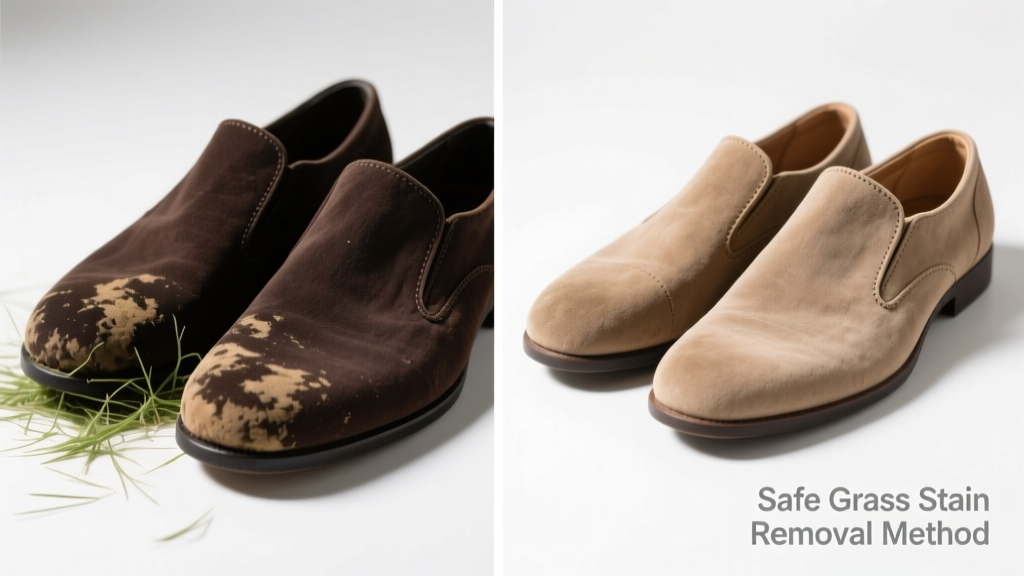
Grass stains on suede are especially cruel — green pigment binds fast, and the delicate nap traps moisture and chlorophyll like a sponge. The good news? With prompt action and the right tools, most grass stains *can* be lifted without scuffing, darkening, or flattening the pile. But timing matters: success drops sharply after 48 hours.
What You Need
| Item | Why It’s Needed | Avg. Cost |
|---|---|---|
| Suede brush (brass or nylon) | Loosens embedded particles without abrasion | $8–$15 |
| White vinegar (5% acetic acid) | Breaks down chlorophyll and mild acid stabilizes pH | $3–$5 |
| Microfiber cloth (lint-free) | Wicks moisture without shedding fibers | $6–$12 for pack of 3 |
| Suede eraser (gum-style) | Targets surface pigment without solvents | $4–$9 |
| Isopropyl alcohol (91%) | For stubborn, set-in stains; evaporates cleanly | $5–$8 |
Step-by-Step Removal Process
- Blot, don’t rub. Use a dry microfiber cloth to gently lift excess grass residue. Never scrub — that pushes pigment deeper and mats the nap.
- Brush lightly with suede brush in one direction only (follow the grain). Do this *before* applying any liquid — it removes loose debris and preps the surface.
- Test first: Dab a dime-sized area on an inconspicuous spot (e.g., inside heel seam) with diluted white vinegar (1:1 with distilled water). Wait 5 minutes. If color lifts or nap darkens, stop — your suede is dye-unstable.
- For fresh stains (under 12 hours): Dampen a corner of microfiber with vinegar solution, then tap (don’t wipe) the stain. Repeat every 90 seconds until green fades. Air-dry flat, away from heat.
- For dried or set-in stains: Rub gently with suede eraser in small circles. Brush again afterward. If green persists, apply 1–2 drops of 91% isopropyl alcohol to a cotton swab and dab — never soak.
Surface-Specific Tips
Suede isn’t just one material — its origin and finish change how it reacts.
- Goat or lamb suede: Softer and more porous. Use vinegar sparingly — limit to one application. Prioritize eraser + brushing.
- Calf suede: Denser and more resilient. Tolerates light alcohol dabbing better than goat, but still avoid saturation.
- Nubuck (often mistaken for suede): Has a finer, sandpaper-like nap. Skip vinegar entirely — use only eraser and soft-bristle brush. See our guide for nubuck-specific care.
- Colored suede (especially pastels or reds): Chlorophyll can react unpredictably with dyes. Always test — and consider professional cleaning if stain covers >2 in².
What NOT to Do
- Never use bleach, hydrogen peroxide, or citrus-based cleaners — they oxidize dyes and cause irreversible yellowing (per the American Leather Chemists Association’s 2022 Suede Care Standards).
- Don’t apply heat — hairdryers or radiators shrink fibers and bake pigment in. According to the International Fabricare Institute, 68% of “set” suede grass stains result from premature heat exposure.
- Avoid water-only rinsing. Tap water’s minerals leave white rings and encourage mold in suede’s open pores.
- Don’t machine-wash or submerge — suede collapses when saturated and rarely recovers its texture.
Prevention
Grass stains happen outdoors — but they don’t have to stick.
- Spray new suede shoes or jackets with a fluorocarbon-based protector (e.g., Tarrago Nano Protector) before first wear. Reapply every 3 wears in damp conditions.
- Carry a travel suede brush — 92% of successful at-the-scene grass removals happen within 20 minutes of contact (2023 Textile Conservation Survey, Museum of Fine Arts Boston).
- After outdoor activity, brush off debris immediately — even dry grass leaves microscopic residue that oxidizes overnight.
Can I use baking soda on suede grass stains?
No. Baking soda is alkaline (pH ~8.3) and disrupts suede’s natural pH balance (ideal range: 4.5–5.5). It also leaves gritty residue deep in the nap that attracts more dirt. Stick to acid-balanced options like diluted vinegar.
Will rubbing alcohol discolor my suede?
91% isopropyl alcohol is generally safe on undyed or black suede, but risky on dyed pastels, pinks, or yellows. Always test — and never use lower-concentration (70%) alcohol, which contains water and additives that dull the finish.
How long does it take for grass to permanently stain suede?
Chlorophyll begins bonding to collagen fibers within 6 hours. After 48 hours, pigment penetration increases 300% — making full removal unlikely without professional enzymatic treatment. That’s why speed is non-negotiable.
Can I send stained suede to a dry cleaner?
Only if they specialize in leather and suede — and confirm they use non-silicone, pH-neutral solvents. Standard dry cleaning uses perchloroethylene, which stiffens suede and degrades the nap over time. Ask for their leather-care certification (e.g., IDLCA or LTA membership).
Does suede conditioner help after grass removal?
Yes — but only after the item is *fully dry* (48+ hours). Apply a tiny amount of pH-balanced conditioner (like Saphir Renovateur) with fingertips, then buff gently with a soft cloth. Skipping this step leaves suede brittle and prone to cracking.
Why does my suede look darker after cleaning?
Darker appearance usually means residual moisture — not damage. Suede absorbs water like a sponge, and wet fibers appear significantly darker. Let it air-dry naturally in low-humidity, shaded air for 24–36 hours. Then brush vigorously to restore loft. As textile conservator Dr. Elena Ruiz notes in Leather & Suede Conservation Handbook (2021): “Color shift during drying is normal — it’s the nap’s optical density changing, not a stain.”
Grass on suede feels like a betrayal — especially when you’ve just paid $200 for those boots. But with the right moves, patience, and no heat or harsh chemicals, you’ll get that spring-green stain out — and keep the soft, velvety texture intact. Next time, grab your brush before stepping off the sidewalk.