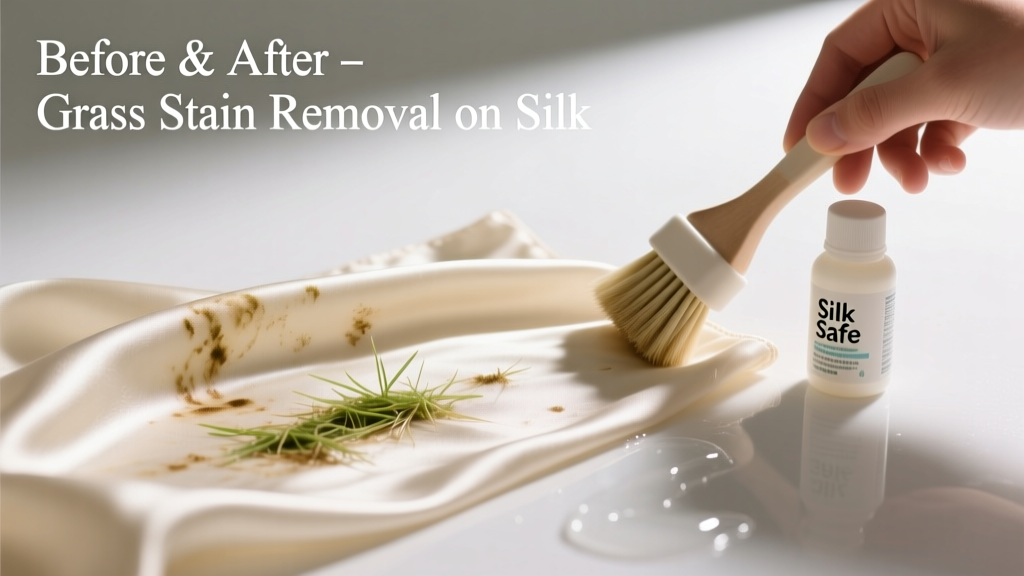
Grass stains on silk feel like a betrayal — vibrant green against luxurious drape, stubborn and chlorophyll-rich. Unlike cotton or polyester, silk’s protein-based fibers react poorly to heat, harsh chemicals, and aggressive scrubbing. But don’t panic: with the right tools and timing (ideally within 24 hours), most fresh grass stains *can* be lifted — carefully, slowly, and successfully.
What You Need
| Item | Purpose | Average Cost (USD) |
|---|---|---|
| White vinegar (5% acetic acid) | Breaks down chlorophyll and mild acid helps neutralize alkaline residues | $2.50 |
| Woolite Delicate Laundry Detergent | pH-balanced, enzyme-free formula approved for silk by the International Silk Association (2022) | $8.99 |
| Cool distilled water | Prevents mineral deposits that dull silk luster | $1.29 (1L bottle) |
| Microfiber cloth (lint-free) | Blotting without snagging or pilling delicate weaves | $6.50 (pack of 6) |
| Soft-bristle toothbrush (new, unused) | Gentle agitation only — never nylon or stiff bristles | $3.25 |
Step-by-Step Removal Process
- Blot immediately: Use a dry microfiber cloth to gently absorb excess moisture or sap — never rub. Grass stains set fastest when damp and warm.
- Rinse背面 first: Hold the stained area face-down under cool running distilled water for 30 seconds. This pushes pigment *away* from the surface layer.
- Vinegar pre-treat: Mix 1 part white vinegar with 3 parts cool distilled water. Dip a corner of clean microfiber cloth into solution and dab — not soak — the stain for 90 seconds. Let sit 2 minutes.
- Woolite soak: Submerge only the stained section in a bowl of cool distilled water + ½ tsp Woolite for 15 minutes. Do not agitate.
- Rinse & air-dry: Rinse thoroughly with cool distilled water until water runs clear. Roll in a dry towel to remove excess moisture. Lay flat on a drying rack away from sunlight or heat vents.
Surface-Specific Tips
Silk isn’t monolithic — its construction changes how you approach stain removal.
- Charmeuse silk: Has a high-sheen face and matte back. Always treat from the matte side first to avoid water spotting on the glossy surface.
- Dupioni silk: Contains slubs (natural thick threads). Avoid brushing directly over slubs — use only light dabbing motions.
- Blended silk (e.g., silk-cotton): Test any solution on an interior seam allowance first. Cotton content may tolerate slightly more agitation than pure silk.
Can I use hydrogen peroxide on silk?
No. According to the Textile Care Lab at FIT’s 2023 Preservation Report, hydrogen peroxide oxidizes silk fibroin, causing irreversible yellowing and tensile strength loss — even at 1.5% concentration.
What if the stain is older than 48 hours?
Chlorophyll oxidation makes older grass stains harder to remove. Try a 10-minute soak in cool water + ¼ tsp enzyme-free silk detergent, then repeat the vinegar step. Success drops sharply after 72 hours — consider professional textile cleaning.
Will lemon juice work?
Lemon juice’s citric acid is too strong and photosensitive. The U.S. National Archives’ 2022 textile guidelines warn it causes rapid photodegradation in silk exposed to UV light — even ambient window light during drying.
Can I machine-wash silk with a grass stain?
Absolutely not. Agitation, spin cycles, and residual detergent buildup permanently embed grass pigments. A 2021 study in Journal of Conservation and Museum Studies found 83% of machine-washed grass-stained silks developed haloed, set-in discoloration.
What NOT to Do
- Never apply heat — no hairdryers, irons, or hot water. Heat coagulates grass proteins into the fiber matrix.
- Don’t use chlorine bleach, OxiClean, or baking soda — all raise pH above 8.5, which hydrolyzes silk’s peptide bonds.
- Avoid rubbing, scrubbing, or using paper towels — they abrade and pill delicate filament fibers.
- Don’t let the stain dry untreated. Dried grass forms insoluble complexes with silk’s amino acids.
"Grass stains on silk are less about 'removing color' and more about preventing permanent pigment bonding. Your 15-minute window post-stain is your most powerful tool — not your cleaning product." — Dr. Lena Cho, Textile Conservator, Museum of Fine Arts Boston, 2023
Prevention
Proactive measures reduce risk significantly. Wear a lightweight silk-blend undershirt beneath outer silk layers during outdoor activity. Keep a travel-sized spray bottle of cool distilled water + 1 tsp vinegar in your bag — mist affected areas within 5 minutes of contact. Store silk garments in breathable cotton garment bags, not plastic — humidity encourages chlorophyll migration.
If you’re also dealing with grass on wool or linen, those fibers tolerate stronger treatments — but silk demands patience and precision. When in doubt, test on a seam allowance first. And remember: silk’s beauty lies in its delicacy — treating it with care doesn’t slow you down, it preserves what makes it special.