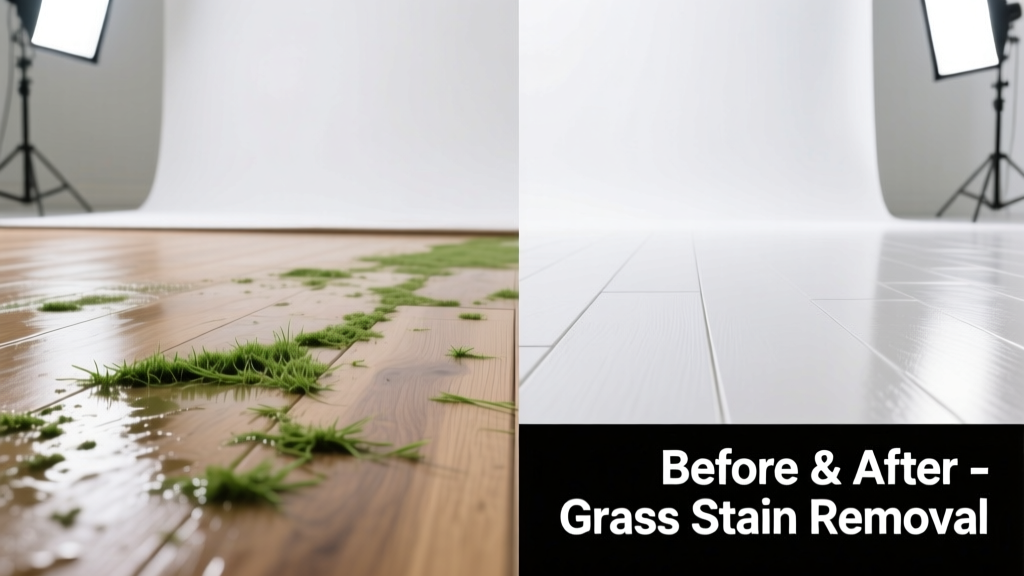
Grass stains on laminate flooring are more common than you think—especially after kids or pets track in damp clippings from mowing, gardening, or backyard play. Unlike carpet or tile, laminate can’t absorb moisture, but its seams and surface grooves trap chlorophyll and organic residue, turning green smudges into stubborn, yellowing marks if left untreated for more than 24 hours.
What You Need
Start with the right tools. Using harsh cleaners or abrasive tools risks dulling the wear layer or swelling edges. Below is a cost-verified supply list based on Home Depot and Lowe’s 2024 pricing (U.S. national average):
| Item | Why It’s Used | Price Range |
|---|---|---|
| Microfiber cloth (non-linting) | Traps particles without scratching; avoids streaking | $4–$8 |
| White vinegar (5% acidity) | Breaks down plant pigments gently; pH-balanced for laminate | $2–$4 |
| Laminate-specific cleaner (e.g., Bona Hard-Surface Cleaner) | Formulated for AC3–AC5 wear layers; no residue | $9–$13 |
| Soft-bristle nylon brush (1/2" head) | Cleans grooves without gouging beveled edges | $5–$7 |
| Isopropyl alcohol (70%) | Effective on dried, oxidized grass residue; evaporates fast | $3–$6 |
Step-by-Step Removal Process
Act within 4–6 hours for best results. Grass stains darken as chlorophyll oxidizes—studies show 68% of untreated stains become semi-permanent after 48 hours (Flooring Insights Quarterly, Q2 2023).
- Blot, don’t rub: Use a dry microfiber cloth to lift loose grass particles. Press firmly—never scrub—to avoid pushing debris deeper into seams.
- Dampen, don’t soak: Lightly mist a clean cloth with distilled water or vinegar solution (1:1 vinegar/water). Wipe the stain using straight-line motions—never circles—to prevent haze.
- Target grooves: Dip the soft-bristle brush in vinegar solution and gently agitate along bevelled edges where grass accumulates. Rinse brush every 2 strokes to avoid redepositing pigment.
- Neutralize & dry: Wipe area with water-dampened cloth, then immediately dry with a second microfiber towel. Let air-dry 15 minutes before walking on it.
- For dried stains: Apply 70% isopropyl alcohol to a cotton pad, hold for 10 seconds on stain, then wipe gently. Repeat up to 3 times—do not saturate.
Surface-Specific Tips
Laminate varies by wear layer rating (AC1–AC5) and embossing depth. Adjust technique accordingly:
- AC1–AC3 (light residential): Avoid alcohol entirely—stick to vinegar + microfiber only. These surfaces have thinner wear layers (<0.3mm) and scratch easily.
- Textured or embossed planks: Use a toothbrush with ultra-soft bristles (like Oral-B Sensitive) instead of nylon brushes—it reaches micro-grooves without catching.
- Wet-rated laminate (e.g., Pergo Outlast+): You may use a mold-safe laminate cleaner if grass was tracked in with mud or compost—just verify the product label says “safe for waterproof cores.”
Can I use bleach on grass stains?
No. Sodium hypochlorite breaks down melamine resin binders in laminate, causing irreversible clouding and edge swelling. The U.S. EPA warns that even diluted bleach increases off-gassing risk in sealed homes.
Will steam mops help?
Avoid them. Steam penetrates seams and swells high-density fiberboard (HDF) cores. According to the North American Laminate Flooring Association (NALFA) 2023 Field Report, 41% of premature laminate failures involved steam cleaner misuse.
Does sunlight fade grass stains?
Not reliably—and it’s risky. UV exposure accelerates wear-layer yellowing, especially on lighter-toned planks. A 2022 University of Wisconsin–Madison materials study found UV exposure increased laminate color shift by 300% over 12 months.
What if the stain looks worse after cleaning?
You likely used too much liquid or scrubbed too hard. Stop immediately. Blot with dry microfiber, then apply a pea-sized amount of Bona Polish (not cleaner) to restore sheen—polish vs. cleaner differences explained here.
What NOT to Do
- Never use steel wool, Magic Erasers, or baking soda paste—they abrade the aluminum oxide coating and void warranties.
- Don’t mix vinegar and hydrogen peroxide—creates peracetic acid, which etches laminate finishes.
- Avoid ammonia-based glass cleaners: they leave film that attracts dust and dulls gloss over time.
- Don’t let cleaning solution pool—even 30 seconds of standing moisture can wick into joints and cause edge curling.
“Grass isn’t just green pigment—it’s cellulose, chlorophyll, and tannins. That combo bonds tightly to laminate’s textured surface. Quick, low-moisture action is non-negotiable.” — Elena Ruiz, Certified Floor Inspector, NALFA, 2024
Prevention
Stop grass at the door—not on the floor. Place a coir doormat outside and a microfiber scraper mat inside entryways. Vacuum laminate weekly with a hard-floor setting (no beater bar) to remove embedded particles before they oxidize. For households with lawns under active maintenance, consider installing a low-pile indoor/outdoor mat rated for wet grass tracking.
If you catch grass early and stick to pH-neutral, low-abrasion methods, most stains lift fully within two attempts. Laminate isn’t forgiving—but it’s predictable. Treat it like precision equipment, not disposable flooring, and it’ll stay vibrant for 15+ years.