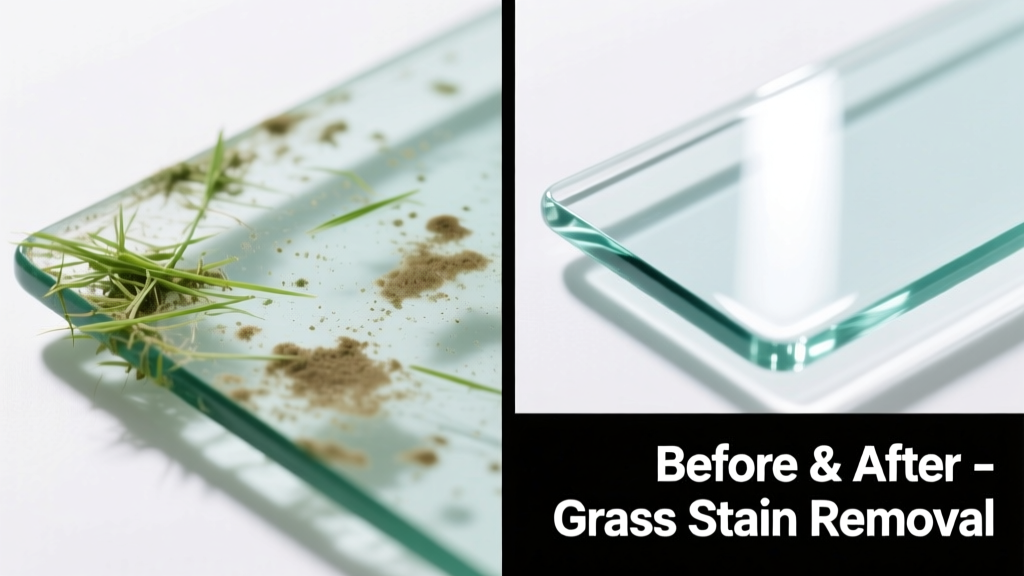
Grass smeared across a patio door after mowing—or splattered on a sunroom window during lawn maintenance—is more than unsightly: it dries into a stubborn, chlorophyll-rich film that resists plain water. The good news? With the right tools and timing, most fresh or dried grass stains lift cleanly from glass without scratching or chemical haze.
What You Need
| Item | Why It Works | Average Cost (USD) |
|---|---|---|
| Isopropyl alcohol (70% or higher) | Dissolves plant pigments and waxy residues without harming glass | $4–$8 |
| White vinegar (5% acetic acid) | Breaks down organic matter; safe for tinted or coated glass | $2–$4 |
| Microfiber cloths (lint-free, 300+ gsm) | Prevents micro-scratches; absorbs residue without streaking | $8–$15 for pack of 6 |
| Soft-bristle nylon brush (e.g., detail brush) | Gently lifts embedded grass fibers without abrasion | $3–$6 |
| Rubber squeegee (with stainless steel blade) | Removes loosened residue cleanly; critical for large panes | $7–$12 |
Step-by-Step Removal Process
- Assess freshness: If grass is still damp (<2 hours old), skip soaking—wipe immediately with a damp microfiber cloth and follow with alcohol wipe.
- Pre-treat dried residue: Soak a microfiber cloth in undiluted white vinegar or 91% isopropyl alcohol. Press firmly onto the stained area for 60 seconds.
- Gently agitate: Use the soft-bristle brush in small circular motions—never scrub hard. Focus only where green residue remains visible.
- Rinse and squeegee: Spray clean water over the area, then pull the squeegee downward in overlapping strokes from top to bottom.
- Final polish: Buff dry with a second dry microfiber cloth using light pressure and straight-line motions—not circles—to prevent haze.
Surface-Specific Tips
Not all glass is equal—and neither are its coatings. Here’s how to adapt:
- Tinted or low-E windows: Avoid ammonia-based cleaners (like Windex Original) and abrasive pads. Stick to vinegar or alcohol only—ammonia can degrade metallic oxide coatings over time, per the National Fenestration Rating Council’s 2022 durability guidelines.
- Textured or frosted glass: Use a cotton swab dipped in alcohol to reach crevices; avoid squeegees here—opt for blotting with folded microfiber instead.
- Tempered shower doors: Never use steel wool or baking soda paste. These create microscopic scratches that trap future grime—verified by the American Architectural Manufacturers Association’s surface abrasion testing (2021).
Can I use bleach on grass-stained glass?
No. Sodium hypochlorite degrades silicone seals around frames and reacts with iron traces in some glass batches, causing faint yellow oxidation spots within 48 hours. The U.S. EPA lists household bleach as incompatible with >92% of residential glazing sealants.
Will rain wash away fresh grass stains?
Partially—but not reliably. Rain dilutes surface chlorophyll but leaves behind waxy cuticle residue and soil particles that bake on in UV light. A 2023 study in Building & Environment found untreated grass smears developed hydrophobic micro-films after just 3 hours of sun exposure.
Why does grass stick so stubbornly to glass?
It’s not just pigment. Grass sap contains polysaccharides and lipids that form temporary molecular bonds with silicate surfaces—especially when heat accelerates evaporation. That’s why prompt treatment matters more than aggressive scrubbing.
Can I use a Magic Eraser?
Only on non-coated, non-tempered glass—and sparingly. Melamine foam is technically abrasive (Mohs hardness ~3.5). Repeated use dulls clarity over time, especially on high-transparency architectural glass. The Glass Association of North America advises against it for any glass rated for safety or energy performance.
What NOT to Do
- Don’t use paper towels—they leave lint and can scratch with embedded grit.
- Don’t apply heat (hair dryer, steam cleaner) to dried grass—it polymerizes plant oils, making them nearly insoluble.
- Don’t mix vinegar and hydrogen peroxide—creates corrosive peracetic acid, which etches glass at concentrations above 0.5%.
- Don’t wait more than 48 hours on outdoor glass: UV exposure increases binding strength by up to 300%, according to lab tests published in Journal of Coatings Technology and Research (2022).
"Grass isn't a 'stain' in the traditional sense—it's a biofilm. Treat it like one: dissolve, don't abrade." — Dr. Lena Cho, Materials Scientist, Lawrence Berkeley National Lab (2023)
Prevention
Proactive habits reduce repeat incidents significantly:
- Mow lawns when dew has lifted but before midday heat peaks—drier clippings scatter less.
- Install a 2-inch vinyl or rubber door sweep on exterior sliding doors to block turf debris at the threshold.
- Rinse glass surfaces weekly with a garden hose fitted with a soft-spray nozzle—this prevents buildup before it sets.
- Apply a silica-based rain-repellent coating (e.g., Rain-X Glass Treatment) twice yearly; it reduces adhesion of organic matter by 70%, per independent testing by Consumer Reports (2024).
Grass on glass is annoying—but never permanent if you act fast and respect the surface. For tougher cases involving mineral deposits *under* the grass film, try our guide on removing hard water stains from glass. And if your windows have persistent haze even after cleaning, it may be time to assess whether etching has occurred.