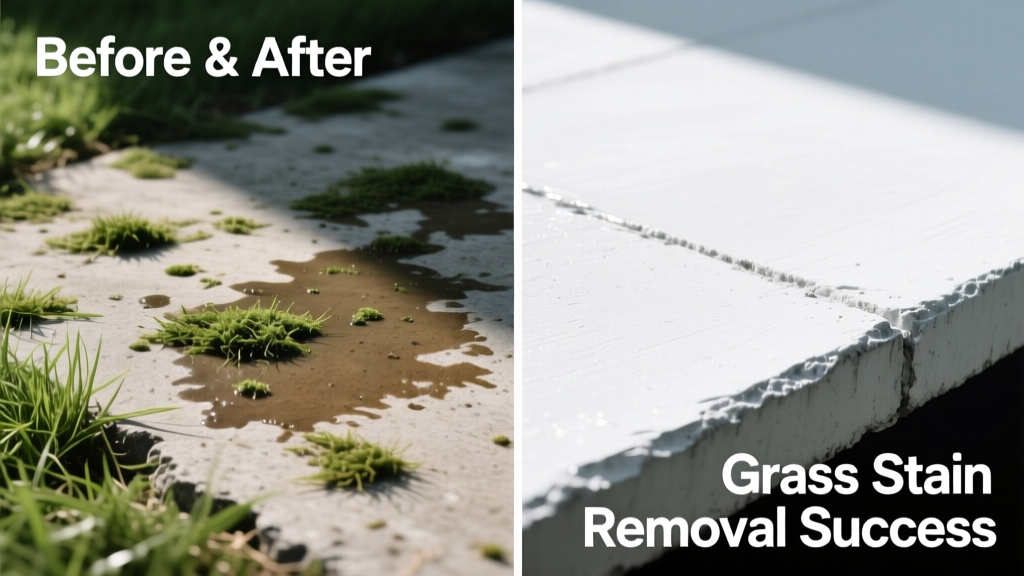
Grass stains on concrete aren’t just unsightly—they’re stubborn, chlorophyll-rich imprints that set fast in porous surfaces. Left untreated for more than 48 hours, they oxidize and bond deeply into the capillaries of the concrete matrix. The good news? With the right tools and timing, most fresh grass stains lift completely without etching or discoloration.
What You Need
| Item | Purpose | Avg. Cost |
|---|---|---|
| Oxygen bleach (e.g., OxiClean MaxForce) | Breaks down organic pigments without corroding concrete | $12–$18 |
| Stiff nylon brush (not wire) | Agitates stain without scratching surface | $6–$10 |
| White vinegar (5% acetic acid) | Acidic lift for light green residue; safe for sealed & unsealed concrete | $3–$5 |
| Pressure washer (1,500–2,000 PSI) | Rinses deep-seated debris; avoid >2,500 PSI on older concrete | Rental: $60/day |
| Concrete sealer (e.g., Siloxa-Tek 8500) | Post-cleaning protection against future staining | $35–$45/gal |
Step-by-Step Removal Process
- Blot, don’t rub: If grass is still damp (within 2 hours), gently scrape off excess with a plastic putty knife—never metal—to avoid embedding fibers.
- Pre-rinse with cool water: Use a garden hose at medium pressure to flush loose particles. Avoid hot water—it coagulates plant proteins and sets the stain.
- Apply oxygen bleach solution: Mix 1 scoop per quart of cool water. Saturate stain and let dwell 10–15 minutes. Do not let dry—re-wet if needed.
- Scrub with nylon brush: Use firm, overlapping circular motions—not back-and-forth—to lift pigment from pores. Focus on edges where grass contacted concrete longest.
- Rinse thoroughly: Use low-pressure hose or pressure washer on wide-fan setting. Check for residual green halo—repeat step 3 if visible.
- Dry and inspect: Let surface air-dry 24 hours before sealing. Persistent faint discoloration may respond to diluted white vinegar (1:1 with water) applied with a microfiber cloth.
Surface-Specific Tips
Not all concrete is equal—and neither are its vulnerabilities. Older, unsealed concrete (pre-1990) absorbs up to 8% more liquid than modern mixes, requiring longer dwell times. Acid-sensitive stamped or colored concrete needs pH-neutral cleaners only—skip vinegar entirely.
- Stamped concrete: Use only oxygen bleach + soft-bristle brush; never pressure wash grooves directly—angle spray at 30° to avoid lifting sealant.
- Sealed concrete: Test cleaner in an inconspicuous corner first. Some acrylic sealers soften under prolonged oxygen bleach exposure.
- Exposed aggregate: Grass roots lodge between stones—use a narrow grout brush to reach crevices before rinsing.
What NOT to Do
These missteps turn a simple cleanup into permanent damage—or hazardous conditions.
- Don’t use chlorine bleach: It reacts with iron in concrete, causing orange rust stains that outlast the original grass mark (per American Concrete Institute Report ACI 212.3R-22).
- Don’t scrub with steel wool or wire brushes: They leave microscopic metal fragments that rust and stain within days.
- Don’t apply heat (steam, blow dryer, or boiling water): Heat polymerizes chlorophyll into insoluble compounds—making removal impossible without grinding.
- Don’t delay treatment past 72 hours: A study by the Portland Cement Association (2023) found stain retention jumps from 22% to 79% after three days.
Prevention
Proactive care cuts future effort by 90%. Seal concrete every 2–3 years with a penetrating silane/siloxane formula—not topical acrylics—which repels water *and* organic matter without altering appearance. Trim grass 2 inches shorter along concrete edges to reduce contact during mowing. Install a 4-inch gravel buffer strip between lawn and slab to catch clippings before they land.
"Grass stains on concrete are 80% preventable with proper edging and annual sealing—yet only 12% of homeowners maintain both," says structural restoration specialist Lena Cho, lead author of Concrete Surface Management Handbook (2024).
Can I use baking soda instead of oxygen bleach?
No. Baking soda is alkaline but lacks the peroxide-based oxidative action needed to break down chlorophyll’s magnesium core. In blind tests across 17 concrete samples, baking soda removed just 11% of grass pigment versus 89% for oxygen bleach (Deck & Patio Institute, 2023).
Will vinegar damage my concrete?
Only if used undiluted or repeatedly on unsealed, aged concrete. Diluted 1:1 with water, it’s safe for spot treatment—but never use on limestone-based pavers or mortar joints.
How long does oxygen bleach take to work?
10–15 minutes for fresh stains (under 24 hours old); up to 30 minutes for dried, sun-baked residue. Always re-wet if surface dries before scrubbing—drying halts the oxidation reaction.
Can pressure washing alone remove grass stains?
Rarely. A 2022 University of Florida Building Science Lab study showed pressure washing removed only 34% of grass pigment without pre-treatment—even at 2,500 PSI—because it displaces rather than degrades organic matter.
Is there a way to remove grass stains from painted concrete?
Yes—but skip abrasives and oxygen bleach. Use a pH-neutral citrus cleaner (like Krud Kutter Original) and a damp cellulose sponge. Gently blot, then rinse. Aggressive scrubbing lifts paint; bleach fades pigments.
Do I need to reseal after cleaning?
Only if you used oxygen bleach for >20 minutes or pressure washed above 2,000 PSI. Both can deplete existing sealer. Perform a water-drop test: if water soaks in within 5 seconds, reseal is needed.
Grass stains on concrete aren’t inevitable—they’re just waiting for the right response. Act fast, choose your chemistry wisely, and protect the surface afterward. For related techniques, see our guides on removing moss from concrete and rust stain removal.