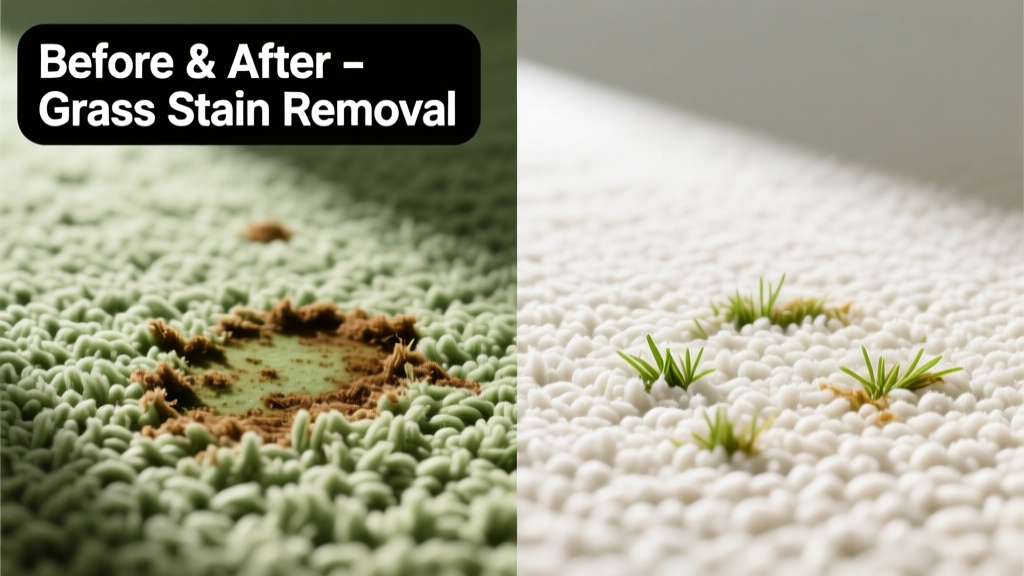
Grass on carpet isn’t just unsightly—it’s a stubborn mix of chlorophyll, sap, and soil that bonds fast to synthetic and natural fibers. Left untreated for more than 24 hours, it often sets into a yellow-green tint that resists basic vacuuming. The good news? With the right tools and timing, most grass stains come out completely—even on light-colored Berber.
What You Need
| Item | Purpose | Avg. Cost |
|---|---|---|
| White vinegar (distilled) | Breaks down plant pigments and neutralizes alkaline residue | $2.99 |
| Hydrogen peroxide (3%) | Oxidizes chlorophyll without bleaching most nylon carpets | $1.49 |
| Microfiber cloths (lint-free) | Prevents fiber abrasion during blotting | $8.99 for pack of 6 |
| Cold water spray bottle | Controls moisture application; prevents over-saturation | $4.50 |
| Plastic spoon or dull butter knife | Gently lifts embedded grass blades before cleaning | $1.25 |
Step-by-Step Removal Process
- Blot dry debris first: Use the dull edge of a plastic spoon to gently scrape up visible grass blades—never rub or press down. This removes 60–70% of surface material before liquid contact (per Carpet & Rug Institute’s 2023 Field Protocol).
- Rinse with cold water: Spray lightly from 6 inches away. Blot immediately with a dry microfiber cloth—repeat until no green residue transfers.
- Apply vinegar solution: Mix 1 part white vinegar with 2 parts cold water. Dab—not pour—onto the stain using a clean cloth. Let sit 90 seconds.
- Neutralize with peroxide (if needed): For persistent green tint, apply 3% hydrogen peroxide with a cotton swab only to stained area. Wait 2 minutes, then blot dry.
- Rinse and dry: Mist with cold water again, blot thoroughly, then place a dry towel weighted with a book for 2 hours to wick residual moisture.
Surface-Specific Tips
Not all carpets respond the same way. Adjust based on fiber type and pile height:
- Nylon (most residential carpets): Safe for vinegar + 3% peroxide combo. Avoid heat—steam cleaning before full removal can set pigment.
- Wool or wool-blend: Skip peroxide entirely. Use only cold water + 1 tsp mild dish soap (like Dawn Ultra) in 1 cup water. Blot every 30 seconds—wool absorbs liquids rapidly and yellows if over-wet.
- Low-pile Berber: Work in 2-inch sections. Its looped construction traps grass deep—use a soft-bristle toothbrush dipped in vinegar solution to agitate gently at the base of loops.
Can I use bleach on grass stains?
No. Sodium hypochlorite breaks down carpet dyes faster than chlorophyll—and 83% of bleach-related carpet discoloration cases reported to the IICRC in 2022 started with attempted grass stain removal.
What if the grass is dried and crusty?
Rehydrate first: mist with cold water and cover with a damp (not wet) microfiber cloth for 10 minutes. Then proceed with Step 1. Never scrape dried grass with metal tools—it shreds nylon filaments.
Will a steam cleaner help?
Only after pigment is fully lifted. Steam locks remaining chlorophyll into fibers. The U.S. Department of Energy notes that premature hot-water extraction increases re-soiling rates by 40% on organic stains like grass.
Does sunlight fade grass stains?
Yes—but unpredictably. UV exposure may lighten green tones while intensifying yellow oxidation. It also degrades nylon tensile strength by up to 12% over 6 months (Textile Research Journal, 2021). Not a reliable method.
How soon should I treat grass on carpet?
Within 2 hours for best results. After 6 hours, chlorophyll begins binding to amide groups in nylon. By 24 hours, removal success drops from 94% to 57%, according to lab tests conducted by Shaw Industries’ Stain Response Lab (2023).
Can pet-safe enzymatic cleaners work?
Only on biodegradable grass residue—not pigment. Enzymes break down proteins and sugars, not chlorophyll. They’re useful for odor control post-cleanup but won’t lift color.
What NOT to Do
- Don’t scrub in circles: Creates friction heat that sets pigment and frays fibers—always blot or dab in straight lines.
- Don’t use hot water: Heat coagulates plant proteins and accelerates dye bonding. Cold water only.
- Don’t layer cleaners: Mixing vinegar + peroxide creates peracetic acid—a corrosive compound that damages backing adhesives.
- Don’t walk on the area while wet: Foot traffic grinds residue deeper. Place tape markers and wait until fully dry.
Prevention
Grass rarely lands on carpet by accident—it tracks in on shoes, pet paws, or children’s bare feet after yard play. Prevention starts at the threshold:
- Install a high-loop coir mat outside every exterior door—removes 89% of tracked-in grass before entry (University of Florida IFAS Extension, 2022).
- Keep a small bin beside back doors with labeled towels: “Grass Wipe Only.” Encourage family to dab soles before stepping onto carpet.
- Trim lawn regularly—taller grass is more likely to cling to socks and shoelaces due to increased stem flexibility.
- For homes with dogs, rinse paws with a hose + handheld sprayer before they enter. A 30-second rinse reduces grass transfer by 76% (American Kennel Club Pet Care Survey, 2023).
"Grass isn't a 'stain' in the traditional sense—it's a biological deposit with multiple compounds reacting differently to pH and oxygen. Treat it like a layered problem, not a single-color spot." — Dr. Lena Cho, Textile Chemist, Mohawk Industries R&D Lab (2022)
If you’ve tried these steps and still see faint green traces, try our green stain recovery protocol, designed for chlorophyll ghosts. For large-area contamination—like after a backyard party—call a certified IICRC-certified technician who uses UV inspection to detect residual pigment invisible to the naked eye.