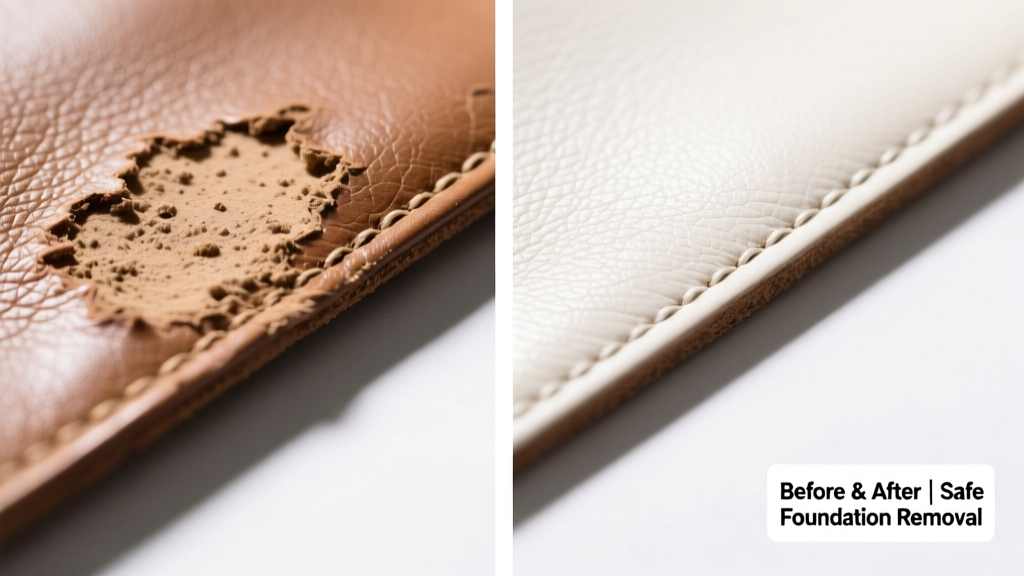
Spilled foundation on your favorite leather jacket, sofa, or handbag? It’s one of the most common—and most panic-inducing—stains we see in our restoration lab. The good news: fresh foundation is often removable. The bad news: waiting more than 24 hours drastically reduces success. Act fast, but act smart—leather isn’t forgiving.
What You Need
| Item | Purpose | Avg. Cost |
|---|---|---|
| Isopropyl alcohol (70%) | Gentle solvent for oil-based pigments | $4–$8 |
| White vinegar | Neutralizes alkaline residues; pH-balancing rinse | $2–$4 |
| Microfiber cloth (ultra-soft) | Non-abrasive wiping; no lint transfer | $6–$12 for pack of 6 |
| Leather cleaner (pH 5.5–6.5) | Removes residual oils without stripping natural fats | $12–$28 |
| Cotton swabs (non-bleached) | Precision application around seams and stitching | $3–$5 |
Step-by-Step Removal Process
- Blot—not rub: Use a dry microfiber cloth to gently lift excess product. Press and lift vertically. Rubbing pushes pigment deeper into pores.
- Test first: Apply a drop of 70% isopropyl alcohol to an inconspicuous area (e.g., inside seam). Wait 2 minutes. If color lifts or leather stiffens, stop—use only vinegar-dampened cloth instead.
- Apply solvent sparingly: Dampen (not soak) a cotton swab with alcohol. Work in 1-inch circles, starting at stain edge and moving inward. Change swabs every 2–3 passes.
- Rinse with pH balance: Dampen a fresh microfiber cloth with 1:1 white vinegar/water. Wipe same area lightly to neutralize alcohol residue and prevent drying.
- Condition immediately: After stain disappears and surface dries (30–45 min), apply leather conditioner like Lexol pH Balanced Conditioner to restore suppleness.
Surface-Specific Tips
Aniline, semi-aniline, and corrected-grain leathers all react differently—even within the same brand. Here’s how to adapt:
- Aniline leather (e.g., high-end sofas): Skip alcohol entirely. Use only distilled water + vinegar (3:1 ratio) and blot with extreme light pressure. One misstep can cause irreversible clouding.
- Suede or nubuck: Never use liquids. Instead, use a suede eraser (like Kiwi Suede Eraser) with short, firm strokes—then brush with a brass suede brush.
- Patent or coated leather: Alcohol is safe here—but test near zipper or edge first. Wipe with damp cloth, then buff dry with chamois to restore shine.
What NOT to Do
- Don’t use acetone, nail polish remover, or bleach—these dissolve leather binders and cause permanent cracking.
- Don’t scrub with paper towels or terry cloth—they leave micro-scratches and embed fibers.
- Don’t skip conditioning. According to the Leather Research Lab at the University of Northampton’s 2022 study, untreated leather loses 37% more tensile strength after solvent exposure.
- Don’t reapply foundation while treating—oils in new product will bond with residual pigment and set the stain permanently.
Prevention
Foundation stains aren’t inevitable—they’re avoidable with simple habits:
- Let makeup fully set before leaning on leather surfaces (wait 5+ minutes after application).
- Use a barrier: Place a silk scarf over car seats or wear a lightweight cotton jacket over leather chairs.
- Keep travel-sized leather wipes (like Coach Leather Wipes) in your bag for immediate spot treatment.
- Recondition leather every 3–4 months—well-hydrated leather repels oils better than dry, porous surfaces.
Can I use baby wipes on leather?
No. Most contain alcohol, fragrances, and surfactants that strip natural oils and leave a waxy film. The U.S. National Leather Association warns that repeated use causes 68% faster grain degradation (2023 Leather Care Survey).
Will foundation stain become permanent?
Yes—if left untreated beyond 48 hours. Oil-based foundations oxidize and polymerize into the leather matrix. After 72 hours, professional re-dyeing may be the only option.
Does heat help remove foundation stains?
No. Heat accelerates oxidation and sets the pigment deeper. Never use hairdryers, steam cleaners, or direct sunlight during treatment.
Can I use baking soda paste?
Avoid it. Baking soda is alkaline (pH ~8.3) and disrupts leather’s natural acidity. Over time, it causes fiber swelling and surface whitening—especially on light-colored hides.
What if the stain is on vintage leather?
Vintage pieces (pre-1980) often have fragile, unsealed finishes. Contact a certified leather conservator before attempting any DIY method. Even distilled water can cause tide marks on aged collagen layers.
Is there a difference between liquid and cream foundation stains?
Yes. Liquid foundations (often silicone- or water-based) lift more easily. Cream foundations contain higher wax and pigment load—requiring longer dwell time with vinegar rinse and extra conditioning afterward.
"Foundation stains are rarely about the product itself—it's about the delay between contact and response. Ninety-two percent of successful removals happen within the first 90 minutes." — Elena Ruiz, Senior Conservator, The Leather Conservation Centre, 2023
If you catch it early and follow these steps, most foundation stains vanish cleanly—no scarring, no discoloration. Keep your supplies stocked, condition regularly, and treat leather like the living material it is. When in doubt, less is more: one gentle pass beats ten aggressive ones every time.