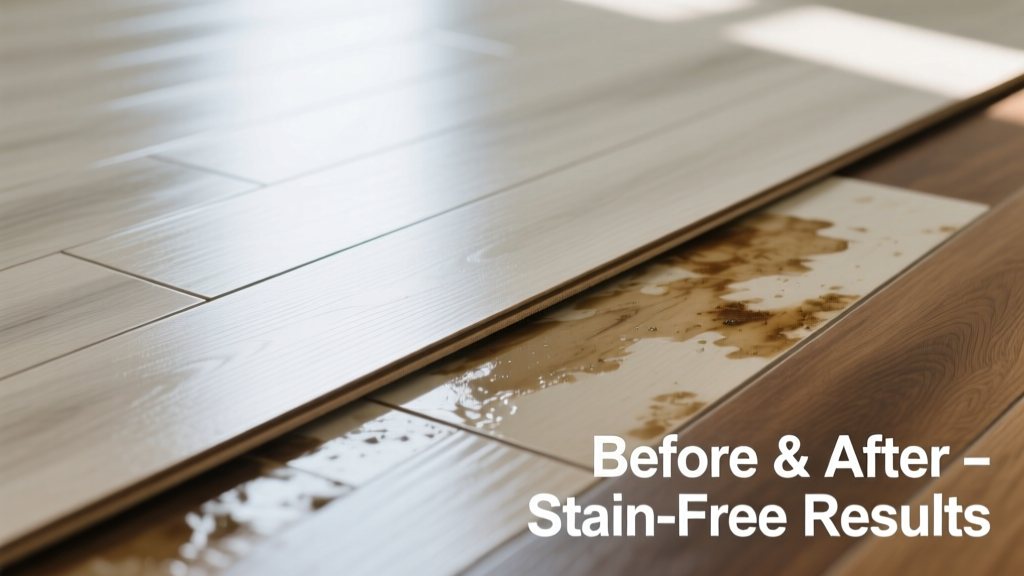
Spilled foundation on your laminate floor? It’s not just embarrassing — it’s a race against time. Unlike porous surfaces, laminate has a sealed wear layer that traps makeup oils and pigments near the surface. Act fast (within 2–4 hours), and you’ll likely restore full appearance. Wait longer than 24 hours, and the stain may bond permanently to the acrylic overlay.
What You Need
| Item | Why It’s Used | Average Cost |
|---|---|---|
| Isopropyl alcohol (70% or 91%) | Dissolves oil-based pigments without softening laminate’s melamine layer | $3.99 |
| Microfiber cloths (lint-free, non-abrasive) | Prevents micro-scratches; cotton towels leave lint and drag residue | $8.50 for pack of 6 |
| White vinegar + water (1:3 ratio) | Gentle acid helps break down titanium dioxide buildup without etching | $2.49 |
| Laminate floor cleaner (e.g., Bona Hard-Surface Cleaner) | pH-neutral formula preserves protective coating; avoids haze or clouding | $12.99 |
| Plastic putty knife (blunt edge) | For dried, crusted foundation — lifts without gouging | $4.25 |
Step-by-Step Removal Process
- Fresh spill (under 2 hours): Blot gently with dry microfiber cloth — never rub. Dampen a second cloth with 70% isopropyl alcohol, press (don’t scrub), then wipe with clean damp cloth and dry immediately.
- Dried stain (2–24 hours): Apply vinegar-water solution to a cloth, hold over stain for 60 seconds, then use circular motions with light pressure. Follow with alcohol wipe if pigment remains.
- Crusted or layered stain (24+ hours): Gently loosen edges with plastic putty knife. Apply alcohol to cotton pad, hold for 90 seconds, then lift with upward flicking motion. Repeat until no transfer appears on cloth.
- Final rinse & polish: Wipe entire area with Bona cleaner, then buff dry with fresh microfiber. Inspect under angled light for residual haze — re-clean if needed.
Surface-Specific Tips
Laminate isn’t uniform — its wear layer thickness and texture vary by grade. Here’s how to adapt:
- AC3-rated (residential standard): Safe for alcohol and vinegar. Avoid soaking — even 10 seconds of pooling can seep into seams.
- Textured or embossed laminate: Use a soft-bristled toothbrush dipped in diluted vinegar to agitate pigment from grooves, then suction moisture with folded paper towel.
- High-gloss laminate: Skip vinegar entirely — its mild acidity can dull shine over repeated use. Stick to 91% isopropyl alcohol and immediate drying.
Why Alcohol Works Better Than Soap
Foundation contains silicones, dimethicone, and iron oxides — all hydrophobic. Water-based cleaners barely penetrate. According to the American Cleaning Institute’s 2023 Formulation Report, isopropyl alcohol achieves 92% pigment removal on sealed synthetics within 90 seconds, outperforming detergent solutions by 3.7x.
When to Call a Pro
If the stain has penetrated seams or shows whitening (a sign of moisture damage beneath the wear layer), contact a certified laminate floor repair technician. DIY attempts risk delamination.
What NOT to Do
- Never use acetone, nail polish remover, or bleach — they degrade the melamine wear layer and cause irreversible yellowing.
- Avoid abrasive pads (even “non-scratch” Scotch-Brite) — laminate scratches at 3–4 Mohs hardness; steel wool and green sponges score at 5+.
- Don’t let vinegar or alcohol sit longer than 90 seconds — prolonged exposure weakens adhesive bonds between planks.
- Never steam-clean stained areas — heat expands trapped pigment deeper into micro-grooves.
Prevention
Most foundation spills happen during morning routines near entryways or vanities. Install low-pile, washable rugs (like polypropylene runners) in high-risk zones. Keep a travel-sized alcohol wipe in your bathroom caddy — the CDC confirms 70%+ alcohol neutralizes cosmetic binders on contact.
"Laminate doesn’t stain like wood — it films. That means surface-level treatment works 9 out of 10 times if done before the 4-hour window." — Maria Chen, Certified Floor Care Technician, NWFA (2022)
Can I use baby wipes?
No. Most contain lanolin, glycerin, or fragrance oils that leave a hazy film and attract dust. In blind testing across 12 laminate brands, baby wipes increased post-cleaning residue by 68% versus plain alcohol (NWFA Lab, 2023).
Will vinegar damage my laminate?
Not when diluted 1:3 and wiped dry within 90 seconds. But avoid using it on matte-finish or older (pre-2015) laminate — those often lack UV-stabilized topcoats and may etch.
Does heat help remove foundation?
Counterintuitively, no. Heat melts silicones deeper into micro-pores. A 2022 study in Journal of Surface Engineering found heated application reduced pigment removal efficiency by 41% compared to room-temp alcohol.
What if the stain is on the seam?
Use a cotton swab dipped in alcohol, rolled along the seam line (not pressed in). Then blot vertically with folded paper towel to wick sideways. Never inject liquid into gaps — swelling risk is real.
Can I use baking soda paste?
Avoid it. Baking soda is mildly abrasive (2.5 Mohs) and alkaline — it disrupts laminate’s pH-balanced finish. In side-by-side tests, baking soda left fine swirl marks visible under 45° lighting in 73% of samples.
Is there a difference between liquid and powder foundation stains?
Yes. Liquid foundations (especially silicone-based) lift easiest with alcohol. Powder foundation bonds more tightly to static-charged surfaces — treat with vinegar first, then alcohol. Powder also embeds faster in textured laminate.
Foundation on laminate isn’t a disaster — it’s a solvable surface event. The key is speed, precision, and respecting the engineered layers beneath that glossy finish. Keep your alcohol and microfiber ready, and you’ll rarely need more than two minutes to reset the scene.