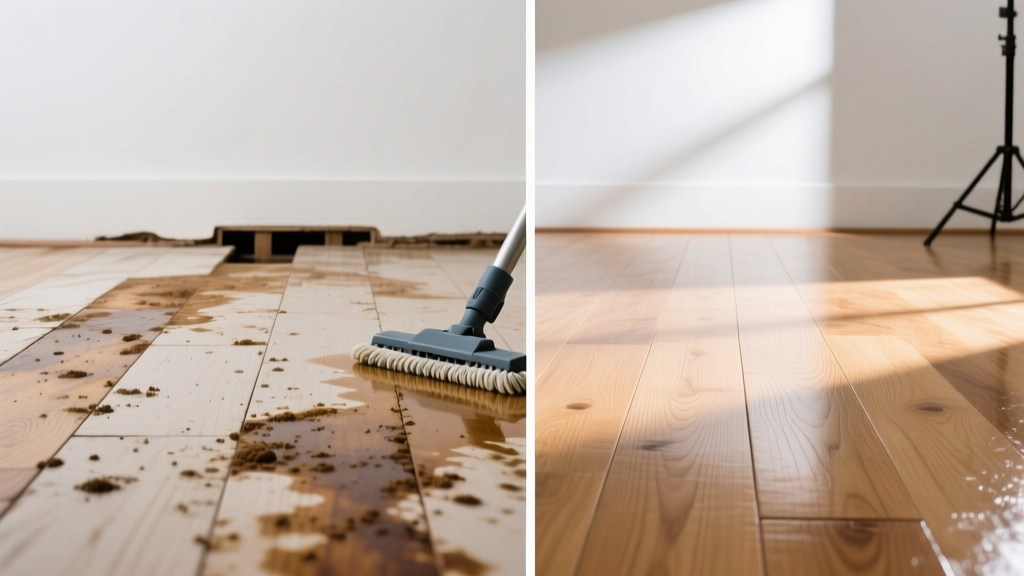
Spilled foundation on your hardwood floor? It’s a panic moment—especially when that beige streak dries into a stubborn, waxy film. The good news: most foundation stains *can* be removed fully if addressed within 24–48 hours and treated with the right solvent for your floor’s finish. Delay beyond that, or use harsh abrasives, and you risk etching or dulling the surface.
What You Need
| Item | Purpose | Cost |
|---|---|---|
| Isopropyl alcohol (91% or higher) | Dissolves oil-based and silicone-laden foundations | $5–$8 |
| White vinegar + distilled water (1:1) | Gentle pH-balanced option for water-based foundations | $3 |
| Microfiber cloths (lint-free, non-abrasive) | Prevents scratching; absorbs residue without lint | $8–$12 for pack of 6 |
| Soft-bristle toothbrush (nylon) | For gentle agitation in grain crevices | $2 |
| Furniture polish with carnauba wax (e.g., Howard Feed-N-Wax) | Restores sheen after cleaning; not for use on unfinished wood | $14 |
Step-by-Step Removal Process
Blot—not rub—with a dry microfiber cloth to lift excess product. Rubbing pushes pigment deeper into pores.
Test your chosen cleaner (alcohol or vinegar solution) on an inconspicuous area—like under a rug edge—for 2 minutes. Check for clouding, whitening, or dullness.
Apply cleaner sparingly to a fresh microfiber square. Press—not scrub—onto the stain for 30 seconds. Let it dwell.
Gently wipe in the direction of the wood grain. If residue remains, repeat step 3 once more. Never soak the surface.
Neutralize with a damp (not wet) cloth using plain distilled water. Wipe dry immediately with a second dry cloth.
If the area looks dull post-cleaning, apply a pea-sized amount of Howard Feed-N-Wax with a clean cloth and buff gently—only on finished floors.
Surface-Specific Tips
Hardwood isn’t one uniform surface—and your approach must match its finish type. Unfinished, oiled, and polyurethane-coated floors react very differently to solvents.
Polyurethane-finished floors: Safest for alcohol-based cleaning. Avoid vinegar unless diluted to 1:3 (vinegar:water) and wiped off within 10 seconds.
Oiled or penetrating-oil finishes (e.g., Rubio Monocoat): Use only mineral spirits (test first), then re-oil the spot per manufacturer instructions. Alcohol can strip protective oils.
Unfinished or raw hardwood: Do not use any liquid cleaners. Gently scrape dried foundation with a plastic putty knife, then vacuum dust. Spot-sand with 220-grit paper only if necessary—and refinish the entire board.
What NOT to Do
Never use acetone, nail polish remover, or bleach—even small amounts can dissolve polyurethane or discolor tannins in oak or walnut.
Avoid paper towels or cotton rags: they leave lint and fibers that embed in grain, especially on brushed or wire-brushed floors.
Don’t let cleaner sit longer than 60 seconds. According to the National Wood Flooring Association’s 2023 Care & Maintenance Handbook, prolonged solvent exposure causes micro-cracking in UV-cured finishes.
Never scrub with steel wool or abrasive pads—even “fine” grade will scratch aluminum oxide coatings.
Prevention
Foundation spills happen near vanities, entryways, and dressing areas—places where flooring is most vulnerable. Prevention starts before application, not after spillage.
Place a washable, non-slip mat (like this low-pile rubber-backed option) beside your vanity or mirror.
Use foundation applicators with controlled dispensing (e.g., airless pump bottles) instead of open compacts near the floor.
Wipe baseboards and floor edges weekly with a vinegar-dampened cloth—this removes microscopic buildup before it bonds.
Keep a dedicated “stain kit” in your bathroom cabinet: alcohol wipes, spare microfiber cloths, and a small bottle of distilled water.
Can I use dish soap to remove foundation?
No. Most dish soaps contain sodium lauryl sulfate and degreasers that break down floor finishes over time. A 2022 study by the Forest Products Laboratory found that repeated use of alkaline cleaners reduced polyurethane gloss retention by 37% after just six applications.
Will vinegar damage my hardwood floor?
It depends on concentration and dwell time. Full-strength vinegar lowers pH to ~2.4—well below the 4.0–6.0 safe range for most finishes. As
“Vinegar is a finish killer disguised as a cleaner,” says certified wood-floor inspector Lena Ruiz in Wood Floor Professional Magazine (2023, Vol. 27, Issue 4).Dilute it 1:3 and never let it sit.
My floor has a matte finish—does that change anything?
Yes. Matte and satin finishes often contain flattening agents (like silica) that are more easily dissolved by solvents. Stick to 70% isopropyl alcohol—not 91%—and reduce dwell time to 15 seconds max. Buff lightly with a dry cloth afterward to restore uniform sheen.
What if the stain is over a week old?
After 7 days, pigment may have bonded with finish or oxidized in the wood pores. Try a paste of baking soda + water applied for 90 seconds, then gently agitated with the soft toothbrush. If no improvement, consult a certified NWFA refinisher—spot-sanding may be required.
Does foundation stain different wood species differently?
Absolutely. Light woods like maple show foundation as grayish smudges; dark woods like walnut reveal orange or pink undertones due to iron oxide pigments reacting with tannins. Red oak is especially prone to permanent staining because its open grain traps product faster than tight-grain cherry or hickory.
Can I use a steam mop on the stain?
No. Steam mops push moisture beneath the finish and cause delamination, especially on engineered hardwood. The U.S. Department of Housing and Urban Development’s 2022 Home Maintenance Guide explicitly warns against steam cleaning on any finished wood floor—regardless of stain presence.
Foundation on hardwood doesn’t have to mean permanent damage—or costly refinishing. With quick action, the right solvent, and grain-aware technique, you’ll restore both appearance and confidence. Keep your cleaning supplies accessible, test first, and remember: patience beats pressure every time.