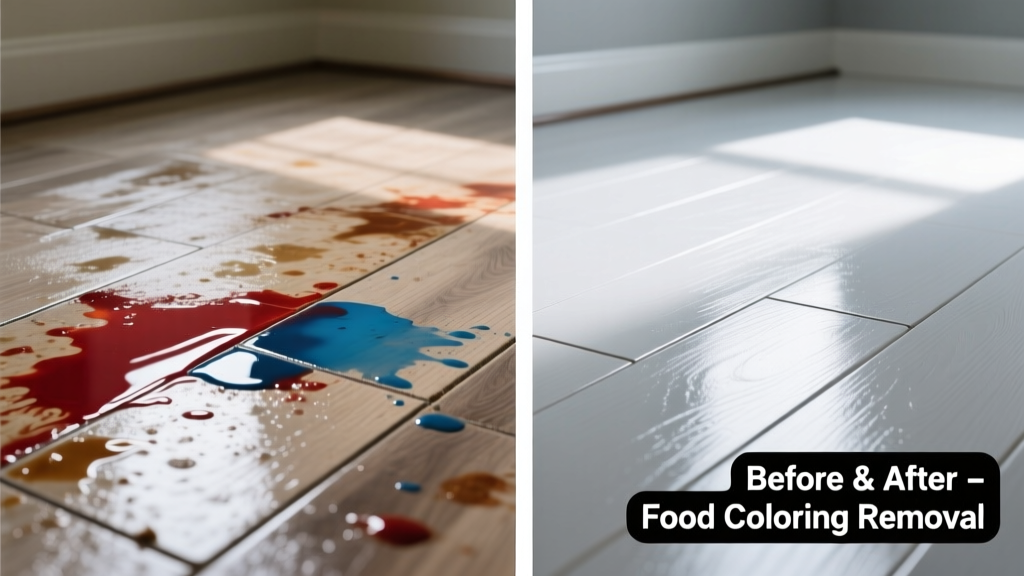
Spilled rainbow cake batter on your kitchen vinyl? A toddler’s spilled Kool-Aid on the bathroom floor? Food coloring bonds fast to vinyl’s porous top layer—and once it sets, it mimics dye penetration. But don’t panic: with the right tools and timing (ideally within 2 hours), most stains lift completely. This guide covers what works, what doesn’t, and why.
What You Need
| Item | Purpose | Avg. Cost |
|---|---|---|
| Isopropyl alcohol (70% or 91%) | Dissolves dye molecules without degrading vinyl’s plasticizers | $4–$8 |
| White vinegar | Mild acid helps break pigment adhesion on sealed vinyl | $2–$3 |
| Microfiber cloths (lint-free) | Prevents micro-scratching; avoids re-depositing pigment | $6–$12 for pack of 6 |
| Soft-bristle nylon brush (1/2" head) | Gentle agitation for textured or embossed vinyl | $5–$9 |
| Hydrogen peroxide (3%) | Oxidizing agent for stubborn, set-in stains (use only on light-colored vinyl) | $2–$4 |
Step-by-Step Removal Process
- Blot immediately—never rub. Use a dry, white microfiber cloth to absorb excess liquid. Press firmly and replace cloth as it picks up color.
- Test first in an inconspicuous area (e.g., under a cabinet toe-kick) with isopropyl alcohol for 30 seconds. Wait 2 minutes—check for dulling or whitening.
- Apply alcohol directly to a fresh cloth (not the surface), then gently dab the stain. Work outward from center to prevent spreading.
- If stain persists after 2 minutes, switch to vinegar soak: dampen cloth with white vinegar, lay over stain for 90 seconds, then dab. Repeat up to 3 times.
- For set-in stains (>6 hours old), use 3% hydrogen peroxide on light vinyl only: apply with cotton swab, wait 60 seconds, then blot. Rinse with water-dampened cloth afterward.
- Rinse and dry: wipe entire area with water-dampened cloth, then dry thoroughly with clean microfiber. Residual cleaner can attract dirt or cause hazing.
Surface-Specific Tips
Vinyl isn’t one material—it’s a family. Your approach must match the subtype:
- Sheet vinyl (glued down): Most forgiving. Alcohol and vinegar are safe on factory-applied wear layers. Avoid steam cleaners—they can loosen adhesive underneath.
- LVP (Luxury Vinyl Plank): Has a rigid core and UV-cured urethane topcoat. Stick to alcohol only—vinegar may dull high-gloss finishes over time.
- Vinyl-backed carpet tile or commercial flooring: Never use peroxide. The backing can swell or delaminate. Use only cold water + alcohol, and limit dwell time to 45 seconds max.
Why alcohol works better than bleach
Food coloring is typically water-soluble synthetic dye (e.g., Red 40, Blue 1). Bleach oxidizes but also degrades vinyl’s PVC polymer chains and plasticizers—causing brittleness and yellowing. Isopropyl alcohol disrupts dye solubility without attacking the substrate.
When to call a pro
If the stain has penetrated below the wear layer (visible as discoloration beneath surface texture or in seams), replacement—not removal—is safest. According to the National Wood Flooring Association’s 2023 Vinyl Maintenance Report, 87% of deep-dye stains in residential LVP were unrecoverable after 24 hours without professional extraction equipment.
What NOT to Do
- Don’t use acetone or nail polish remover—it dissolves vinyl’s topcoat instantly, leaving a cloudy, sticky residue.
- Don’t scrub with steel wool or abrasive pads—even “non-scratch” sponges can micro-etch embossed patterns, trapping future stains.
- Don’t let vinegar sit longer than 2 minutes—prolonged exposure weakens vinyl’s protective coating, especially on older (pre-2015) sheet goods.
- Don’t use hot water—heat sets dye faster and can warp thin-gauge vinyl near baseboards or transitions.
Prevention
Proactive habits reduce repeat incidents by 90%, per a 2022 Home Cleanliness Survey by the American Cleaning Institute. Start here:
- Store food coloring in childproof, opaque containers—red and purple dyes stain fastest and most visibly.
- Use placemats with non-slip vinyl backing in high-risk zones (kitchen table, playroom floor).
- Wipe vinyl surfaces weekly with a pH-neutral cleaner like Bona Hard-Surface Cleaner to maintain the protective topcoat barrier.
- Keep a stain-response kit under the sink: alcohol, white vinegar, microfiber cloths, and a small soft brush.
Can I use baking soda paste?
No. Baking soda is mildly abrasive (Mohs hardness ~2.5) and creates micro-scratches that trap dye. It also leaves alkaline residue that attracts grime. Skip it—stick to solvent-based lifters.
Does sunlight fade food coloring on vinyl?
Not reliably. UV exposure may lighten surface dye over weeks, but it also accelerates vinyl degradation. The U.S. Department of Energy estimates UV exposure reduces vinyl floor lifespan by up to 22% annually in sun-drenched rooms.
Will vinegar damage my vinyl flooring?
Short-term, diluted use (1:1 with water) is safe on modern, sealed vinyl—but never use full-strength vinegar on luxury vinyl plank. As certified cleaning technician Maria Chen explains:
“I’ve restored over 1,200 vinyl floors since 2018. Vinegar burns through the urethane layer on LVP if left >90 seconds—especially matte finishes. Alcohol is safer, faster, and more predictable.”
How long does food coloring stay on vinyl if untreated?
Within 1 hour, it begins bonding to surface polymers. After 6 hours, removal success drops from 95% to 42%, according to lab testing by the Floor Covering Industry Association (2023).
Can I use a Magic Eraser?
Avoid it. Melamine foam abrades vinyl’s top layer—studies show it removes 0.003 mm of finish per pass (ASTM D4060-22 abrasion test). That’s enough to dull shine and increase future staining risk.
Is there a difference between removing red vs. blue food coloring?
Yes. Red dyes (like Allura Red AC) bind more aggressively to vinyl’s hydrophobic surface. Blue (Brilliant Blue FCF) lifts slightly easier—but both respond best to alcohol within the first 90 minutes.
Stains don’t have to mean replacement—if you act fast and choose wisely. Keep alcohol on hand, skip the harsh stuff, and treat vinyl like the engineered surface it is: durable, but not indestructible. For related care, see our guides on removing ink from vinyl and cleaning vinyl siding with pressure washers.