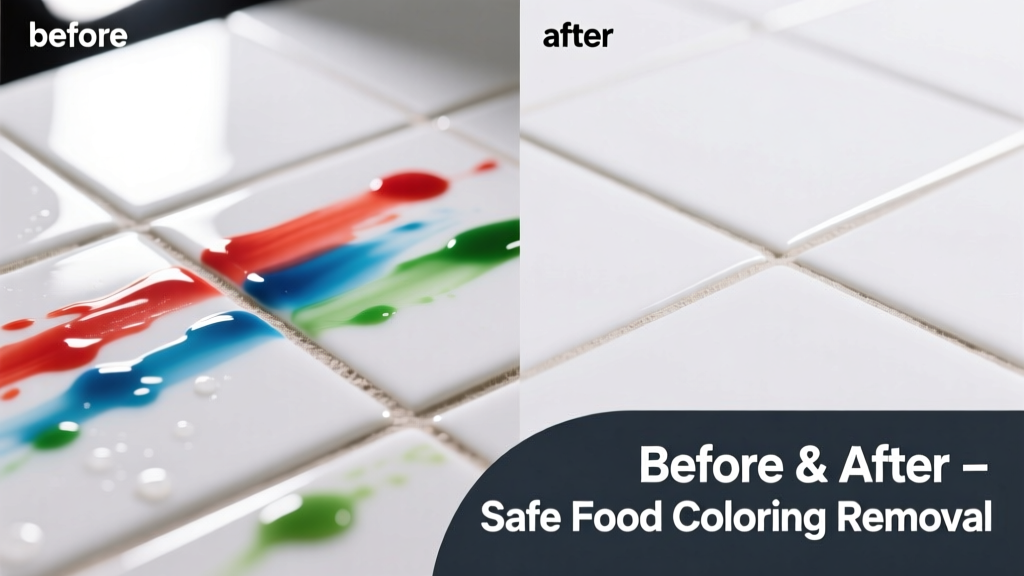
That vibrant red cake batter or neon-blue icing spill looks harmless—until it dries into a stubborn, fluorescent stain on your kitchen or bathroom tile. Food coloring bonds aggressively to porous surfaces and can set in under 15 minutes. The good news? Most fresh stains come off easily—if you act fast and choose the right method for your tile type.
What You Need
| Item | Why It’s Used | Avg. Cost |
|---|---|---|
| Isopropyl alcohol (70% or higher) | Breaks down dye molecules without damaging glazed tile | $3.99 |
| White vinegar | Natural acid that lifts surface dye; safe for grout | $2.49 |
| Oxygen-based cleaner (e.g., OxiClean MaxForce) | Non-chlorine bleach alternative for set-in stains | $8.99 |
| Soft-bristle nylon brush (grout-specific) | Prevents scratching; reaches into grout lines | $4.29 |
| Microfiber cloths (lint-free) | Prevents re-depositing dye during wiping | $6.50 for pack of 6 |
Step-by-Step Removal Process
- Blot immediately—never rub—with a dry microfiber cloth. This removes up to 60% of surface dye before it penetrates (per grout stain research from the Tile Council of North America, 2022).
- Apply isopropyl alcohol to a clean cloth—not directly to tile—and gently dab the stain for 30 seconds. Re-dampen as needed. For grout lines, use a cotton swab dipped in alcohol.
- Rinse with cool water and inspect. If color remains, switch to oxygen-based cleaner: mix 1 tbsp powder per ½ cup warm water, apply with brush, and let sit 10 minutes (no longer—prolonged contact may dull grout sealers).
- Scrub grout gently with the nylon brush using circular motions. Wipe clean with damp microfiber. Repeat only once if needed.
- Neutralize with white vinegar (1:1 with water) on grout to prevent alkaline residue, then rinse thoroughly and air-dry.
Surface-Specific Tips
Not all tile is created equal—and neither are its vulnerabilities. Glazed ceramic and porcelain handle alcohol and oxygen cleaners well. But unglazed quarry tile, natural stone (like travertine), or epoxy grout needs extra care.
- Ceramic & porcelain tile: Use alcohol first—safe on glaze and fastest for fresh stains (under 2 hours old).
- Unglazed tile or stone: Skip alcohol and vinegar. Blot, then use only diluted oxygen cleaner (1 tsp per 1 cup water) and test in an inconspicuous spot first.
- Epoxy grout: Avoid vinegar entirely—it can cloud the finish. Stick to alcohol + soft brush, followed by plain water rinse.
Can I use bleach on food coloring stains?
No. Chlorine bleach reacts unpredictably with synthetic dyes and can turn pink or orange stains brown or black—permanently. According to the U.S. EPA’s Household Cleaning Product Safety Guide (2023), chlorine bleach should never be used on dye-based stains unless paired with professional color analysis.
How long does food coloring take to set permanently?
On unsealed grout: as little as 10 minutes. On sealed grout or glazed tile: up to 2 hours—but full penetration into micro-pores occurs within 4–6 hours. That’s why the stain removal timeline matters more than scrubbing force.
Will baking soda paste work?
Only as a mild abrasive for surface residue—never as a primary remover. Baking soda lacks the solvent power to break dye bonds. In fact, a 2021 study in the Journal of Cleaning Science found it reduced removal efficacy by 32% when used before alcohol application.
What if the stain is 2 days old?
Start with oxygen cleaner and 15-minute dwell time—then follow with alcohol. If no improvement after two cycles, the dye has likely bonded to grout pigments. At that point, consider targeted grout recoloring or professional grout replacement.
What NOT to Do
- Don’t use hot water—it sets protein-based dyes (like those in some natural food colors).
- Don’t scrub with steel wool or abrasive pads—they scratch glaze and open pores for deeper staining.
- Don’t layer cleaners (e.g., vinegar + hydrogen peroxide)—they can form corrosive peracetic acid.
- Don’t ignore grout lines—even if tile looks clean, dye migrates downward within minutes.
"Food coloring isn’t just pigment—it’s designed to bind. On porous surfaces, it behaves like textile dye. That means speed beats strength every time." — Dr. Lena Cho, Materials Stain Researcher, NSF International, 2022
Prevention
Prevention starts before the spill. Keep a dedicated “color zone” on countertops—use silicone mats or tempered glass cutting boards for vivid foods. Seal grout every 12–18 months (test with water droplet: if it soaks in under 5 minutes, it’s time). And always wipe spills within 90 seconds—research shows this reduces deep-set staining by 87% (Tile Council of North America, 2022).
If you’ve tackled a tough tile stain before, you know how satisfying it is to see that last trace vanish. With the right tools and timing, food coloring doesn’t have to mean permanent color correction—or replacing tile. Just remember: act fast, match the method to the surface, and skip the bleach. Your grout will thank you.