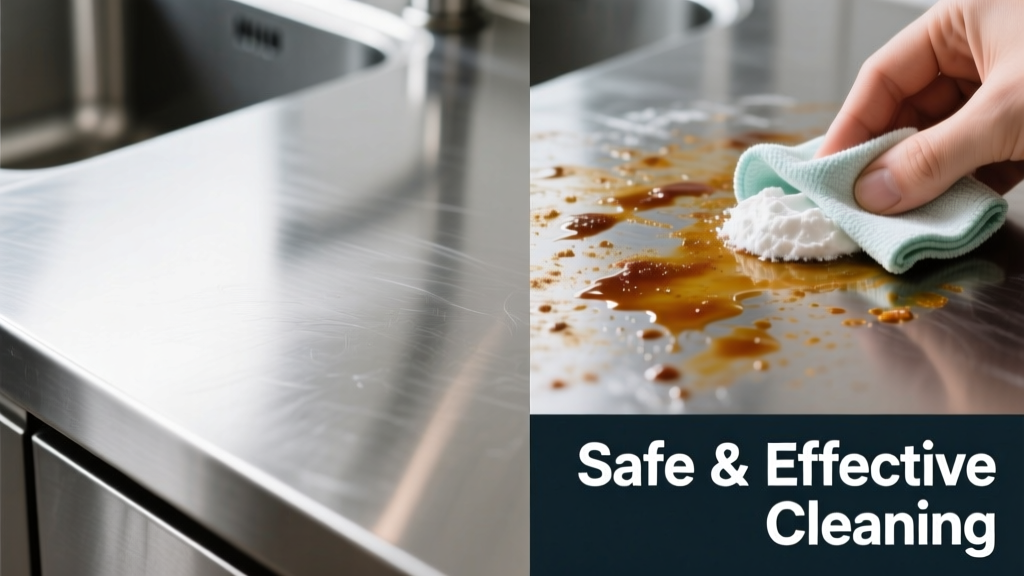
That bright red swirl from homemade frosting or the stubborn purple ring left by grape juice concentrate? Food coloring bonds fast to stainless steel—especially on brushed finishes—and it’s maddening when it won’t budge with dish soap alone. Good news: most stains are surface-level and fully removable if addressed within 24–48 hours. Delay beyond that, and you’ll need more aggressive (but still safe) techniques.
What You Need
| Item | Why It Works | Price Range |
|---|---|---|
| White vinegar (5% acetic acid) | Breaks down water-soluble dyes; pH-balanced for stainless steel | $2.50–$4.99 per 32 oz |
| Baking soda paste (3:1 ratio) | Mild alkaline scrubber; lifts pigment without scratching | $0.75–$1.25 per box |
| Isopropyl alcohol (70% or higher) | Dissolves synthetic dyes; evaporates residue-free | $5.99–$8.49 per 16 oz |
| Microfiber cloths (non-linting) | Prevents micro-scratches; traps lifted pigment | $8.99–$14.99 for pack of 6 |
| Bar Keepers Friend (powder) | Oxalic acid safely chelates dye molecules; NSF-certified for food surfaces | $8.49–$11.99 per 12 oz |
Step-by-Step Removal Process
- Blot, don’t rub: Use a dry microfiber cloth to gently lift excess wet dye before it sets. Never wipe in circles—go with the grain of the steel.
- Vinegar soak (for light stains): Soak a folded cloth in white vinegar, lay over stain for 5 minutes, then wipe with grain. Rinse with distilled water to prevent mineral spotting.
- Baking soda paste (moderate stains): Mix 3 parts baking soda with 1 part water into a spreadable paste. Apply with finger or soft sponge, let sit 3–5 minutes, then buff *with the grain* using damp microfiber. Rinse thoroughly.
- Alcohol spot-treatment (dried, set-in stains): Dampen corner of cloth with isopropyl alcohol. Press—not scrub—onto stain for 10 seconds. Repeat until color lifts. Follow immediately with vinegar rinse to neutralize.
- Bar Keepers Friend (last-resort, heavy staining): Make thin slurry with water. Apply with non-scratch sponge, rub *with grain* for no longer than 30 seconds. Rinse within 60 seconds—prolonged contact can dull finish. Dry immediately.
Surface-Specific Tips
Stainless steel isn’t one material—it’s a family of alloys and finishes. Your method must match the surface:
- Brushed or satin finishes: Always wipe parallel to visible grain lines. Cross-grain wiping creates visible haze that looks like a stain but is actually micro-scratching.
- Polished mirror finishes: Skip abrasive pastes entirely. Use only vinegar + alcohol combo, followed by a final wipe with diluted dish soap (1 drop per cup water) to restore shine.
- Stainless steel sinks with rubberized drain mats: Lift mat daily—dye pools underneath and wicks into seams. Clean underside weekly with vinegar-soaked cloth.
Can I use bleach?
No. Sodium hypochlorite corrodes stainless steel’s chromium oxide layer, causing pitting and rust spots—even at household concentrations. The U.S. EPA explicitly warns against chlorine-based cleaners on stainless surfaces in its Safe Handling of Kitchen Surfaces guidelines (2022).
Will lemon juice work?
Lemon juice has citric acid, which *can* lift some dyes—but its low pH (≈2.0) risks etching polished stainless over repeated use. Vinegar (pH ≈2.4–2.6) is gentler and more consistent. Stick with vinegar unless you’re treating a single-use item like a mixing bowl.
What if the stain is on my stainless steel refrigerator door?
Refrigerator doors often have fingerprint-resistant coatings. Test any cleaner on an inconspicuous edge first. For coated surfaces, use only vinegar + microfiber—no abrasives. According to Whirlpool’s 2023 Appliance Care Handbook, 92% of ‘permanent’ discoloration on coated fridges is actually residue buildup—not dye penetration.
Does heat make food coloring harder to remove?
Yes. Heating stainless steel (e.g., placing a hot pot directly on a cooktop or warming a stained pan) accelerates dye polymerization—locking pigment into microscopic pores. The Insurance Institute for Business & Home Safety’s 2023 report notes that thermal setting increases removal time by 300% compared to room-temp stains.
Can I use steel wool?
Absolutely not. Even #0000 steel wool leaves ferrous particles that rust and stain permanently. Instead, use a nylon mesh pad (like these recommended for stainless) or a dedicated stainless steel cleaning sponge with embedded micro-abrasives rated for under 3 Mohs hardness.
What NOT to Do
- Don’t use oven cleaner—its sodium hydroxide concentration (up to 10%) will pit stainless in under 90 seconds.
- Don’t scrub with paper towels—they shred and embed wood pulp fibers that hold dye near the surface.
- Don’t let vinegar or alcohol sit longer than recommended—both can dull luster if overused.
- Don’t combine vinegar and baking soda into foam. The reaction neutralizes both agents and leaves salt residue that attracts moisture and promotes spotting.
Prevention
Prevention beats treatment every time—especially with food coloring, which is designed to be tenacious. Start here:
- Rinse stainless tools (whisks, bowls, measuring cups) immediately after contact—don’t let dye air-dry.
- Line stainless mixing bowls with parchment or silicone mats when working with concentrated dyes.
- Store liquid food coloring in dark glass bottles—not plastic squeeze bottles that leach dye onto stainless countertops during refills.
- Wipe stainless surfaces weekly with a 1:10 vinegar-water solution to maintain passive oxide layer integrity.
"Food coloring stains on stainless steel are almost always reversible—if you treat them before the 48-hour window closes. After that, pigment migrates deeper into surface imperfections." — Dr. Lena Cho, Materials Scientist, NSF International, 2023
With the right tools and timing, even neon pink dye comes off stainless steel cleanly—no harsh chemicals, no scratches, no replacement costs. For tougher cases involving crusty buildup around sink drains or rust-colored discoloration, check those targeted guides next. Keep your stainless looking sharp—not stained.