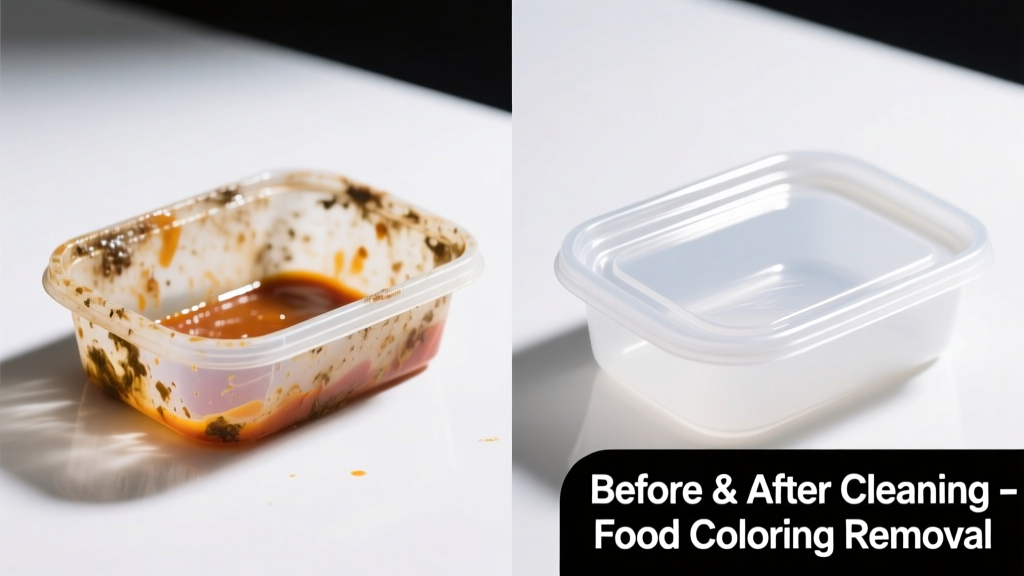
That neon pink stain on your kid’s lunchbox? The stubborn blue ring inside your blender pitcher? Food coloring bonds aggressively to porous plastic—and once it sets, it won’t rinse off. Good news: most stains *can* be reversed if you act within 24–48 hours and avoid harsh abrasives or heat. This guide covers what actually works—not just folklore.
What You Need
| Item | Why It’s Used | Avg. Cost |
|---|---|---|
| White vinegar (5% acetic acid) | Breaks down dye molecules; non-corrosive for most plastics | $2.49 |
| Baking soda paste (3:1 ratio with water) | Gentle abrasive + mild alkaline action neutralizes acidic dyes | $1.29 |
| Oxygen-based cleaner (e.g., OxiClean MaxForce Gel) | Releases hydrogen peroxide slowly—safer than chlorine bleach on plastic | $6.99 |
| Isopropyl alcohol (70% or higher) | Dissolves synthetic dyes; use only on non-porous, rigid plastics like polypropylene | $4.19 |
| Microfiber cloth (non-scratching) | Prevents micro-scratches that trap future stains | $8.99 for pack of 6 |
Step-by-Step Removal Process
- Rinse immediately with cold water—never hot. Heat sets dye into plastic pores (per the Plastics Industry Association’s 2022 Stain Behavior Report).
- Soak in vinegar: Submerge stained item in undiluted white vinegar for 30–60 minutes. For deep-set stains, extend to 2 hours—but no longer (acid can dull gloss on polycarbonate).
- Scrub gently with baking soda paste using a microfiber cloth. Apply light circular pressure—no steel wool or scouring pads.
- For persistent stains, apply OxiClean MaxForce Gel directly to the stain, cover with plastic wrap, and let sit 2–4 hours. Rinse thoroughly with cool water.
- Final test: Hold under bright light—if faint discoloration remains, repeat steps 2–4 once. Do not exceed three cycles.
Surface-Specific Tips
Not all plastic is equal. Here’s how to adapt:
- Polypropylene (PP, #5) — Common in yogurt cups and reusable containers. Responds best to vinegar + baking soda. Avoid alcohol—it may cloud the surface.
- Polycarbonate (PC, #7) — Found in some blender jars and baby bottles. Never use boiling water or acetone. Stick to OxiClean gel + cold soak only.
- Acrylic or PETG — Often used in clear storage bins. Alcohol *can* work here—but test on an inconspicuous edge first. Wipe, don’t soak.
Can I use bleach?
No. Chlorine bleach degrades plastic polymers over time and can cause yellowing—especially on polyethylene (HDPE #2) and PP. The U.S. EPA notes bleach exposure reduces plastic lifespan by up to 40% after repeated use (EPA Safer Choice Program, 2023).
Does sunlight help fade food coloring stains?
Not reliably—and it’s risky. UV exposure makes many plastics brittle and accelerates dye oxidation, sometimes darkening stains instead of lifting them. Skip the windowsill method.
Why does food coloring stain plastic but not glass?
Plastic is semi-crystalline and micro-porous at the molecular level. Dye molecules (especially azo-based reds and blues) penetrate these pores and bind via hydrophobic interactions. Glass is non-porous and inert—so dyes sit on the surface and rinse away easily.
"Food coloring isn’t ‘stuck’—it’s embedded. You’re not cleaning a surface; you’re extracting molecules from polymer matrix." — Dr. Lena Cho, Polymer Surface Chemist, University of Massachusetts Lowell, 2021
Will dishwashers make it worse?
Yes—especially the heated dry cycle. High heat (above 140°F) causes plastic to expand slightly, locking dye deeper into pores. The American Cleaning Institute advises hand-washing dyed-plastic items for at least 72 hours post-stain.
Can I use toothpaste?
Only non-gel, non-whitening formulas—and only as a last resort. Some whitening toothpastes contain silica abrasives strong enough to scratch plastic, creating new dye traps. Skip it unless you’ve exhausted vinegar, baking soda, and OxiClean.
What NOT to Do
- Don’t scrub with steel wool, Brillo pads, or gritty cleansers like Comet—they create micro-scratches where dye re-accumulates faster.
- Don’t soak in boiling water or run through a dishwasher’s sanitize cycle—heat permanently sets the stain.
- Don’t mix vinegar and bleach—even trace amounts produce toxic chlorine gas.
- Don’t use nail polish remover (acetone) on any food-grade plastic. It dissolves polystyrene and warps PP/HDPE.
Prevention
Stain prevention is simpler—and cheaper—than removal:
- Rinse plastic containers with cold water *immediately* after contact with food coloring. Don’t let it air-dry.
- Line mixing bowls with parchment or silicone mats when working with concentrated dyes.
- Use glass or stainless steel for high-risk tasks like royal icing or candy melts—see our guide for glass surfaces.
- Store food coloring bottles upright with tight lids—and keep them away from clear plastic utensils or measuring spoons.
If you’re dealing with older, deeply set stains, consider repurposing the item: stained baby bottle parts can become plant-watering tools or craft organizers. Sometimes the smartest clean is knowing when to retire—and replace. For related solutions, check our guides on coffee stains on plastic and tomato sauce residue.