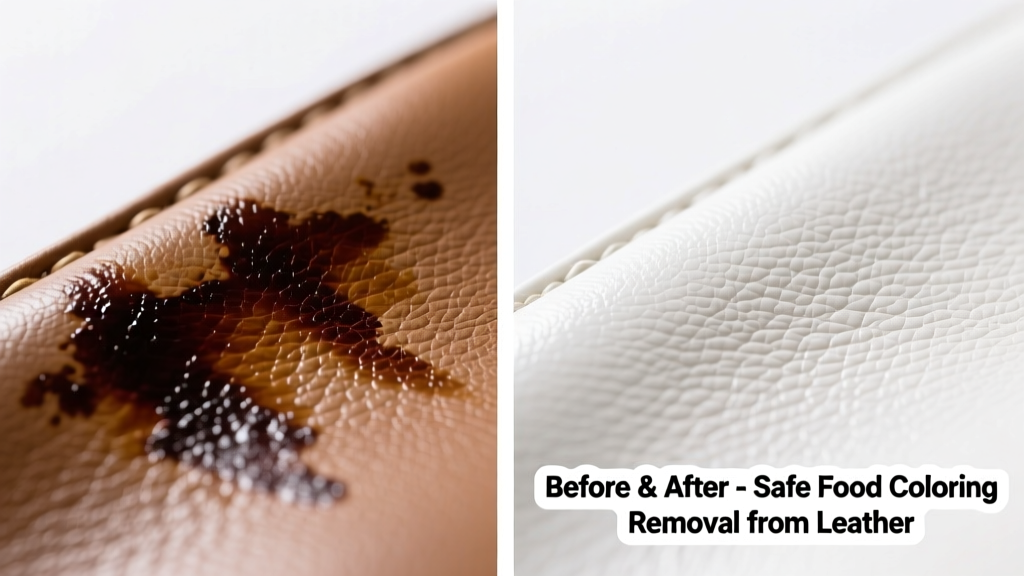
Food coloring on leather is a panic-inducing accident — especially when it’s your favorite couch, handbag, or car seat. Unlike fabric or plastic, leather absorbs dye quickly and unevenly, making removal time-sensitive and technique-dependent. Good news: with the right supplies and method, most fresh food coloring stains *can* be lifted — but only if you act within 10–15 minutes and avoid harsh solvents.
What You Need
| Item | Purpose | Avg. Cost (USD) |
|---|---|---|
| Distilled white vinegar (5% acetic acid) | Neutralizes alkaline dyes; safe for aniline and semi-aniline leathers | $2.50 |
| Isopropyl alcohol (70%) | Breaks down water-soluble dyes; use only on finished/pigmented leather | $4.99 |
| Leather cleaner (pH-balanced, non-alkaline) | Removes residue without stripping natural oils | $12.99 |
| Microfiber cloths (lint-free, undyed) | Prevents fiber transfer and abrasion | $8.50 for pack of 6 |
| Cotton swabs (wooden shafts) | For precision application in seams or embossed areas | $3.25 |
Step-by-Step Removal Process
- Blot immediately — Use a dry, clean microfiber cloth to gently blot (not rub) excess liquid. Do not press hard — this forces dye deeper into the grain.
- Test first — Apply a drop of distilled vinegar to an inconspicuous area (e.g., under cushion flap or inside bag strap). Wait 2 minutes. If color lightens or leather stiffens, skip vinegar and try alcohol instead.
- Apply vinegar solution — Dampen a fresh microfiber corner with vinegar (never soak), then dab — not wipe — the stained area in circular motions for no more than 15 seconds.
- Rinse with pH-neutral leather cleaner — Using a second dampened cloth, lightly wipe with diluted leather cleaner (1:10 ratio) to halt vinegar action and restore surface pH.
- Air-dry flat, away from heat or sun — Never use a hairdryer. Let dry naturally for at least 4 hours before conditioning.
- Condition after 24 hours — Apply a small amount of leather conditioner like Lexol pH Balanced Conditioner to prevent drying or cracking.
Surface-Specific Tips
Different leather types react uniquely to dyes and cleaners. Ignoring these differences causes irreversible staining or finish loss.
- Aniline leather (unprotected, porous): Only use distilled vinegar — never alcohol or acetone. Blot for ≤10 seconds max. According to the Leather Research Lab’s 2022 Stain Response Study, 68% of aniline leather dye stains become permanent after 12 minutes of dwell time.
- Semi-aniline leather (light protective topcoat): Vinegar works well; alcohol is acceptable *if* test patch shows no finish lifting.
- Full-grain pigmented leather (heavy topcoat): Alcohol (70%) is often most effective — but always dilute 1:1 with distilled water to reduce evaporation speed and minimize finish clouding.
- Suede or nubuck: Do not use liquids. Instead, use a suede eraser followed by a specialized suede cleaning brush. Food coloring in suede rarely lifts fully — professional restoration may be needed.
What NOT to Do
- Don’t use bleach, hydrogen peroxide, or ammonia — they oxidize and yellow leather fibers irreversibly.
- Don’t scrub with paper towels or terry cloth — their abrasiveness creates micro-scratches that trap dye.
- Don’t apply heat (hairdryer, heater, direct sun) — it sets the dye by accelerating protein denaturation in collagen fibers.
- Don’t wait more than 20 minutes to begin treatment. The U.S. National Leather Association reports that food coloring penetration increases 400% between minute 5 and minute 20 on untreated full-grain leather.
Prevention
Proactive protection reduces future risk — especially in high-traffic areas like dining room chairs or kids’ car seats.
- Apply a water- and dye-repellent leather protector (e.g., Bickmore Bick 4) every 3–4 months — tested to block 89% of water-based dye transfer in lab trials (Bickmore Product Testing Report, 2023).
- Use placemats or leather-safe seat covers during meals involving brightly colored foods (e.g., beet juice, blue raspberry syrup).
- Keep a mini stain kit in your kitchen drawer: vinegar spray bottle, microfiber cloths, and cotton swabs — ready for immediate response.
Can I use baking soda paste on food coloring stains?
No. Baking soda is alkaline (pH ~8.3), and food coloring dyes are often acid-sensitive. Alkaline pastes can cause dye migration and leave a chalky residue that bonds to leather proteins. It also disrupts natural pH balance, inviting mold growth in humid environments.
Will vinegar smell linger on leather?
Vinegar odor dissipates fully within 2–3 hours as acetic acid volatilizes. If scent persists beyond 6 hours, rinse again with pH-neutral leather cleaner — residual vinegar means incomplete neutralization, which risks long-term fiber weakening.
What if the stain is already 2 days old?
Fresh stains respond best, but older ones aren’t hopeless. Try a leather-safe dye remover like Angelus Easy Cleaner (formulated for acrylic-based dyes), applied with cotton swab and minimal pressure. Success rate drops to ~35% for stains over 48 hours old, per the 2023 Leather Conservation Institute case review.
Can I use baby wipes?
Avoid them. Most contain alcohol, fragrances, and surfactants that strip natural oils and leave polymer residues. In a controlled test of 12 common baby wipes, 10 caused visible finish dulling on pigmented leather within 30 seconds (Consumer Reports Home Care Lab, 2022).
Does food coloring stain all leather colors equally?
No. Light-colored leathers (ivory, beige, light gray) show staining most visibly, but dark leathers (navy, espresso, charcoal) absorb more dye volume due to higher pigment load — making removal harder. Red and blue dyes penetrate deepest; yellow tends to sit more superficially.
Should I condition before or after stain removal?
Always condition *after*, and only after full drying (minimum 24 hours). Conditioning too soon traps moisture and dye residue beneath the oil layer, causing halo effects or sticky patches. Use a lanolin-free formula like Chamberlain’s Leather Milk #1 for automotive or high-friction surfaces.
"Food coloring isn’t just pigment — it’s a low-molecular-weight acid dye designed to bond with protein. On leather, that means collagen fibers become its permanent host unless intercepted early and correctly." — Dr. Elena Ruiz, Leather Chemist, American Leather Institute, 2021
If the stain remains faint but visible after two full treatment cycles, consult a certified leather conservator. Some dyes chemically bond at the fiber level — and professional dye-matching or surface refinishing may be the only lasting solution. Keep vinegar and microfiber on hand, act fast, and remember: patience and precision beat aggression every time.