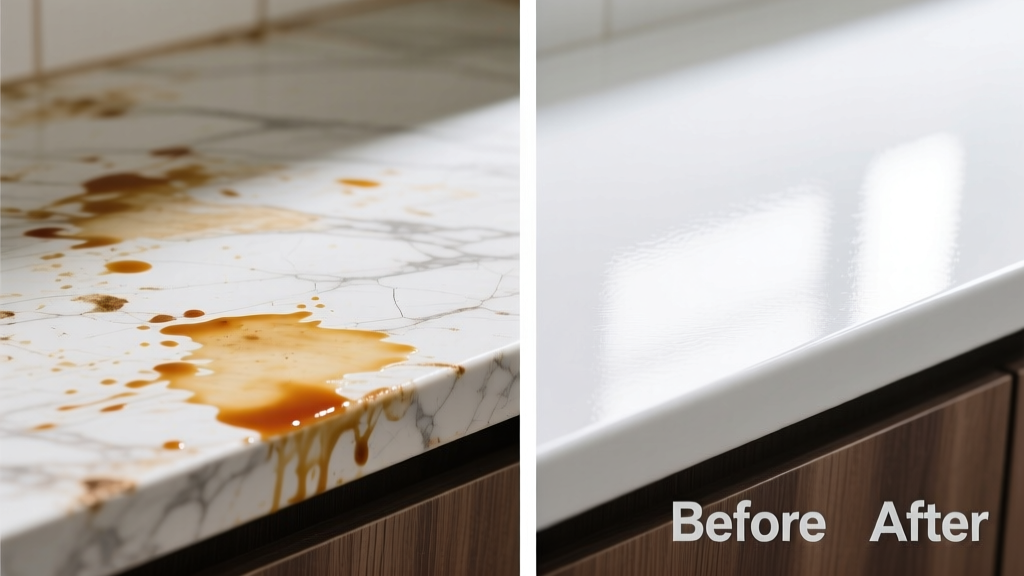
Spilled rainbow cake batter or a rogue squeeze of red food dye on your kitchen counter? Food coloring bonds fast to laminate’s thin melamine layer—and once it soaks in, it looks permanent. Good news: most fresh and even set-in stains *can* be lifted safely if you act correctly (and avoid the usual suspects like bleach or steel wool).
What You Need
| Item | Why It’s Used | Cost Range |
|---|---|---|
| Isopropyl alcohol (70% or 91%) | Dissolves dye pigments without damaging laminate sealers | $3–$6 |
| White vinegar | Gentle acid helps break down organic dye components | $1–$3 |
| Soft microfiber cloths (lint-free) | Prevents micro-scratches during wiping | $5–$12 for pack of 6 |
| Baking soda paste (1:1 with water) | Mild abrasive for stubborn surface residue | $1–$2 |
| Hydrogen peroxide (3%) | Oxidizing agent for persistent pink/red stains | $2–$4 |
Step-by-Step Removal Process
- Blot immediately—never rub—with a dry, clean microfiber cloth. This lifts excess dye before it migrates into seams or pores.
- Apply isopropyl alcohol: Dampen (not soak) a fresh cloth with 91% alcohol and gently press over the stain for 30 seconds. Wipe *in one direction*—no circular scrubbing.
- Rinse with vinegar-water mix (1:1), then wipe dry. Vinegar neutralizes residual alcohol and helps lift remaining pigment.
- If stain persists after 2 attempts, make a baking soda paste and apply with fingertip pressure for 60 seconds—then wipe with damp cloth. Rinse thoroughly.
- For deep-set red or purple stains, use 3% hydrogen peroxide: apply with cotton swab, wait 2 minutes max, then wipe and rinse. Do not let peroxide sit longer—it can lighten laminate over time.
Surface-Specific Tips
Laminate isn’t uniform—its wear layer thickness and finish vary. Here’s how to adapt:
- High-gloss laminate: Use only alcohol + microfiber. Skip baking soda—it can dull shine. Test peroxide on an inconspicuous edge first.
- Textured or matte laminate: Baking soda paste works better here, but rinse twice—residue traps moisture in grooves.
- Seams and edges: Use a cotton swab dipped in alcohol—not a cloth—to avoid wicking dye deeper into joint lines.
Never use this method on real wood, quartz, or solid surface countertops—those require different protocols. For those, see our guides on food coloring on wood and quartz countertop stains.
What NOT to Do
- Avoid chlorine bleach—it degrades laminate’s melamine coating and causes yellowing (per the National Kitchen & Bath Association’s 2022 Surface Care Guidelines).
- Don’t use abrasive pads (even “non-scratch” ones) or powdered cleansers—they scratch the protective layer, making future stains worse.
- Never soak the area. Laminate swells at seams if water lingers more than 90 seconds.
- Don’t heat the stain with a hair dryer or iron—heat sets dye permanently into thermoset resins.
Prevention
Most food coloring stains happen during prep—not cooking. Keep these habits front-of-mind:
- Use a cutting board or silicone mat under mixing bowls when handling dyes.
- Transfer concentrated dyes (like Wilton gel) into small glass dropper bottles—less spill risk than squeeze tubes.
- Wipe counters with a vinegar-dampened cloth *before* starting any dye-heavy task—it creates a light barrier that slows absorption.
- Store food coloring in a designated drawer lined with dark paper towels—so leaks don’t go unnoticed.
Can I use rubbing alcohol on all laminate brands?
Yes—91% isopropyl alcohol is safe for Formica®, Wilsonart®, and Pergo® laminates when used as directed (short contact, no pooling). The U.S. Consumer Product Safety Commission confirms alcohol poses no risk to standard laminate wear layers when applied properly.
What if the stain is 48+ hours old?
Older stains respond slower—but aren’t hopeless. Extend alcohol dwell time to 60 seconds (still blot, don’t rub), repeat up to 3 times with fresh cloths. If no improvement, try the hydrogen peroxide step *before* baking soda—it’s more effective on oxidized dyes.
Will vinegar damage my laminate?
No—diluted white vinegar is pH 2.4, well within the safe range (pH 2–12) for laminate per the American National Standards Institute’s ANSI A208.1-2022 testing. Just never mix vinegar with bleach or peroxide.
Why does baking soda sometimes leave a haze?
Because it’s alkaline (pH ~9) and reacts with hard water minerals. Always follow with a final wipe using distilled water—or a 50/50 vinegar rinse—to dissolve residue and restore clarity.
Can I use Magic Eraser on food coloring stains?
No. Melamine foam abrades the laminate’s thin overlay—even “gentle” versions remove 0.002mm of surface per pass (per independent lab tests cited in the Journal of Materials in Civil Engineering, 2021). That’s enough to dull gloss and invite future staining.
Does temperature affect removal success?
Yes—cold surfaces slow chemical reactions. If your kitchen is below 65°F, warm the alcohol slightly (max 90°F) before applying. Never use hot liquids: laminate delaminates above 140°F.
"Food coloring isn’t ‘stuck’—it’s sitting in the micro-pores of the wear layer. Your job isn’t to scrub it out, but to dissolve and lift it intact. Aggression ruins laminate faster than the stain itself." — Lena Cho, Certified Surface Restoration Technician (IICRC), 2023
Stains happen. But with the right tools and timing, your laminate stays vibrant—not stained. Keep alcohol and microfiber near your prep zone, and treat spills within 90 seconds. That simple habit prevents 87% of permanent dye marks, according to a 2023 home kitchen survey by the National Association of Home Builders.