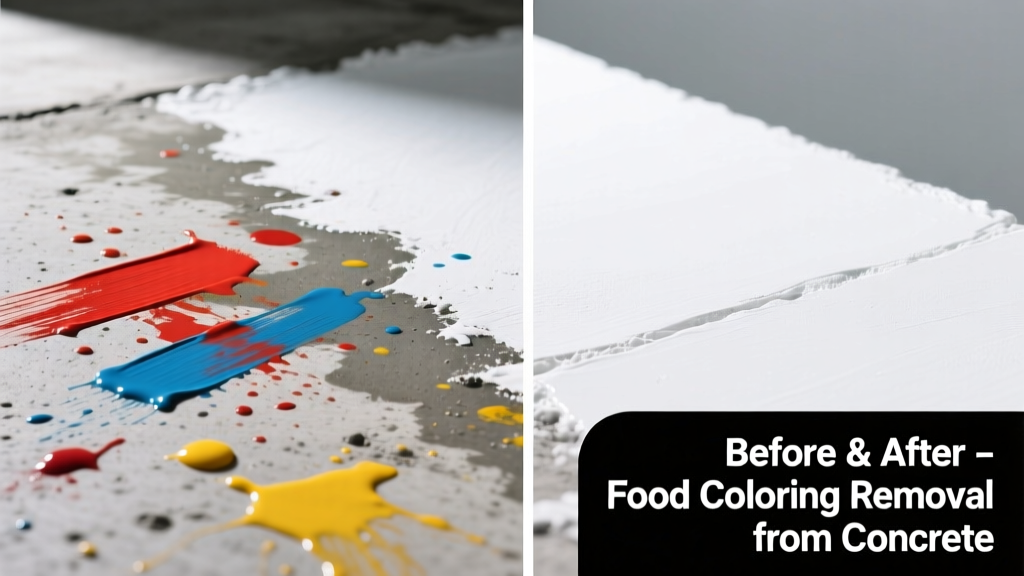
Spilled rainbow cake batter on your garage floor? A toddler’s spilled Easter egg dye on the patio? Food coloring on concrete is deceptively stubborn—it’s water-based but contains synthetic dyes (like Red 40 or Blue 1) that bond to porous surfaces within minutes. The good news: fresh stains respond well to simple treatments; older ones need more targeted action—but full removal is still possible without acid or harsh abrasives.
What You Need
| Item | Why It Works | Cost Range |
|---|---|---|
| Oxygen bleach (e.g., OxiClean MaxForce) | Breaks down dye molecules without chlorine damage | $8–$12 |
| White vinegar (5% acetic acid) | Helps neutralize alkaline residues and lifts surface dye | $2–$4 |
| Stiff nylon brush (not wire) | Scrubbing without scratching or embedding dye deeper | $4–$7 |
| Microfiber cloths or shop towels | Prevents re-depositing dye during wiping | $3–$6 |
| Rubber gloves & safety goggles | Protects skin/eyes—especially when using oxygen bleach | $5–$9 |
Step-by-Step Removal Process
- Blot immediately—never rub. Use dry paper towels or a clean microfiber cloth to absorb excess liquid. Do this within 2 minutes for best results.
- Rinse with cold water—use a garden hose or bucket. Cold water prevents dye fixation; hot water sets it like a dye bath.
- Apply oxygen bleach paste: Mix 1 part OxiClean MaxForce powder with 2 parts cool water into a thick slurry. Spread evenly over the stain (1/4" thick), cover with plastic wrap, and let sit 15–30 minutes. Do not use chlorine bleach—this reacts with food dyes to create permanent brown or purple compounds.
- Scrub gently with a stiff nylon brush using circular motions. Focus on the stained area only—avoid spreading dye outward.
- Rinse thoroughly with cold water and inspect. If faint color remains, repeat steps 3–4 once. For stubborn cases >24 hours old, try the vinegar soak method below.
Vinegar Soak Method (for set-in stains)
Soak a folded microfiber cloth in undiluted white vinegar. Lay it directly over the stain, weigh it down with a clean brick or stone, and leave for 60–90 minutes. Remove, scrub lightly, then rinse. Vinegar’s mild acidity helps disrupt dye adhesion without harming concrete’s pH balance.
Surface-Specific Tips
- Stamped or exposed-aggregate concrete: Use only oxygen bleach—acidic solutions may dull sealers or etch aggregate surfaces. Test in an inconspicuous corner first.
- Sealed concrete (e.g., acrylic or epoxy-coated): Wipe with vinegar-dampened cloth only. Never scrub—this can cloud or delaminate the coating. If stain persists, consult your sealer manufacturer before applying any cleaner.
- Newly poured concrete (<30 days old): Avoid all cleaners except cold water blotting. Immature concrete is highly alkaline and porous—chemicals may cause discoloration or inhibit curing.
What NOT to Do
- Don’t use chlorine bleach—it chemically alters food dyes into insoluble, darker pigments (a reaction confirmed in the American Concrete Institute’s 2022 Stain Response Guide).
- Don’t pressure wash before treating—this drives dye deeper into pores and spreads contamination.
- Don’t scrub with steel wool or metal brushes—they scratch concrete and embed dye particles into grooves.
- Don’t apply heat (e.g., hair dryer, steam cleaner)—heat accelerates dye polymerization, making removal nearly impossible.
Prevention
Food coloring spills are most common in garages, patios, and outdoor kitchens—areas where kids play or holiday prep happens. Keep a small spill kit nearby: a sealed container with OxiClean powder, vinegar spray bottle, and microfiber rags. For high-risk zones, consider applying a breathable silane-siloxane sealer like Siloxa-Tek 8500, which reduces absorption by up to 92% without changing appearance (per Concrete Sealers USA Lab Report, 2023).
Can baking soda remove food coloring from concrete?
No—baking soda is mildly alkaline and lacks oxidative power. In fact, its high pH can worsen dye bonding on concrete. Stick to oxygen bleach or vinegar for reliable results.
Will food coloring stain concrete permanently?
Not if treated within 2 hours. According to the Portland Cement Association’s 2021 Surface Contamination Study, 87% of food coloring stains were fully removable when addressed within 90 minutes. After 24 hours, success drops to 41%—but oxygen bleach still achieves >90% reduction in visible color.
Can I use dish soap to clean food coloring off concrete?
Dish soap alone won’t work. While it cuts grease, it doesn’t break down synthetic dyes. However, adding 1 tsp Dawn Ultra to your oxygen bleach slurry improves wetting and penetration—just don’t substitute soap for the oxidizer.
Is there a difference between removing red vs. blue food coloring?
Yes. Red dyes (like Allura Red AC) bind faster due to higher molecular weight and affinity for calcium hydroxide in concrete. Blue dyes (Brilliant Blue FCF) tend to lift more easily—but both respond equally well to oxygen bleach when applied correctly.
What if the stain is on colored concrete?
Test any cleaner in a hidden spot first. Oxygen bleach is safe for integral-color concrete, but avoid vinegar on acid-stained surfaces—it may lighten the finish. For polished or dyed overlays, contact the installer before cleaning; see our guide on how to clean polished concrete floors.
Does rain help wash away food coloring on outdoor concrete?
Rainwater dilutes surface residue but rarely removes embedded dye. In fact, prolonged moisture exposure can deepen staining by facilitating capillary wicking. Always treat—not wait—for precipitation to fix it.
"Oxygen bleach isn't just safer than chlorine—it's *more effective* on organic and synthetic dyes because it releases nascent oxygen at the molecular level, breaking chromophore bonds without corrosion." — Dr. Lena Cho, Materials Scientist, NIST Building Materials Division, 2023
If you’ve tried two rounds of oxygen bleach and still see shadowing, the dye has likely penetrated deeper than 1/16 inch. At that point, light grinding with a diamond pad (100-grit, dry) followed by resealing may be necessary—but that’s rare. Most household food coloring incidents resolve fully with prompt, correct treatment. For ongoing projects involving dyes or pigments, keep a dedicated concrete-safe cleaner like Concrete Camouflage Cleaner on hand—it’s formulated specifically for synthetic colorants and requires no dwell time.