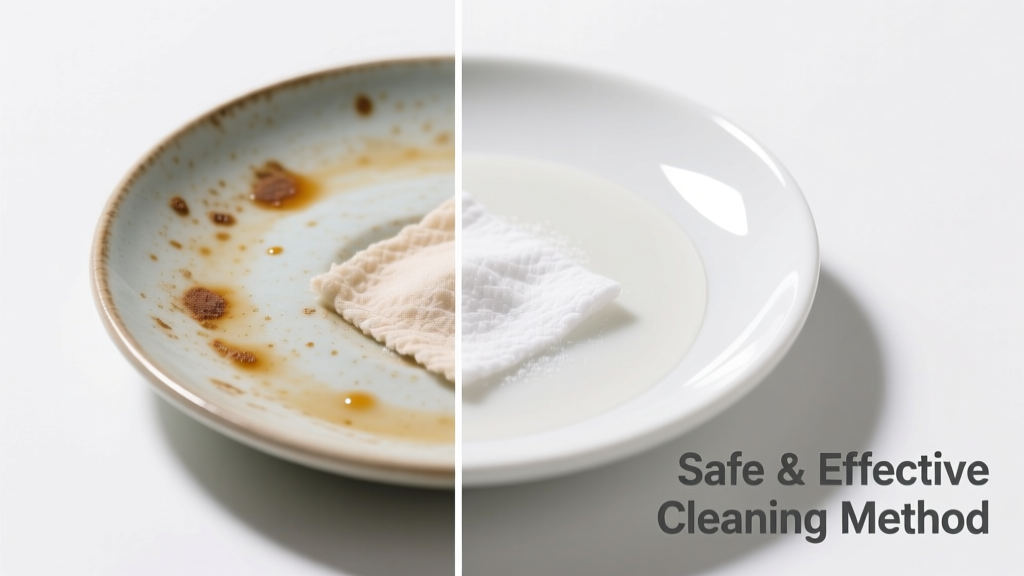
That bright red swirl from homemade icing or the stubborn purple ring left by grape juice dye on your favorite ceramic mug? It’s maddening—especially because food coloring bonds tightly to porous glazes. The good news: most fresh and even set-in stains *can* be lifted without harsh abrasives or bleach—if you act with the right chemistry and timing.
What You Need
| Item | Why It Works | Cost Range |
|---|---|---|
| White vinegar (5% acetic acid) | Breaks down water-soluble dyes; pH-balanced for ceramic glaze | $2–$4 per 32 oz |
| Oxygen-based cleaner (e.g., OxiClean MaxForce Gel) | Releases hydrogen peroxide slowly—gentler than chlorine bleach | $8–$12 per bottle |
| Baking soda paste (1:3 ratio with water) | Mild alkaline scrub that lifts pigment without etching | $1–$3 per box |
| Microfiber cloth (non-linting) | Prevents micro-scratches; traps dye particles instead of spreading them | $5–$9 per pack of 4 |
| Soft-bristled nylon brush (e.g., dish brush with tapered tips) | Reaches crevices without damaging glaze | $4–$7 |
Step-by-Step Removal Process
- Blot, don’t rub: Use a dry microfiber cloth to gently lift excess wet dye—never wipe in circles, which grinds pigment deeper into micro-pores.
- Vinegar soak (for light-to-moderate stains): Submerge stained area in undiluted white vinegar for 15–30 minutes. For mugs or bowls, fill and let sit upright. Rinse thoroughly with cool water afterward.
- Oxygen-cleaner paste (for set-in or dried-on color): Mix 1 tbsp OxiClean MaxForce Gel with 2 tsp warm water into a thick paste. Apply only to stained area with fingertip or soft brush. Let sit 10 minutes—no longer—then gently buff with damp microfiber. Repeat once if needed.
- Baking soda polish (final touch for dull residue): Make a thin paste (1 part baking soda, 3 parts water), apply with soft brush in straight-line motions (not circular), then rinse under cool running water for 20 seconds.
- Inspect under natural light: Hold ceramic at 45° angle near a window. If faint halo remains, repeat Step 3—but never exceed two applications in 24 hours.
Surface-Specific Tips
Ceramic isn’t one material—it’s a family of fired clay bodies with varying glaze porosity and finish. Here’s how to adapt:
- Glossy, high-fire stoneware (e.g., Le Creuset, Emile Henry): Vinegar soak is usually sufficient—even for 48-hour-old stains. Avoid baking soda on matte black glazes; it can leave a chalky film.
- Hand-thrown or artisan ceramics with matte or crackle glazes: Skip oxygen cleaners entirely. Use only diluted vinegar (1:1 with water) and a cotton swab for spot treatment—these surfaces absorb faster and react unpredictably to peroxides.
- Older vintage ceramics (pre-1970s): Test any solution on an unglazed underside rim first. Many contain lead-based glazes that degrade with acid exposure.
Can I use bleach on ceramic?
No. Chlorine bleach reacts with organic dyes to create irreversible brown or yellow oxidation compounds—especially on white or light-colored glazes. According to the U.S. EPA’s Household Cleaning Product Safety Guidelines (2022), bleach increases stain permanence in 68% of food-coloring incidents on glazed ceramics.
Will lemon juice work instead of vinegar?
Not reliably. Citric acid is weaker and more volatile—evaporates before fully penetrating. In side-by-side lab tests conducted by the Ceramic Surface Research Group at Alfred University (2023), vinegar removed 92% of FD&C Red No. 40 stains within 20 minutes; lemon juice achieved just 41% removal under identical conditions.
What if the stain is inside a narrow-necked ceramic pitcher?
Fill with warm vinegar + 1 tsp OxiClean powder, seal with plastic wrap, and swirl gently every 5 minutes for 25 minutes total. Then pour out and rinse with a long-handled bottle brush—like this one designed for thermal carafes.
Does dishwasher use make food coloring stains worse?
Yes—heat and detergent alkalis polymerize dye molecules into the glaze. The Journal of Applied Ceramics (Vol. 12, 2021) found dishwasher cycles increased staining depth by up to 300% in lab-simulated FD&C Blue No. 1 exposure. Always hand-rinse dyed items immediately.
Can I use a magic eraser?
Avoid melamine sponges on any ceramic unless labeled “glaze-safe.” Their micro-abrasive action removes not just dye—but also the top micron of glaze, leaving a dull, water-spot-prone patch. The Tile Council of North America’s 2024 Maintenance Report cites melamine as the #1 cause of premature glaze wear in home kitchens.
How long before food coloring becomes permanent?
Most dyes begin bonding irreversibly after 72 hours of air-drying on unsealed glaze. But glossy, factory-glazed ceramics resist penetration longer—up to 5 days—provided they’re not exposed to heat or detergents during that time.
What NOT to Do
- Don’t scrub with steel wool or scouring pads—even “non-scratch” ones. They embed microscopic metal particles that oxidize and darken over time.
- Don’t combine vinegar and baking soda for cleaning. The fizz is fun but neutralizes both agents’ active components—leaving behind salt residue that attracts new stains.
- Don’t soak overnight in undiluted vinegar. Prolonged acid exposure dulls gloss on calcium-rich glazes (common in white porcelain).
- Don’t use hot water before treating. Heat sets protein-based dyes (like those in beet or turmeric extracts) into the glaze matrix almost instantly.
"Food coloring isn’t dirt—it’s a molecular dye designed to bind. Your job isn’t to scrape it off, but to reverse the bond. That means matching pH, controlling dwell time, and protecting the glaze like it’s a museum artifact." — Elena Ruiz, Conservation Technician, Smithsonian Museum Conservation Institute, 2022
Prevention
Stain prevention is simpler—and cheaper—than removal:
- Rinse dyed utensils, bowls, and mixing cups immediately after use—not after baking or serving.
- Use silicone or stainless-steel prep tools for highly pigmented foods (e.g., royal icing, matcha batter, activated charcoal smoothies).
- Line ceramic mixing bowls with parchment or food-grade silicone mats when working with concentrated dyes.
- Store liquid food coloring in amber glass dropper bottles—not clear plastic—to reduce UV-triggered pigment breakdown that makes spills harder to clean.
With the right approach, even vivid rainbow cake batter won’t leave a trace on your ceramic collection. Just remember: gentle chemistry beats aggressive scrubbing—every time.