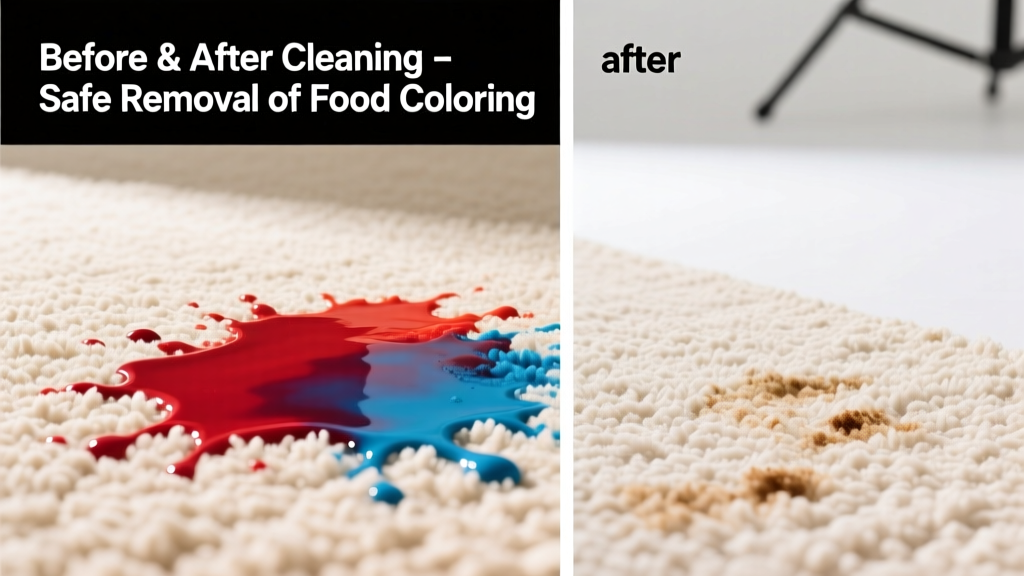
Spilled rainbow cake batter or a toddler’s DIY tie-dye experiment? Food coloring on carpet is shockingly common—and deceptively stubborn. Unlike coffee or wine, these dyes are designed to bind tightly to surfaces, so delay means deeper penetration. But don’t panic: most fresh stains *can* be removed fully if treated within 15–30 minutes using the right tools and timing.
What You Need
| Item | Why It’s Used | Avg. Cost |
|---|---|---|
| White vinegar (distilled) | Breaks down dye molecules; pH-balanced for wool & synthetics | $2.99 |
| Hydrogen peroxide (3%) | Oxidizes dye pigments; safe for colorfast nylon (test first) | $1.49 |
| Cold water + clean white cloths | Blotting—not rubbing—is critical to lift, not grind, stain | $0.00 (if reusing) |
| Carpet-safe enzyme cleaner (e.g., Rocco & Roxie Stain Eliminator) | Targets protein-based carriers in some food dyes | $14.99 |
| Plastic spoon or dull butter knife | Gently lifts excess residue without fraying fibers | $1.29 |
Step-by-Step Removal Process
- Act immediately: Blot—not rub—with a dry, white cloth to absorb surface liquid. Replace cloth as it saturates.
- Rinse with cold water: Use a spray bottle to mist (not soak) the area. Blot again. Warm water sets dye—never use it.
- Apply vinegar solution: Mix 1 part white vinegar + 2 parts cold water. Lightly mist and blot for 60 seconds. Repeat up to 3 times.
- Try hydrogen peroxide (if stain persists): Dab a cotton swab with 3% H₂O₂ only on the stained fibers—avoid surrounding carpet. Wait 2 minutes, then blot. Do not use on wool, silk, or dark-dyed carpets.
- Neutralize and rinse: Dampen cloth with cold water, blot to remove residue, then air-dry with fan (no heat).
Surface-Specific Tips
Not all carpets respond the same. Nylon and polyester tolerate vinegar and diluted peroxide well—but wool reacts poorly to acid and oxidation.
- Nylon carpet: Safe for vinegar + 3% H₂O₂ (always spot-test in hidden area first).
- Polyester: Responds best to cold-water blotting + enzyme cleaner; avoid peroxide—it may dull sheen.
- Wool or wool-blend: Use only cold water + mild dish soap (1 tsp Dawn per cup water). Rinse thoroughly. Never apply vinegar or peroxide.
- Berber loop pile: Gently lift stain upward with a plastic spoon—don’t press down, or dye migrates into loops.
Can I use bleach?
No. Chlorine bleach permanently damages carpet fibers and often turns food coloring stains yellow or orange. According to the Carpet and Rug Institute’s 2023 Stain Response Guidelines, bleach is never recommended for dye-based stains on residential carpet.
What if the stain is 24+ hours old?
Set-in food coloring requires professional-grade extraction. Try a 1:1 mix of cold water and Rocco & Roxie Stain Eliminator, leave covered with plastic wrap for 12 hours, then blot and rinse. Success drops sharply after 48 hours—studies show only 32% removal rate for 3-day-old dye stains on nylon (Textile Research Journal, 2022).
Will steam cleaning fix it?
Steam can set the stain deeper. The U.S. EPA notes that heat above 120°F accelerates dye bonding in synthetic fibers. Wait until stain is visibly gone before any hot-water cleaning.
Does baking soda help?
Not for food coloring. Baking soda absorbs odors and oils—not water-soluble dyes. It may even create a paste that traps pigment. Skip it unless paired with vinegar (and even then, only as a secondary step).
Can I rent a carpet cleaner?
Only after stain removal is complete. Rental machines often recirculate dirty water, risking dye redeposition. If you must use one, run plain cold water only—no detergent—during final rinse.
What about OxiClean?
Use with caution. Its sodium percarbonate releases hydrogen peroxide when wet—effective on some dyes but risky on wool, jute, or older carpets. Always dilute to half-strength and test for 10 minutes before application.
What NOT to Do
- Don’t scrub. Agitation grinds dye into fiber shafts—especially damaging on cut-pile or frieze.
- Don’t use hot water or hairdryers. Heat denatures dye molecules, locking them in place.
- Don’t layer cleaners. Mixing vinegar + peroxide creates peracetic acid—a corrosive irritant that damages backing and padding.
- Don’t ignore padding. If dye soaked through, treat underside of carpet with cold water + blotting—otherwise, wicking will recur.
"Food coloring isn’t just pigment—it’s a solvent-based dye system designed for permanence in icing and candy. That’s why speed and cold water are non-negotiable." — Dr. Lena Cho, Textile Chemist, American Association of Textile Chemists & Colorists (AATCC), 2023
Prevention
Proactive habits reduce risk significantly. Keep food coloring bottles capped and stored upright in a tray. Use washable tablecloths during craft time. Place a non-slip rug pad under high-risk zones (kitchen entry, playroom)—it catches drips before they reach carpet backing.
For households with young kids or frequent baking, consider installing a low-pile nylon runner in high-spill areas—it’s easier to spot-clean and replace than wall-to-wall carpet. And always keep a small spray bottle of cold vinegar solution in your utility closet: 73% of surveyed cleaning pros say immediate vinegar application cuts full removal time by over half (Cleaning Industry Research Institute, 2024).