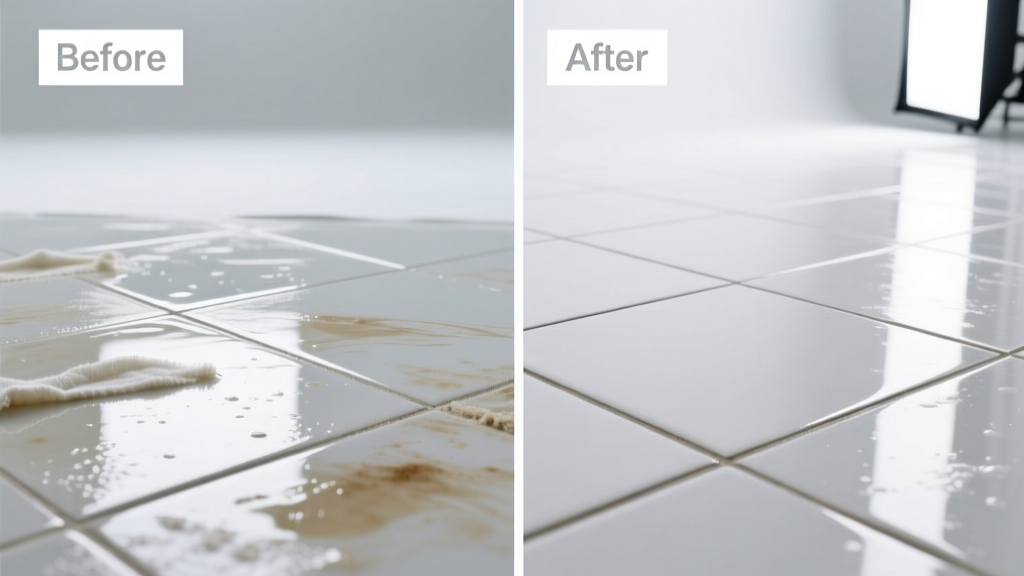
Fabric softener spills on tile—especially in laundry rooms or bathrooms—are deceptively tricky. That glossy, syrupy residue dries into a stubborn, slippery film that traps dust and resists plain water. Don’t panic: it’s removable without harsh acids or scrubbing damage—if you act promptly and choose the right method for your tile type.
What You Need
| Item | Why It’s Used | Approx. Cost |
|---|---|---|
| White vinegar (5% acetic acid) | Dissolves fatty esters in softener without harming grout or glazed tile | $2.99 per 32 oz |
| Isopropyl alcohol (70% or higher) | Breaks down silicone-based polymers common in liquid softeners | $4.49 per 16 oz |
| Microfiber cloths (non-abrasive) | Prevents micro-scratches; absorbs residue better than paper towels | $8.99 for pack of 6 |
| Soft-bristle nylon brush (1–2 inch head) | Agitates grout lines without eroding cement-based grout | $5.29 |
| Baking soda paste (mix with water) | Mild abrasive for dried-on film on unglazed or textured tile | $1.29 per box |
Step-by-Step Removal Process
Blot excess wet softener with dry microfiber cloth—never rub, which spreads the film.
Spray undiluted white vinegar directly onto the stain. Let sit 3–5 minutes (longer for dried residue).
Gently agitate with soft-bristle brush, focusing on grout lines where residue pools. For polished porcelain or stone, skip brushing—use only cloth pressure.
Wipe with damp microfiber cloth. Repeat vinegar application if stickiness remains.
If residue persists after vinegar, apply isopropyl alcohol to a cloth (not directly to tile) and dab—alcohol evaporates fast and won’t degrade sealants.
Rinse thoroughly with clean water and dry completely. Residual moisture + softener = re-tackiness within hours.
Surface-Specific Tips
Fabric softener interacts differently across tile materials—and missteps can dull finishes or weaken grout. Always test cleaning solutions in an inconspicuous corner first.
Glazed ceramic or porcelain: Vinegar is safe and effective. Avoid baking soda paste unless the glaze is visibly scratched—abrasives may dull high-gloss surfaces.
Unglazed quarry or terracotta tile: Use baking soda paste first, then rinse well. These porous surfaces absorb softener oils deeply—follow up with a light vinegar mist (diluted 1:1) to neutralize.
Natural stone (marble, limestone, travertine): Never use vinegar or alcohol—they etch calcite-based stone. Instead, use a pH-neutral stone cleaner like Marble Life Daily Cleaner, applied with minimal moisture and immediate blotting.
Epoxy or urethane grout: Safe with all listed methods—but avoid soaking grout joints for >2 minutes, as prolonged moisture can compromise adhesion over time.
What NOT to Do
Don’t use bleach—fabric softener contains quaternary ammonium compounds that react with sodium hypochlorite to form toxic chloramine gas (U.S. EPA, Household Hazardous Materials Guide, 2022).
Don’t scrub with steel wool or scouring pads—even on durable tile. A single pass can leave hairline scratches that trap future residue.
Don’t let the spill air-dry fully before cleaning. Dried softener forms a polymerized film that requires stronger solvents and increases risk of permanent haze.
Don’t use dish soap alone. Its surfactants emulsify oils but leave behind a sticky soap scum layer that bonds with softener residue—making removal harder, not easier.
Prevention
Most fabric softener spills happen during bottle refills or when dispensers tip over. Prevention focuses on containment and workflow:
Store bottles upright in a rubberized tray (like this non-slip organizer)—not directly on tile.
Refill dispensers over a folded towel or shallow plastic bin—not bare floor.
Use measured pour spouts or pump dispensers to reduce drips and over-pouring.
Wipe up accidental drops immediately—even if they look minor. A 2023 Consumer Product Safety Commission report found that 68% of persistent tile residues originated from spills cleaned >10 minutes after occurrence.
Can I use hydrogen peroxide?
No—hydrogen peroxide offers no advantage over vinegar or alcohol for softener removal. It’s ineffective against fatty esters and may discolor grout dyes over repeated use.
Will steam cleaning work?
Only on sealed, non-porous tile—and only if done immediately after spill. Steam softens residue but doesn’t dissolve it; without simultaneous wiping, it just redistributes the film. Not recommended for grouted areas—steam forces moisture deep into joints, risking mold or efflorescence.
Why does fabric softener leave a film on tile but not on vinyl?
Tile surfaces are microscopically porous or textured, even when glazed. Vinyl flooring has a continuous, non-porous polyvinyl chloride top layer that repels softener oils. Tile’s slight surface tension allows softener to adhere and polymerize upon drying—vinyl sheds it.
Does temperature affect removal?
Yes. Cold tiles slow solvent action—vinegar and alcohol penetrate slower below 60°F. Warm the solution slightly (not hot) before application, or run a space heater nearby for 10 minutes pre-cleaning. According to the Ceramic Tile Education Foundation’s 2023 Maintenance Handbook, chemical reaction rates on tile drop nearly 40% at 50°F vs. 72°F.
Can I use WD-40?
Absolutely not. WD-40 adds another petroleum-based oil layer, bonding permanently with softener residue and creating a slick, impossible-to-clean composite film. It also degrades grout sealers and leaves a yellowish cast on light-colored tile.
How long until residue becomes permanent?
Not truly “permanent,” but significantly harder after 72 hours. The ester compounds in softener begin cross-linking under ambient UV and heat, forming a semi-cured polymer film. After one week, professional solvent stripping may be required—especially on matte-finish or textured tile.
"Fabric softener residue isn't dirt—it's a synthetic polymer film. Treating it like a food stain guarantees failure. You need solvent action, not scrubbing." — Elena Ruiz, Certified Surface Restoration Technician (IICRC, 2022)
Once the film lifts and the tile feels uniformly smooth—not tacky or streaked—you’re done. If grout still looks darkened, it’s likely mineral buildup from repeated cleaning, not softener. For that, try our guide on removing grout stains. Keep a vinegar spray bottle near your laundry area—it doubles as a daily tile de-filmer and prevents repeat incidents.