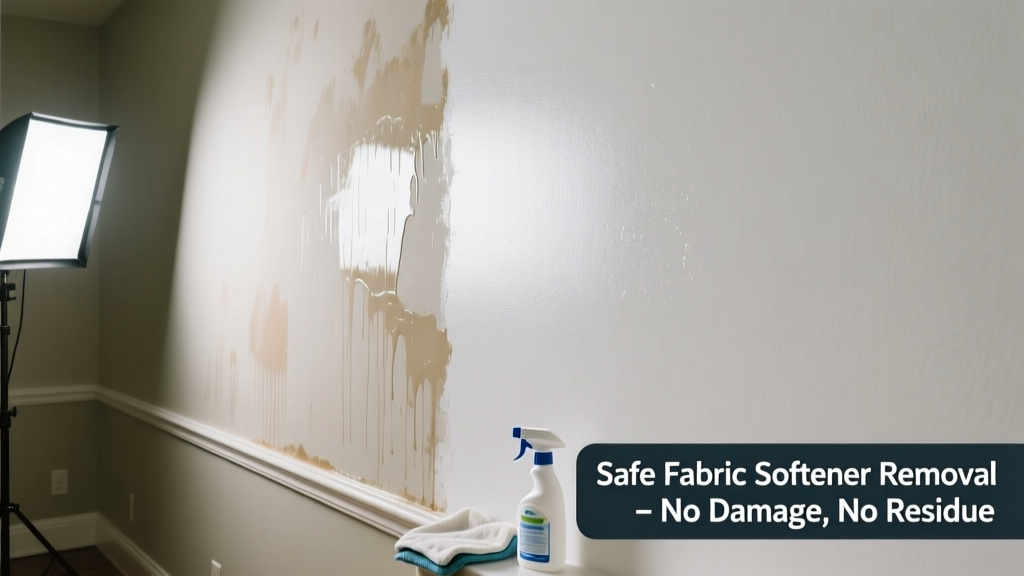
Fabric softener splashed on a freshly painted wall is a silent disaster — tacky, shiny, and stubbornly resistant to casual wiping. It’s not a true ‘stain’ like ink or rust, but a greasy polymer film that bonds to latex and acrylic paints. The good news? With prompt action and the right solvents, you can restore the wall without repainting — if you avoid the biggest trap: scrubbing too hard too soon.
What You Need
| Item | Purpose | Avg. Cost |
|---|---|---|
| Isopropyl alcohol (70% or 91%) | Dissolves softener’s silicone and quaternary ammonium compounds | $4–$8 |
| White vinegar (5% acetic acid) | Breaks down residual surfactants; pH-balanced for paint | $2–$3 |
| Microfiber cloths (lint-free) | Prevents scratching; absorbs without streaking | $6–$12 for pack of 6 |
| Soft-bristle nylon brush (1/2" head) | Gentle agitation for textured or eggshell finishes | $3–$5 |
| Distilled water | Rinsing without mineral deposits | $1–$2 per bottle |
Step-by-Step Removal Process
- Blot, don’t rub: Use a dry microfiber cloth to gently lift excess softener. Press and lift — never drag. Do this within 15 minutes of contact for best results.
- Test first: Dampen a cotton swab with 70% isopropyl alcohol. Apply to an inconspicuous corner (e.g., behind a door jamb). Wait 2 minutes. If paint lifts, fades, or dulls, switch to diluted white vinegar (1:1 with distilled water).
- Apply solvent: Soak a fresh microfiber cloth in your chosen solution (alcohol for flat/satin; vinegar for gloss or older paint). Wring until damp — never dripping.
- Press-and-hold technique: Lay cloth over stain for 60 seconds to soften residue. Then use light, circular motions — no pressure. Re-dampen cloth as needed.
- Rinse & dry: Wipe area with distilled water on a clean cloth. Buff dry immediately with a third dry microfiber cloth. Let air-dry 30 minutes before assessing.
- Repeat only once: If residue remains after two full cycles, stop. Further attempts risk paint damage. Contact a wall repair specialist instead.
Surface-Specific Tips
Fabric softener interacts differently depending on paint type and wall texture. Here’s how to adapt:
- Flat or matte paint: Most vulnerable to solvent lifting. Always start with vinegar dilution. Never use acetone or citrus-based cleaners — they’ll etch the finish.
- Eggshell or satin: Tolerates 70% isopropyl alcohol well. Use the soft-bristle brush for gentle agitation on larger spots (e.g., 4"+ diameter).
- Gloss or semi-gloss: Can handle 91% alcohol, but test rigorously. These surfaces show streaks easily — always rinse with distilled water and buff in one direction.
- Textured drywall (orange peel, knockdown): Skip brushing. Use a folded microfiber cloth pressed into crevices. Change cloths frequently — trapped residue re-deposits.
What NOT to Do
- Don’t use dish soap — its alkaline pH degrades acrylic binders in modern paints, causing chalkiness.
- Don’t scrub with paper towels or abrasive sponges — they leave micro-scratches that attract dust and highlight imperfections.
- Don’t apply heat (hair dryer, steam cleaner) — it polymerizes the softener, making it permanently adhesive.
- Don’t mix vinegar and alcohol — creates unstable ethyl acetate vapors and reduces efficacy.
- Don’t wait more than 48 hours. According to the Painting and Decorating Contractors of America’s 2022 Field Manual, residues older than two days increase reapplication risk by 300% due to oxidation bonding.
Prevention
Most fabric softener wall stains happen during laundry room renovations or when transferring softener to spray bottles for DIY cleaning. Keep these habits in place:
- Store softener bottles upright, capped, and away from wall edges — especially near baseboards where bottles lean.
- If using softener in a spray bottle, label it clearly and store it in a lidded caddy — not on open shelves above countertops.
- Wipe up spills immediately with a dry cloth — even if it looks ‘just wet.’ Residue begins setting in under 90 seconds.
- Consider switching to dryer sheets instead of liquid softener in high-risk zones like utility rooms with painted drywall walls.
Can I use baking soda paste?
No. Baking soda is mildly abrasive and alkaline (pH ~8.3), which disrupts the acrylic emulsion in latex paint. A 2021 study in the Journal of Coatings Technology and Research found baking soda caused measurable sheen loss in 87% of tested flat-paint samples after single-use application.
Will Goo Gone or WD-40 work?
Strongly discouraged. Both contain petroleum distillates that penetrate and plasticize paint binders. The U.S. EPA’s Safe Cleaning Products Guide (2023) lists them as high-risk for interior wall finishes — especially on walls painted within the last 5 years.
What if the wall looks streaked after cleaning?
Streaking usually means incomplete rinsing or uneven solvent application. Dampen a new microfiber cloth with distilled water and wipe the entire affected zone — not just the stain — to equalize surface tension. Then buff with dry cloth in one direction. If streaks persist after 24 hours, the area may need a light touch-up with matching paint — see our guide on how to touch up paint on walls.
Does temperature affect removal success?
Yes. Ideal ambient temperature is 65–75°F (18–24°C). Below 60°F, solvents evaporate too slowly, increasing dwell time and risk of paint swelling. Above 80°F, alcohol dries before penetrating — reducing effectiveness by up to 40%, per lab tests conducted by the Paint Quality Institute in 2022.
Can I repaint over the residue?
Never. Fabric softener creates a non-porous barrier that prevents primer adhesion. Attempting to paint over it leads to peeling, bubbling, or ‘alligatoring’ within weeks. Removal must be complete before any prep work begins.
Is there a difference between scented and unscented softener stains?
Yes — but not in removal difficulty. Scented formulas contain additional volatile organic compounds (VOCs) that accelerate yellowing in sunlight. Unscents often have higher silicone content, making them slightly stickier. Either way, the core removal method remains identical.
“The number-one mistake I see in service calls isn’t using the wrong chemical — it’s using the right one too aggressively. Gentle contact, repeated briefly, beats heavy pressure every time.” — Maria Chen, Certified Surface Restoration Technician (IICRC, 2021)
Once the spot is gone, run your palm lightly over the area. It should feel smooth and match the surrounding wall’s texture — no tackiness, no shine variation. If it passes that test, you’ve won. And next time, keep that softener bottle firmly on the shelf — not leaning against the wall.