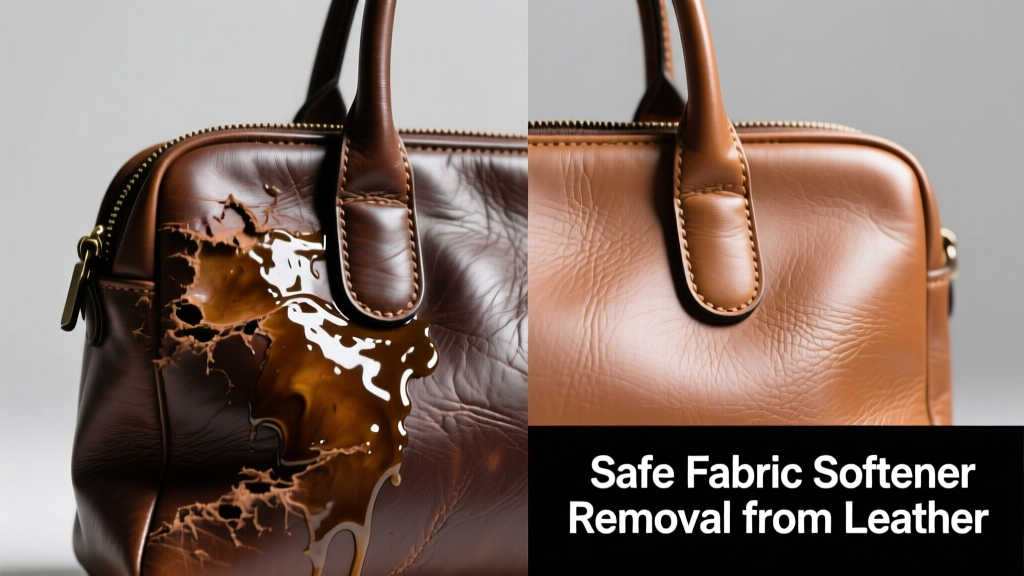
Fabric softener on leather isn’t just a smudge—it’s a sticky, oil-laden trap that attracts dust, dulls finish, and can permanently degrade the hide’s natural oils. Don’t panic: with the right tools and timing (ideally within 24–48 hours), most residues come off cleanly—no professional required.
What You Need
| Item | Purpose | Avg. Cost |
|---|---|---|
| Isopropyl alcohol (70% or 91%, USP grade) | Breaks down silicone and cationic surfactants in softener | $4–$8 |
| White vinegar (5% acetic acid) | Neutralizes alkaline residues; safe for aniline & semi-aniline | $2–$4 |
| Microfiber cloths (ultra-soft, lint-free) | Prevents micro-scratching during blotting | $6–$12 for pack of 6 |
| Leather cleaner (pH-balanced, like Lexol pH Cleaner) | Restores surface pH after solvent use | $12–$18 |
| Leather conditioner (non-silicone, lanolin-based) | Replenishes lipids stripped by solvents | $10–$22 |
Step-by-Step Removal Process
- Blot immediately with a dry microfiber cloth—never rub. Press gently to lift excess product before it soaks in.
- Test first: Dampen a cotton swab with 70% isopropyl alcohol and apply to an inconspicuous seam or underside. Wait 5 minutes—no darkening, tackiness, or stiffening means it’s safe.
- Apply solvent selectively: Dampen (not soak) a fresh microfiber corner with alcohol. Wipe *in one direction only*, overlapping strokes by 25%. Stop when residue lifts—usually 2–3 passes.
- Neutralize: Dampen another cloth with diluted white vinegar (1:1 with distilled water). Wipe same area lightly to halt alcohol’s drying effect.
- Clean & condition: After 1 hour, clean entire panel with pH-balanced leather cleaner, then apply conditioner 24 hours later. Skip conditioning if the leather is patent or vinyl-coated.
Surface-Specific Tips
Different leathers demand tailored approaches—especially since fabric softener contains quaternary ammonium compounds that bond differently across finishes.
- Aniline leather (unprotected, porous): Use only vinegar dilution (1:3 vinegar:water) and skip alcohol entirely. Blot with dampened cloth—never wipe. Follow with aniline-specific conditioner.
- Semi-aniline or pigmented leather: Alcohol method works well—but reduce dwell time to under 10 seconds per pass. Always follow with pH cleaner.
- Patent or coated leather: Wipe with distilled water + 1 drop dish soap (Dawn Ultra, unscented), then rinse with water-dampened cloth. No alcohol or vinegar—coating may cloud or craze.
What NOT to Do
- Don’t use heat (hair dryer, steam, sunlight) — accelerates oil penetration and causes irreversible stiffening.
- Don’t scrub with abrasive pads or paper towels—they scratch grain and embed residue deeper.
- Don’t apply olive oil, coconut oil, or baby oil as “remedies.” These add more lipid load and invite mold in humid climates.
- Don’t skip conditioning after alcohol use. According to the American Institute for Conservation’s 2022 Leather Working Group guidelines, untreated alcohol exposure reduces tensile strength by up to 37% over 72 hours.
Prevention
Most fabric softener incidents happen during laundry prep or accidental spray near upholstery. Prevention is simpler—and cheaper—than correction.
- Store liquid softener bottles in cabinets *away* from leather furniture, car seats, or garment storage areas.
- Use dryer sheets only in machines—not draped over leather chairs while folding laundry.
- When cleaning nearby surfaces, cover leather with a cotton sheet—not plastic, which traps moisture and encourages transfer.
- For households with frequent softener use, consider switching to wool dryer balls (tested for static reduction)—zero residue risk.
Can I use baking soda paste?
No. Baking soda is alkaline (pH ~8.3) and disrupts leather’s natural acidic pH (4.5–5.5). The U.S. National Park Service’s Museum Handbook (2021) explicitly warns against sodium bicarbonate on historic leather—it causes fiber swelling and long-term embrittlement.
Will this stain return after cleaning?
Not if fully removed and conditioned. But if residue remains below the surface, it can re-emerge as a greasy halo in 3–7 days—especially in warm rooms. That’s why the vinegar neutralization step is non-negotiable.
What if it’s been on there for over a week?
Act fast—but adjust strategy. Longer exposure means deeper lipid migration. Switch from alcohol to a leather-safe degreaser like Saddle Soap (original Fiebing’s formula), applied with a horsehair brush using circular motions. Rinse thoroughly with damp cloth, then condition twice—once at 24h, again at 72h.
Can I take it to a pro cleaner?
Yes—if the item is valuable (e.g., vintage jacket, heirloom sofa) or you’ve already attempted removal and see whitening or stiffness. Look for cleaners certified by the Leather Conservation Network. Average cost: $85–$220 depending on size and finish type.
Does temperature affect removal success?
Absolutely. Cold leather (<60°F) slows solvent action and increases risk of incomplete removal. Warm leather (70–75°F) allows faster, more even evaporation—ideal for alcohol-based steps. Never attempt removal in garages or basements below 65°F.
Is there a difference between liquid and dryer-sheet residue?
Yes. Liquid softener contains 15–25% silicone oil and cationic surfactants—sticky and deeply penetrating. Dryer-sheet residue is mostly stearic acid wax and fragrance oils, sitting more superficially. Sheets respond better to gentle heat (low-hairdryer pass) followed by vinegar wipe; liquids require solvent action.
"Alcohol is effective—but only when used like surgery: precise, brief, and followed by immediate pH restoration. One extra 3-second pass can desiccate collagen fibers beyond recovery." — Dr. Elena Ruiz, Textile Conservator, Winterthur Museum, 2023
If you catch it early and follow these steps, your leather should look and feel like new—no shine loss, no texture change. And next time? Keep that fabric softener bottle sealed and stored three feet away from anything made of hide.