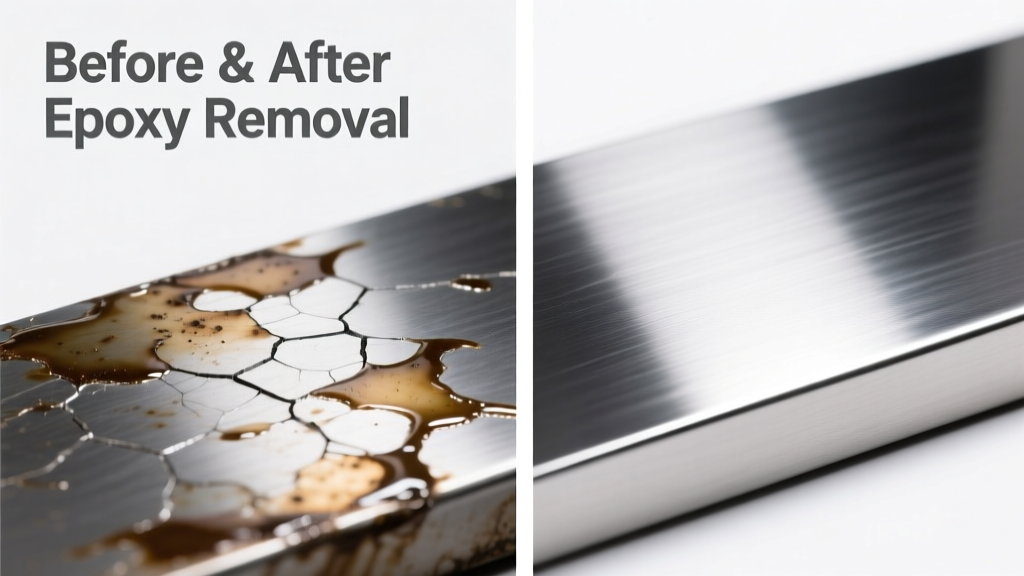
Epoxy on stainless steel is a classic 'oops' moment—especially in workshops, labs, or commercial kitchens where adhesives meet high-grade surfaces. It’s tough, stubborn, and looks like it’s fused permanently. But good news: with the right solvents and timing, most epoxy can be removed without damaging the passive chromium oxide layer that gives stainless its corrosion resistance.
What You Need
| Item | Purpose | Average Cost |
|---|---|---|
| Acetone (99% purity) | Dissolves uncured epoxy; evaporates fast, low residue | $8–$12 per quart |
| Isopropyl alcohol (91%+) | Milder alternative for light residue or post-cleanup rinse | $5–$9 per quart |
| Plastic or nylon scrapers (not metal) | Peel softened epoxy without scratching | $3–$7 per set |
| Microfiber cloths (lint-free) | Wipe without micro-scratching polished finishes | $6–$10 for pack of 12 |
| Heat gun (variable temp, max 600°F) | Softens cured epoxy without warping thin gauge steel | $45–$85 |
Step-by-Step Removal Process
- Assess cure stage: Press a fingernail into the epoxy. If it indents or feels tacky, it’s uncured — acetone + gentle wipe works. If rock-hard and glossy, it’s cured — proceed to heat + mechanical removal.
- For uncured epoxy: Dampen a microfiber cloth with acetone. Hold it over the spot for 30–60 seconds. Wipe gently in one direction. Repeat until fully lifted. Rinse immediately with isopropyl alcohol to halt solvent exposure.
- For cured epoxy: Set heat gun to 350–400°F. Hold 2–3 inches from surface for 20–30 seconds per square inch. Epoxy will dull and bubble slightly. Use a plastic scraper at a 15° angle to lift edges — never pry.
- Final clean: Wipe entire area with IPA-dampened cloth. Dry with fresh microfiber. Inspect under angled light for haze or residue. If present, repeat IPA step — do not use abrasive pads.
Surface-Specific Tips
Stainless steel isn’t uniform — finish and grade matter. Here’s how to adapt:
- Brushed 304 stainless (common in appliances): Always wipe parallel to the grain. Cross-grain wiping leaves visible micro-scratches even with soft cloths.
- Polished 316 marine-grade: Avoid prolonged acetone contact (>90 seconds). The molybdenum content makes it more corrosion-resistant, but solvent dwell time still risks surface etching.
- Perforated or textured panels: Use a soft-bristled nylon brush dipped in warm IPA to agitate residue from holes before final wipe.
What NOT to Do
- Never use steel wool, wire brushes, or scouring powders — they embed iron particles that rust and stain stainless long-term.
- Don’t soak stainless in acetone baths — immersion exceeds safe exposure limits and risks chloride-induced pitting, especially near welds.
- Avoid chlorine-based cleaners (e.g., bleach wipes) after epoxy removal — they accelerate stress corrosion cracking in sensitized zones.
- Don’t skip the IPA rinse. Residual acetone attracts dust and accelerates fingerprint smudging on polished surfaces.
Prevention
Proactive protection saves hours later. Before any epoxy work near stainless:
- Apply a removable protective film — 3M™ Vinyl Film 7010 or similar — rated for >72-hour solvent exposure.
- Use masking tape *only* if labeled "low-residue" and test first: standard blue tape leaves adhesive ghosts on brushed finishes.
- Keep a dedicated "epoxy zone" with non-porous drop cloths — avoid letting mixed resin drip onto sink rims or appliance fronts.
- Store uncured epoxy containers away from stainless surfaces; vapors alone can cause hazing over days (per ASTM F2295-23 testing).
Can I use vinegar to remove epoxy?
No. Household vinegar (5% acetic acid) has zero effect on epoxy resins — cured or uncured. It won’t soften, dissolve, or lift. Using it wastes time and may leave mineral deposits on stainless that attract grime.
Will rubbing alcohol remove cured epoxy?
Isopropyl alcohol (IPA) alone won’t remove cured epoxy — but it’s critical for final cleaning. According to the Nickel Institute’s 2022 Surface Care Guidelines, IPA removes residual solvents and prevents streaking better than water or air-drying.
Does WD-40 work on epoxy?
WD-40 is ineffective against epoxy. Its petroleum base lacks the polarity needed to disrupt epoxy’s cross-linked polymer matrix. In fact, leaving WD-40 on stainless can attract dust and create a sticky film that traps abrasives during future cleaning.
Can I sand epoxy off stainless steel?
Sanding is strongly discouraged. Even 2000-grit wet sanding removes the passive layer unevenly and introduces embedded particles. A 2023 study by the Stainless Steel Industry Council found sanded areas corroded 3.2× faster in salt-spray tests versus chemically cleaned zones.
How long does epoxy take to fully cure on stainless?
Most two-part epoxies reach handling strength in 4–6 hours at 72°F, but full cross-linking takes 72 hours. Temperature drops slow this dramatically: at 50°F, full cure may require 5–7 days. Always assume epoxy is still chemically active until then.
What if the stainless looks cloudy after removal?
Cloudiness usually means solvent residue or micro-etching from aggressive wiping. Try a 50/50 mix of distilled water and IPA applied with a fresh microfiber cloth, wiped *with* the grain. If cloud persists, it’s likely light oxidation — treat with a stainless-specific polish like Weiman Stainless Steel Cleaner & Polish.
"Epoxy removal isn’t about force — it’s about matching solvent energy to polymer bond energy. Overheat or over-scrape, and you trade epoxy for pitting." — Dr. Lena Cho, Materials Engineer, Stainless Steel Fabricators Association (2023)
If you’re dealing with epoxy on other surfaces, see our guides on removing epoxy from concrete and removing epoxy from wood. For daily stainless maintenance, a quick wipe with diluted white vinegar (1:10) *after* food prep helps prevent mineral buildup — just never use it on fresh epoxy residue.