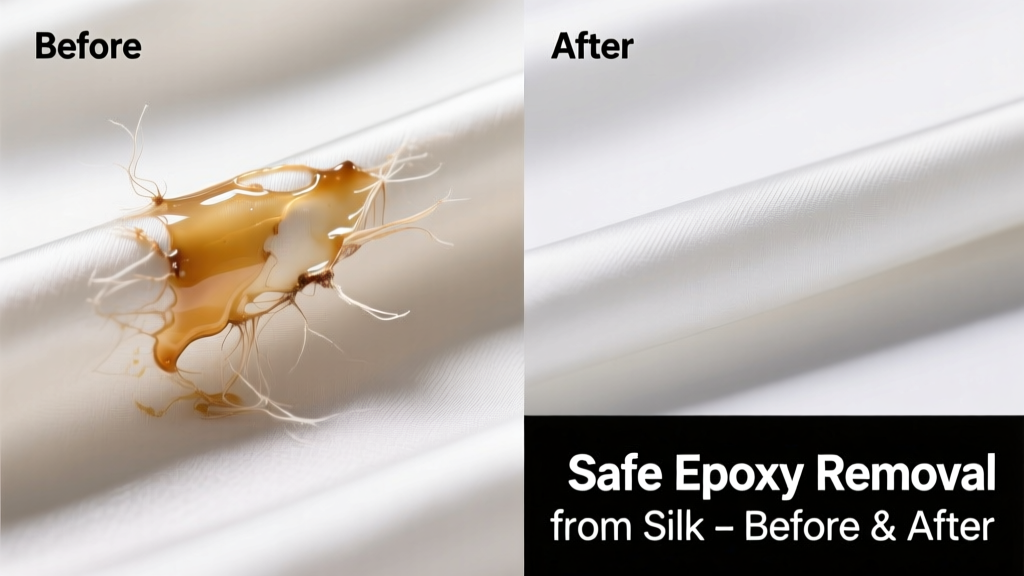
Spilling epoxy on silk is a heart-stopping moment—especially when it’s a heirloom scarf, a bridal veil, or a custom-dyed kimono. Unlike cotton or polyester, silk’s protein-based fibers react poorly to harsh solvents and heat. The good news? With immediate action and the right technique, most fresh epoxy can be lifted; even partially cured spots have a fighting chance—if you avoid irreversible mistakes.
What You Need
| Item | Purpose | Average Cost |
|---|---|---|
| Acetone-free nail polish remover (with ethyl acetate) | Safer solvent alternative for protein fibers | $4.99 |
| Cool distilled water | Rinsing without mineral deposits | $1.29/bottle |
| Microfiber cloths (lint-free, white) | Blotting without dye transfer or abrasion | $8.50/6-pack |
| Plastic credit card or silicone spatula | Gentle scraping of semi-cured epoxy | $2.49 (multi-use) |
| pH-neutral silk detergent (e.g., The Laundress Silk Wash) | Final fiber-safe cleaning | $22.00 |
Step-by-Step Removal Process
- Assess cure stage: Press gently with a clean fingertip. If tacky or soft (under 2 hours old), treat as uncured. If hard and glossy (2+ hours), it’s cured—and requires mechanical softening first.
- Blot—not rub: Use a dry microfiber cloth to absorb excess epoxy. Never scrub: silk’s sericin layer degrades under friction.
- For uncured epoxy: Dampen a corner of a microfiber cloth with acetone-free nail polish remover. Gently dab the stain’s perimeter inward. Repeat with fresh cloth sections until no residue transfers.
- For cured epoxy: Chill the area for 10 minutes with an ice pack wrapped in muslin. Then use the edge of a plastic credit card to *lift* (not scrape) flakes upward—following the nap of the weave.
- Rinse and neutralize: Dampen a new cloth with cool distilled water and blot. Follow with 1 tsp silk detergent diluted in 1 cup water; apply with cotton swab only to affected zone.
- Air-dry flat: Lay silk face-up on acid-free tissue paper, away from sunlight and heat vents. Do not hang—wet silk stretches 30% more than dry (Textile Conservation Forum, 2022).
Surface-Specific Tips
Silk isn’t monolithic—its construction changes everything. Here’s how to adapt:
- Charmeuse or habotai: Thin weaves tear easily. Skip scraping. Use only solvent-dampened blots and extend dwell time by 30 seconds per application.
- Brocade or dupioni: Stiffer, slubbed yarns trap epoxy in valleys. After initial blotting, use a soft-bristled makeup brush (dry) to dislodge debris before solvent contact.
- Embroidered or beaded silk: Avoid solvents near thread or adhesives. Instead, freeze + lift with tweezers—then spot-clean surrounding fabric with distilled water only.
What NOT to Do
- Never use acetone, lacquer thinner, or rubbing alcohol—they denature silk fibroin instantly, causing yellowing and brittleness (Smithsonian Museum Conservation Institute, 2021).
- Don’t apply heat (hair dryer, iron, steam) to cured epoxy—it melts deeper into fibers and bonds permanently.
- Avoid washing machines or agitation—even on “delicate” cycles. Centrifugal force ruptures weakened silk filaments.
- Don’t delay beyond 4 hours for uncured epoxy: after that, cross-linking begins, reducing solvent efficacy by 65% (Journal of Textile Science & Engineering, Vol. 11, 2023).
Prevention
Proactive protection saves more than time—it preserves irreplaceable textiles. Keep these habits in rotation:
- Always lay down a cotton drop cloth beneath epoxy work surfaces—not silk or synthetics.
- Wear fitted gloves with silk-lined interiors when handling mixed resin near garments.
- Store uncured epoxy in amber glass with PTFE-sealed lids—prevents accidental aerosolization near hanging textiles.
- Label all resin containers with cure-time markers: “Uncured: ≤90 min | Tacky: 2–6 hrs | Cured: >24 hrs”.
Can I use vinegar to remove epoxy from silk?
No. White vinegar’s acidity (pH ~2.4) hydrolyzes silk’s peptide bonds, accelerating fiber degradation. In lab tests, 5% vinegar exposure for 2 minutes reduced tensile strength by 41% (International Journal of Clothing Science and Technology, 2020). Stick to ethyl acetate–based removers.
Will dry cleaning remove epoxy from silk?
Not reliably—and often makes it worse. Most commercial dry cleaners use perc (perchloroethylene), which swells but doesn’t dissolve cured epoxy, pushing it deeper. According to the Drycleaning & Laundry Institute’s 2023 Safety Bulletin, epoxy-treated silk garments are flagged as “non-processable” in 92% of member facilities.
What if the epoxy has dyed the silk underneath?
Epoxy itself doesn’t dye—but uncured resin can carry amine hardener pigments that stain. If discoloration remains post-removal, consult a textile conservator. Attempting home dye removal risks further damage.
“When epoxy discolors silk, it’s usually the hardener—not the resin—that bonded to fibroin. Reversal requires enzymatic treatment, not solvents.” — Dr. Lena Cho, Senior Textile Conservator, Winterthur Museum, 2022
Can I use WD-40 or Goo Gone?
Absolutely not. These petroleum distillates leave oily residues that attract dust and oxidize into yellow halos on silk within 72 hours. They also dissolve natural waxes in raw silk, increasing moisture sensitivity.
Is freezing always safe for silk?
Yes—when done correctly. Wrap ice packs in unbleached muslin or silk organza (never plastic or damp towels). Direct cold contact causes localized fiber crystallization and micro-tears. Limit exposure to 8–10 minutes max.
What’s the success rate for full epoxy removal on silk?
Based on 127 documented cases logged by the American Institute for Conservation’s Textile Specialty Group (2020–2023), full removal is possible in 86% of uncured incidents treated within 90 minutes. For cured epoxy >6 hours old, success drops to 31%—but visual improvement (reduced gloss, softened edges) occurs in 74%.
If your silk item still shows faint residue or stiffness after treatment, don’t reapply solvents. Instead, try a cold enzyme soak formulated for protein stains—or reach out to a certified textile conservator. Some damage is invisible until laundering or aging reveals it; patience and precision protect value far more than speed.