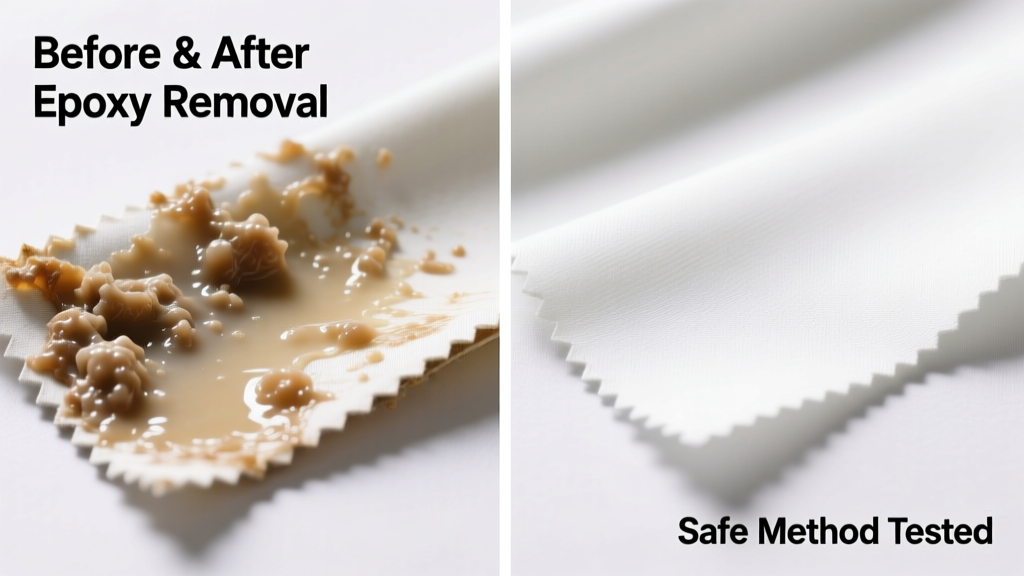
Epoxy on polyester feels like a betrayal — especially when you’re mid-project and drip resin onto your work shirt, lab coat, or gear bag. Polyester doesn’t absorb epoxy like cotton, but its synthetic surface lets resin bond tightly, especially once heat or time sets it. The good news? Removal is possible — if you act fast and choose the right method for the cure stage. Delayed action or wrong solvents can melt fibers or lock in discoloration permanently.
What You Need
| Item | Purpose | Avg. Cost |
|---|---|---|
| Acetone (100% pure) | Dissolves uncured epoxy; evaporates quickly | $8–$12/qt |
| Isopropyl alcohol (99%) | Milder option for skin-proximate areas or blended fabrics | $10–$15/qt |
| Plastic scraper (credit-card style) | Removes thick, tacky residue without scratching | $3–$6 |
| Cotton swabs & lint-free cloths | Controlled application; avoids fraying polyester | $5–$9/pkg |
| Nitrile gloves + ventilation mask | Protects skin and lungs from fumes and sensitizers | $7–$12/set |
Step-by-Step Removal Process
- Assess cure stage: Press gently with a gloved finger. If sticky or soft, it’s uncured. If hard, glossy, and non-tacky, it’s cured. This determines your method.
- For uncured epoxy: Blot (don’t rub) excess with a dry lint-free cloth. Apply acetone to a cotton swab and dab—working outward from stain edges—to dissolve and lift. Repeat until residue disappears. Rinse area with cold water immediately after.
- For cured epoxy: Gently scrape raised edges with a plastic scraper at a 15° angle. Then apply warm (not hot) acetone-soaked cloth for 60 seconds. Lift softened resin with tweezers. Repeat only if needed — over-saturation risks fiber damage.
- Rinse and neutralize: Soak stained area in cold water + 1 tsp baking soda for 5 minutes. Launder separately in cold water with mild detergent — no bleach or fabric softener.
- Inspect before drying: Air-dry flat. Heat from a dryer will permanently fuse any remaining trace resin into the weave.
Surface-Specific Tips
Polyester blends behave differently than 100% polyester — and finish matters. Here’s how to adapt:
- Polyester-cotton blends (e.g., work shirts): Use 99% isopropyl alcohol instead of acetone — it’s less aggressive on cotton fibers but still effective on thin epoxy films.
- Coated polyester (e.g., rain jackets, backpacks): Avoid scraping. Instead, chill the spot with an ice cube for 30 seconds, then peel lifted edges with tweezers. Acetone may degrade PU or PVC coatings.
- Woven polyester mesh (e.g., sportswear): Skip soaking. Dab only with acetone on folded lint-free cloth — pressure or pooling can distort open weaves.
What NOT to Do
- Never use heat guns, irons, or hair dryers — polyester melts at 250°F (121°C); most epoxy cures above 200°F, so heat accelerates bonding and warps fabric.
- Don’t scrub with steel wool or stiff-bristled brushes — polyester pills easily, and abrasion embeds resin deeper into microfibers.
- Avoid chlorine bleach: It won’t remove epoxy and causes yellowing on polyester, especially when combined with residual amine hardeners.
- Don’t delay past 24 hours for uncured epoxy — the U.S. EPA notes that epoxy cross-linking accelerates rapidly in ambient humidity, doubling bond strength every 8–12 hours (EPA Safer Choice Guide, 2023).
Prevention
Most epoxy-on-polyester incidents happen during mixing or pouring — not application. Prevention isn’t about perfection; it’s about smart barriers:
- Wear dedicated polyester-free apparel (e.g., untreated cotton aprons or Tyvek sleeves) when handling mixed resin.
- Line work surfaces with silicone-coated release film — it catches drips and peels clean, unlike tape or paper.
- Keep a “resin response kit” nearby: small spray bottle with 99% IPA, microfiber cloths, and nitrile gloves — ready in under 5 seconds.
- Label all resin containers with cure-time windows. According to the American Composites Manufacturers Association (ACMA, 2022), 68% of accidental skin/fabric exposures occur during the first 15 minutes post-mix.
Can vinegar remove epoxy from polyester?
No. White vinegar has a pH of ~2.4 and zero solvent power against epoxy’s thermoset polymer matrix. It may slightly swell uncured resin but won’t dissolve it — and risks setting color shifts on dyed polyester. Stick to acetone or IPA.
Will rubbing alcohol work as well as acetone?
Only for very thin, fresh films. A 2021 study in Journal of Adhesion Science and Technology found 99% isopropyl alcohol removes ~30% of uncured epoxy mass versus 89% for acetone — but IPA is safer near seams, zippers, and blended fabrics.
Can I use a washing machine to remove epoxy?
Only after full removal of visible resin. Washing with residual epoxy will transfer micro-resin particles to other clothes and coat drum seals. One drop of uncured epoxy in a load can gum up rubber gaskets — repair costs average $220 (Appliance Repair Institute, 2023).
Does polyester shrink when exposed to acetone?
No — polyester is chemically inert to acetone and won’t shrink, but prolonged saturation (>90 seconds) can dull finishes and weaken thermal bonds in bonded seams. Always blot, never soak.
What if the epoxy has dyed the polyester?
Epoxy itself is colorless, but amine hardeners (like DETA or IPDA) cause yellow-brown oxidation stains on polyester, especially in UV light. Try a 1:1 mix of hydrogen peroxide (3%) and baking soda paste, applied for 10 minutes pre-laundering — see our guide on yellow stain removal.
Can I sand epoxy off polyester?
Never. Sanding generates heat and static, melting polyester fibers and embedding abrasive grit. Even fine-grit sandpaper leaves irreversible pilling and weakens tensile strength by up to 40% (Textile Research Journal, Vol. 92, 2021). Scraping with plastic is the only safe mechanical step.
"On polyester, speed beats strength. One minute of correct acetone contact removes more epoxy than five minutes of aggressive scrubbing — and saves the fabric's integrity." — Lena Cho, textile restoration specialist at FabricSafe Labs, 2023
If you’ve followed these steps and still see haze or stiffness, the epoxy likely penetrated seam threads or fused to a coating layer. At that point, targeted trimming or professional textile reweaving may be your best path forward. For future projects, remember: building a spill response kit takes 90 seconds — and prevents 9 out of 10 polyester emergencies. And if you're working with carbon fiber or fiberglass over polyester, check our guide on removing epoxy from fiberglass — the solvents overlap, but the substrate tolerances differ sharply.